



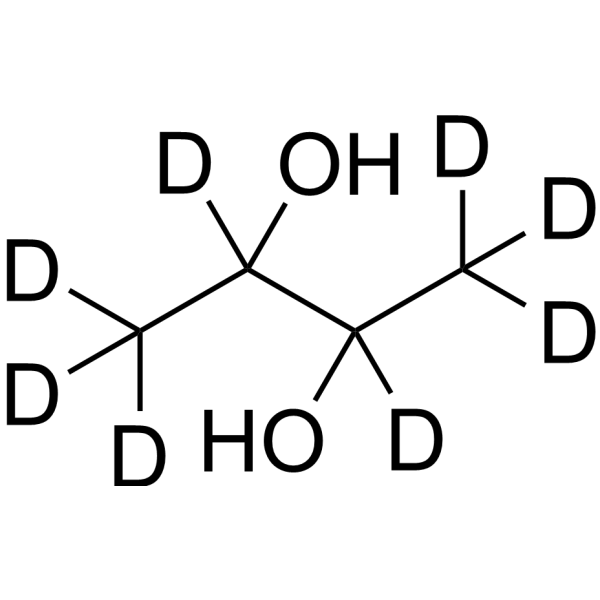
2,3-Butanediol-d8

Based on 1 Customer Validation
2,3-Butanediol-d8 is the deuterium labeled 2,3-Butanediol (HY-128387). 2,3-Butanediol is microbially derived compound that is a discriminating urinary biomarker of Fmo5-/- mice. 2,3-Butanediol prevents age-related increases in the plasma concentration of cholesterol. 2,3-Butanediol has potential applications in the manufacture of printing inks, perfumes, fumigants, moistening and softening agents, plasticizers, and as a carrier for pharmaceuticals.
For research use only. We do not sell to patients.
- Purity : 99.3%
- CAS No.: 347841-77-4
- Formula: C4H2D8O2
- Molecular Weight:98.17
-
Storage:Pure form -20°C, 3 years ; In solvent -80°C, 6 months , -20°C, 1 month

To place orders, for customer services and technical support, please contact: MedChemExpress USA
Tel: 609-228-6898 E-mail: [email protected] [email protected]


-
 Biological Activity
-
Chemical Information
- Protocols
- Purity & Documentation
- References
-
 Help & FAQs


All Endogenous Metabolite Isoforms
More

Biological Activity
Description
In Vitro
Stable heavy isotopes of hydrogen, carbon, and other elements have been incorporated into drug molecules, largely as tracers for quantitation during the drug development process. Deuteration has gained attention because of its potential to affect the pharmacokinetic and metabolic profiles of drugs[1].
MedChemExpress (MCE) has not independently confirmed the accuracy of these methods. They are for reference only.
Application
1. This compound can be used as a tracer
2. This compound can be used as an internal standard for quantitative analysis by NMR, GC-MS, or LC-MS.


Chemical Information
-
CAS No. 347841-77-4
-
Unlabeled CAS 513-85-9
-
Appearance Liquid
-
Molecular Weight 98.17
-
Formula C4H2D8O2
-
Color Colorless to light yellow
-
SMILES
[2H]C([2H])([2H])C(O)([2H])C(O)([2H])C([2H])([2H])[2H]
-
Shipping
Room temperature in continental US; may vary elsewhere.
-
Storage
Pure form -20°C 3 years In solvent -80°C 6 months -20°C 1 month


Purity & Documentation
-
Data Sheet (274 KB)
-
SDS (394 KB)
- English - EN (394 KB)
- Français - FR (394 KB)
- Deutsch - DE (394 KB)
- Norwegian - NO (394 KB)
- Español - ES (394 KB)
- Swedish - SV (394 KB)
- Italian - IT (394 KB)
- Korean - KR (394 KB)
- Portuguese - PT (394 KB)
-
Handling Instructions (2659 KB)
References
[1]. Russak EM, et al. Impact of Deuterium Substitution on the Pharmacokinetics of Pharmaceuticals. Ann Pharmacother. 2019 Feb;53(2):211-216. [Content Brief]
[2]. Zhang L, et al. Mechanism of 2,3-butanediol stereoisomers formation in a newly isolated Serratia sp. T241. Sci Rep. 2016 Jan 12;6:19257. [Content Brief]
[3]. Veeravalli S, et al. Treatment of wild-type mice with 2,3-butanediol, a urinary biomarker of Fmo5-/- mice, decreases plasma cholesterol and epididymal fat deposition. Front Physiol. 2022 Aug 8;13:859681. [Content Brief]

Calculators
Concentration (start) × Volume (start) = Concentration (final) × Volume (final)


2,3-Butanediol-d8 Related Classifications
HY-128387S1 Related Classifications
 Powered by Bioz