



24-Epicastasterone
Based on 2 publication(s) in Google Scholar
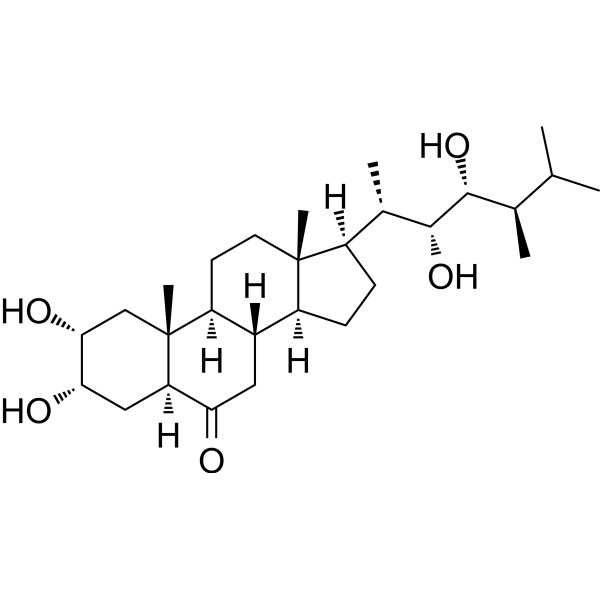
24-Epicastasterone (24-epi-Castasterone) is a bioactive brassinosteroid and a ligand of ABCB1 and ABCB19 in Arabidopsis thaliana. 24-Epicastasterone stimulates the ATPase activity of ABCB19 and the ATP hydrolysis activity of ABCB1, which drive the efflux of substances from plant cells. 24-Epicastasterone increases the activities of catalase and guaiacol peroxidase in the roots of wheat seedlings. 24-Epicastasterone alleviates heat-induced lipid peroxidation through a ROS-dependent mechanism and enhances the heat tolerance of common wheat seedlings.
For research use only. We do not sell to patients.
- Purity : 99.91%
- CAS No.: 72050-71-6
- Formula: C28H48O5
- Molecular Weight:464.68
-
Storage:Powder -20°C, 3 years , 4°C, 2 years ; In solvent -80°C, 6 months , -20°C, 1 month

To place orders, for customer services and technical support, please contact: MedChemExpress USA
Tel: 609-228-6898 E-mail: [email protected] [email protected]


-
 Biological Activity
-
Chemical Information
-
Solvent & Solubility
- Protocols
- Purity & Documentation
- References
-
 Help & FAQs


Publications Citing Use of MedChemExpress (MCE) 24-Epicastasterone
More

Biological Activity
Description
In Vitro
24-epicastasterone (20 min pre-incubation on ice, 10 min reaction at 37°C) potently stimulates the ATPase activity of purified Arabidopsis ABCB19 protein in a dose-dependent manner[1].
24-epicastasterone (0.05 mM) binds directly to purified Arabidopsis ABCB19 protein reconstituted in amphipols with a dissociation constant of 0.36 μM[1].
24-Epicastasterone (1 μM; foliar spray; once daily; 11 consecutive days) rescues growth in brassinosteroid-deficient Arabidopsis biosynthetic mutants but not in ABCB19 transporter-deficient mutants, confirming ABCB19 is required for functional 24-epicastasterone signaling[1].
24-epicastasterone (5-200 nM; 24 h) increases the heat resistance of Triticum aestivum cv. Doskonala wheat seedlings, with the most significant effect observed at a 50 nM concentration applied for 24 h, and a significant effect also seen at 20 nM[2].
24-epicastasterone (50 nM; 2 h, 4 h, 24 h) modulates the activity of superoxide dismutase, catalase, and guaiacol peroxidase in roots of Triticum aestivum cv. Doskonala wheat seedlings, with superoxide dismutase activity elevated at 4 h, catalase activity elevated at 24 h, and guaiacol peroxidase activity elevated at 4 h but not significantly different from control at 24 h[2].
24-epicastasterone (50 nM; 24 h before heat stress) reduces heat-induced lipid peroxidation in roots of Triticum aestivum cv. Doskonala wheat seedlings, an effect dependent on NADPH oxidase-mediated hydrogen peroxide production[2].
MedChemExpress (MCE) has not independently confirmed the accuracy of these methods. They are for reference only. Further protocols information, click here.


Chemical Information
-
CAS No. 72050-71-6
-
Appearance Solid
-
Molecular Weight 464.68
-
Formula C28H48O5
-
Color Off-white to light brown
-
SMILES
C[C@@]12[C@]3([H])[C@](CC([C@@]1([H])C[C@@H]([C@@H](C2)O)O)=O)([H])[C@@]4([H])[C@](CC3)([C@@](CC4)([H])[C@H](C)[C@@H](O)[C@H](O)[C@H](C)C(C)C)C
-
Synonyms
24-epi-Castasterone
-
Initial Source
Hydrodictyon reticulatum
-
Shipping
Room temperature in continental US; may vary elsewhere.
-
Storage
Powder -20°C 3 years 4°C 2 years In solvent -80°C 6 months -20°C 1 month


Publications (2)
-
Journal Impact Factor
-
Most Recent
-
Science
Structure and function of the Arabidopsis ABC transporter ABCB19 in brassinosteroid export. [Abstract]2024 Mar 22;383(6689):eadj4591. PMID: 38513023 -
Plant Commun
Structural insights into brassinosteroid export mediated by the Arabidopsis ABC transporter ABCB1. [Abstract]2025 Jan 13;6(1):101181. PMID: 39497419


Solvent & Solubility
In Vitro:
THF : 10 mg/mL (21.52 mM; Need ultrasonic)
Please refer to the solubility information to select the appropriate solvent. Once prepared, please aliquot and store the solution to prevent product inactivation from repeated freeze-thaw cycles.
Storage method and period of stock solution: -80°C, 6 months; -20°C, 1 month. When stored at -80°C, please use it within 6 months. When stored at -20°C, please use it within 1 month.
Please refer to the solubility information to select the appropriate solvent. Once prepared, please aliquot and store the solution to prevent product inactivation from repeated freeze-thaw cycles.
Storage method and period of stock solution: -80°C, 6 months; -20°C, 1 month. When stored at -80°C, please use it within 6 months. When stored at -20°C, please use it within 1 month.
Concentration (start) × Volume (start) = Concentration (final) × Volume (final)

Protocols
-
ROS/oxidative-stress fluorescent staining
ROS/oxidative-stress fluorescent staining uses cell-permeant fluorogenic probes that become fluorescent after oxidation inside cells or tissues; commonly used examples include DCFH-DA/DCFDA for broad cellular oxidant detection, DHE for superoxide-related signal detection, MitoSOX for mitochondrial superoxide-related signal detection, and CellROX probes for oxidative-stress-associated fluorescence readouts. The assay detects probe oxidation rather than a single ROS species unless the probe and analysis method have been chemically validated for that species. DCFH-DA enters cells, is deacetylated by intracellular esterases to DCFH, and produces fluorescent DCF after oxidation, so the readout is used as an operational measure of total cellular oxidative stress rather than a species-specific ROS measurement. DHE and MitoSOX can report superoxide-related oxidation, but red fluorescence alone can include non-specific ethidium-like oxidation products; HPLC or optimized spectral approaches are
-
Ferroptosis Solutions
Ferroptosis is an iron-dependent, non-apoptotic form of regulated cell death characterized by lethal lipid peroxidation and sensitivity to suppression by iron chelators or lipophilic radical-trapping antioxidants. The core pathway links cystine uptake through system Xc−, glutathione availability, GPX4-dependent detoxification of phospholipid hydroperoxides, iron-dependent oxidative reactions, and polyunsaturated-phospholipid metabolism into a cell-death program that is biochemically and morphologically distinct from apoptosis, necrosis, and autophagy. The ferroptosis pathway is experimentally linked to phenotype through chemical and genetic perturbation. Erastin induces ferroptosis by inhibiting cystine uptake through system Xc− and weakening antioxidant defenses, while GPX4 inhibition or depletion causes lipid peroxide accumulation and ferroptotic cancer-cell death. ACSL4 and oxidizable arachidonoyl- or adrenoyl-containing phosphatidylethanolamines shape ferroptosis sensitivity by con


Purity & Documentation
-
Data Sheet (276 KB)
-
SDS (393 KB)
- English - EN (393 KB)
- Français - FR (393 KB)
- Deutsch - DE (393 KB)
- Norwegian - NO (393 KB)
- Español - ES (393 KB)
- Swedish - SV (393 KB)
- Italian - IT (393 KB)
- Korean - KR (393 KB)
- Portuguese - PT (393 KB)
-
Handling Instructions (2659 KB)
References
[1]. Ying W, et al. Structure and function of the Arabidopsis ABC transporter ABCB19 in brassinosteroid export. Science. 2024 Mar 22;383(6689):eadj4591. [Content Brief]
[3]. Wei H, et al. Structural insights into brassinosteroid export mediated by the Arabidopsis ABC transporter ABCB1. Plant Commun. 2025;6(1):101181. [Content Brief]


Complete Stock Solution Preparation Table
Please refer to the solubility information to select the appropriate solvent. Once prepared, please aliquot and store the solution to prevent product inactivation from repeated freeze-thaw cycles.
Storage method and period of stock solution: -80°C, 6 months; -20°C, 1 month. When stored at -80°C, please use it within 6 months. When stored at -20°C, please use it within 1 month.
| Optional Solvent | Concentration Solvent Mass | 1 mg | 5 mg | 10 mg | 25 mg |
|---|---|---|---|---|---|
| THF | 1 mM | 2.1520 mL | 10.7601 mL | 21.5202 mL | 53.8005 mL |
| 5 mM | 0.4304 mL | 2.1520 mL | 4.3040 mL | 10.7601 mL | |
| 10 mM | 0.2152 mL | 1.0760 mL | 2.1520 mL | 5.3800 mL | |
| 15 mM | 0.1435 mL | 0.7173 mL | 1.4347 mL | 3.5867 mL | |
| 20 mM | 0.1076 mL | 0.5380 mL | 1.0760 mL | 2.6900 mL |


24-Epicastasterone Related Classifications
HY-N10455 Related Classifications
 Powered by Bioz