



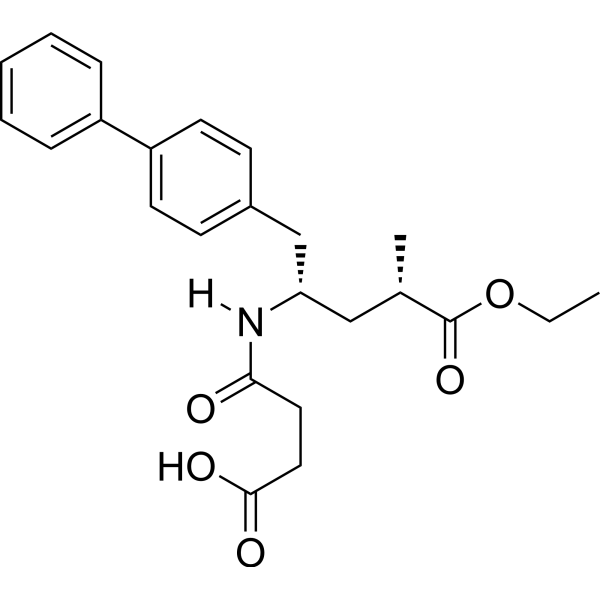
(2S,4S)-Sacubitril

Based on 1 Customer Validation
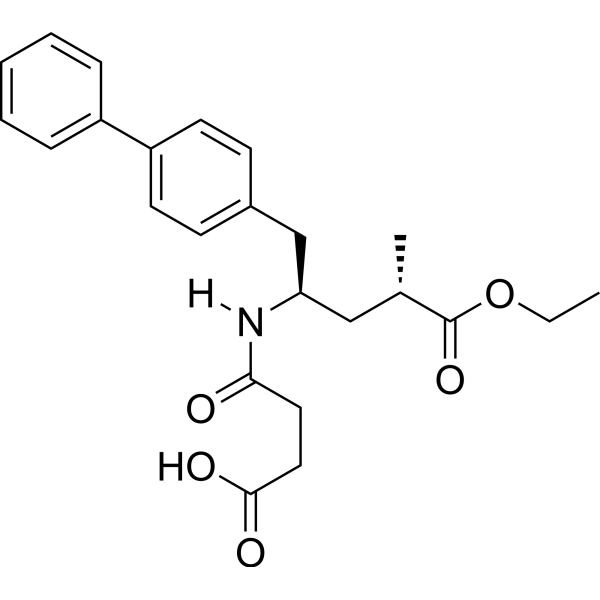
(2S,4S)-Sacubitril is the impurity of Sacubitril. Sacubitril is a potent NEP inhibitor that can be used for the research of heart failure.
For research use only. We do not sell to patients.
- CAS No.: 149709-63-7
- Formula: C24H29NO5
- Molecular Weight:411.49
-
Storage:Pure form -20°C, 3 years , 4°C, 2 years ; In solvent -80°C, 6 months , -20°C, 1 month

To place orders, for customer services and technical support, please contact: MedChemExpress USA
Tel: 609-228-6898 E-mail: [email protected] [email protected]


-
 Biological Activity
-
Chemical Information
-
Solvent & Solubility
- Protocols
- Purity & Documentation
- References
-
 Help & FAQs




Biological Activity
Description
In Vitro
(2S,4S)-Sacubitril is a stereoisomer derived from Sacubitril[1].
MedChemExpress (MCE) has not independently confirmed the accuracy of these methods. They are for reference only. Further protocols information, click here.


Chemical Information
-
CAS No. 149709-63-7
-
Appearance Oil
-
Molecular Weight 411.49
-
Formula C24H29NO5
-
Color Colorless to light yellow
-
SMILES
[H]N(C(CCC(O)=O)=O)[C@H](CC(C=C1)=CC=C1C2=CC=CC=C2)C[C@@H](C(OCC)=O)C
-
Shipping
Room temperature in continental US; may vary elsewhere.
-
Storage
Pure form -20°C 3 years 4°C 2 years In solvent -80°C 6 months -20°C 1 month


Solvent & Solubility
In Vitro:
DMSO : 100 mg/mL (243.02 mM; Need ultrasonic; Hygroscopic DMSO has a significant impact on the solubility of product, please use newly opened DMSO)
Please refer to the solubility information to select the appropriate solvent. Once prepared, please aliquot and store the solution to prevent product inactivation from repeated freeze-thaw cycles.
Storage method and period of stock solution: -80°C, 6 months; -20°C, 1 month. When stored at -80°C, please use it within 6 months. When stored at -20°C, please use it within 1 month.
Please refer to the solubility information to select the appropriate solvent. Once prepared, please aliquot and store the solution to prevent product inactivation from repeated freeze-thaw cycles.
Storage method and period of stock solution: -80°C, 6 months; -20°C, 1 month. When stored at -80°C, please use it within 6 months. When stored at -20°C, please use it within 1 month.
Concentration (start) × Volume (start) = Concentration (final) × Volume (final)

Protocols
-
Research Protocol for Cardiovascular Diseases
Cardiovascular disease can be modeled as maladaptive cardiac remodeling, where ischemic injury or pressure overload activates inflammatory signaling, fibroblast activation, extracellular-matrix deposition, cardiomyocyte hypertrophy, vascular remodeling, and progressive ventricular dysfunction. The TGF-β/SMAD axis is a central profibrotic pathway after myocardial injury and pressure overload, while innate immune and cytokine pathways regulate leukocyte recruitment, scar formation, and adverse remodeling. Key unresolved questions include which inflammatory signals are reparative versus harmful, when fibrosis is protective versus maladaptive, and whether pathway inhibition improves function without weakening necessary infarct healing or compensatory remodeling.


Purity & Documentation
-
Data Sheet (272 KB)
-
SDS (393 KB)
- English - EN (393 KB)
- Français - FR (393 KB)
- Deutsch - DE (393 KB)
- Norwegian - NO (393 KB)
- Español - ES (393 KB)
- Swedish - SV (393 KB)
- Italian - IT (393 KB)
- Korean - KR (393 KB)
- Portuguese - PT (393 KB)
-
Handling Instructions (2659 KB)
References


Complete Stock Solution Preparation Table
Please refer to the solubility information to select the appropriate solvent. Once prepared, please aliquot and store the solution to prevent product inactivation from repeated freeze-thaw cycles.
Storage method and period of stock solution: -80°C, 6 months; -20°C, 1 month. When stored at -80°C, please use it within 6 months. When stored at -20°C, please use it within 1 month.
| Optional Solvent | Concentration Solvent Mass | 1 mg | 5 mg | 10 mg | 25 mg |
|---|---|---|---|---|---|
| DMSO | 1 mM | 2.4302 mL | 12.1510 mL | 24.3019 mL | 60.7548 mL |
| 5 mM | 0.4860 mL | 2.4302 mL | 4.8604 mL | 12.1510 mL | |
| 10 mM | 0.2430 mL | 1.2151 mL | 2.4302 mL | 6.0755 mL | |
| 15 mM | 0.1620 mL | 0.8101 mL | 1.6201 mL | 4.0503 mL | |
| 20 mM | 0.1215 mL | 0.6075 mL | 1.2151 mL | 3.0377 mL | |
| 25 mM | 0.0972 mL | 0.4860 mL | 0.9721 mL | 2.4302 mL | |
| 30 mM | 0.0810 mL | 0.4050 mL | 0.8101 mL | 2.0252 mL | |
| 40 mM | 0.0608 mL | 0.3038 mL | 0.6075 mL | 1.5189 mL | |
| 50 mM | 0.0486 mL | 0.2430 mL | 0.4860 mL | 1.2151 mL | |
| 60 mM | 0.0405 mL | 0.2025 mL | 0.4050 mL | 1.0126 mL | |
| 80 mM | 0.0304 mL | 0.1519 mL | 0.3038 mL | 0.7594 mL | |
| 100 mM | 0.0243 mL | 0.1215 mL | 0.2430 mL | 0.6075 mL |


(2S,4S)-Sacubitril Related Classifications
HY-78841 Related Classifications
 Powered by Bioz