



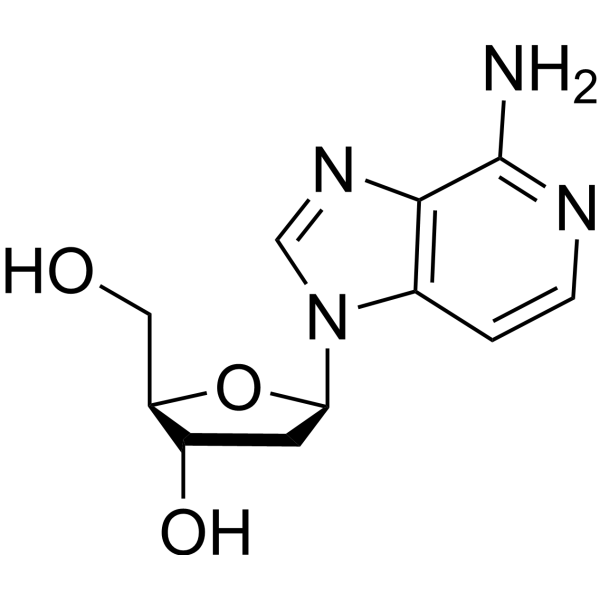
3-Deaza-2'-deoxyadenosine

Based on 1 Customer Validation
3-Deaza-2 '-deoxyadenosine is a nucleoside analog synthesized from 2' -deoxyadenosine. 3-Deaza-2 '-deoxyadenosine inhibits RNA synthesis by binding to ribose fragments of ribonucleotides, thereby preventing the formation of enzyme-substrate complexes, thereby preventing chain elongation, It can also inhibit DNA synthesis by binding deoxyribose fragments of DNA and preventing DNA polymerase from adding nucleotides to the growth chain. 3-Deaza-2 '-deoxyadenosine has antiviral activity.
For research use only. We do not sell to patients.
- Purity : 95.60%
- CAS No.: 78582-17-9
- Formula: C11H14N4O3
- Molecular Weight:250.25
-
Storage:Powder -20°C, 3 years , 4°C, 2 years ; In solvent -80°C, 6 months , -20°C, 1 month

To place orders, for customer services and technical support, please contact: MedChemExpress USA
Tel: 609-228-6898 E-mail: [email protected] [email protected]


-
 Biological Activity
-
Chemical Information
-
Solvent & Solubility
- Protocols
- Purity & Documentation
- References
-
 Help & FAQs


-
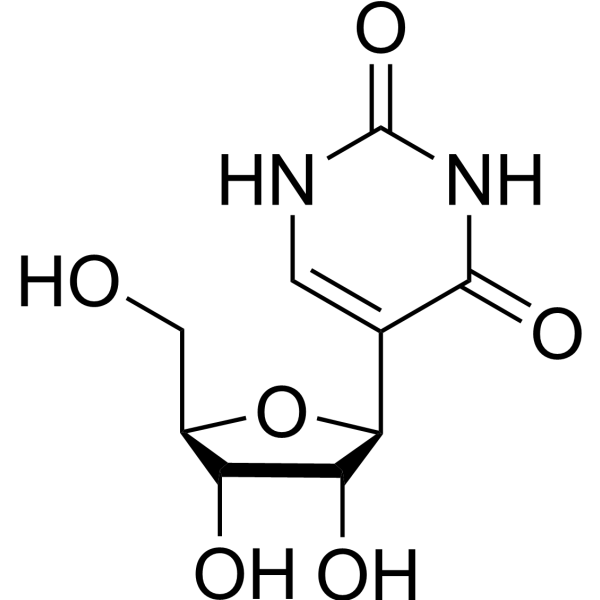
HY-113061
PseudouridineNucleoside -
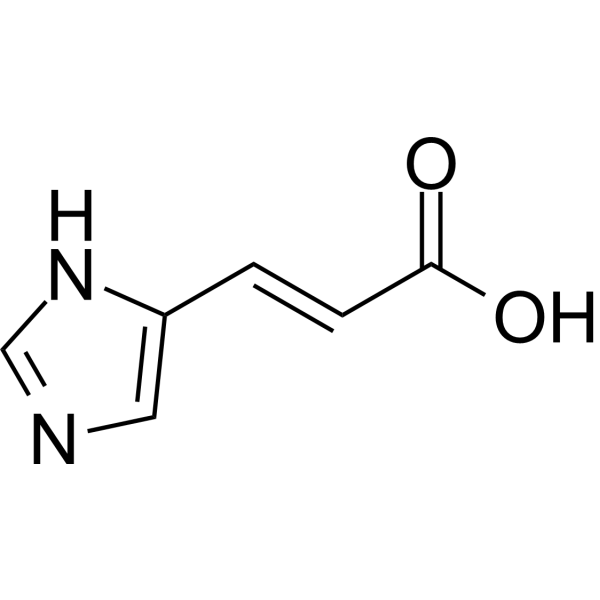
HY-113008B
trans-Urocanic acidNK Cell Inhibitor -

HY-113061R
Pseudouridine (Standard)Nucleoside -
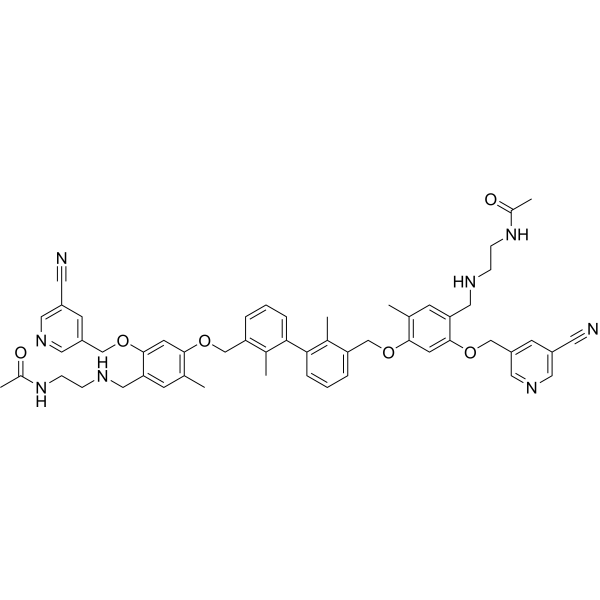
HY-132212
LH1307Inhibitor of PD-1/PD-L1 Protein-Protein Interaction -
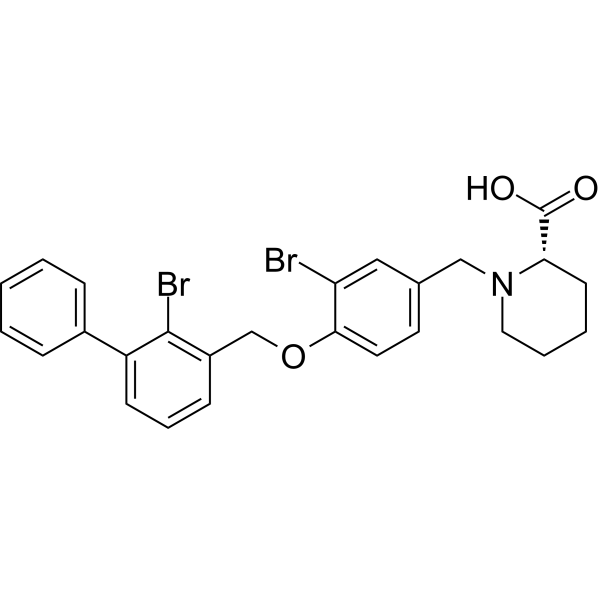
HY-163041
PD-1/PD-L1-IN-36PD-1/PD-L1 Inhibitor -

HY-113008BR
trans-Urocanic acid (Standard)NK Cell Inhibitor -
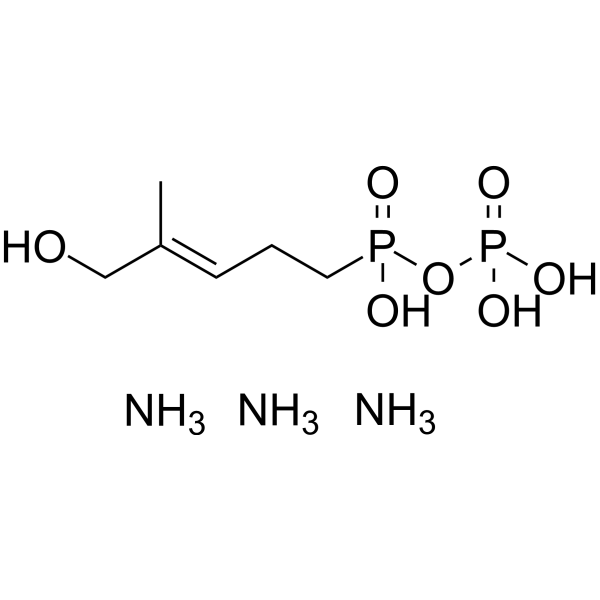
HY-134950
(E)-C-HDMAPP ammoniumPhosphoantigen -
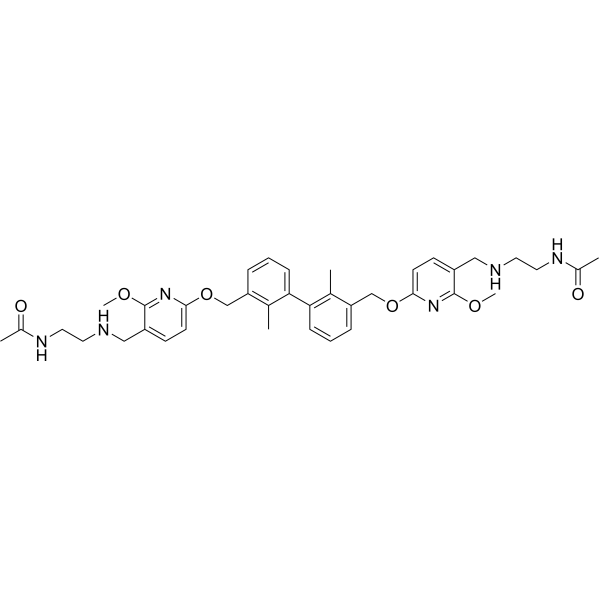
HY-132223
LH1306PD-1/PD-L1 Inhibitor -

HY-N12106
NeosartoricinSecondary Metabolite -

HY-165065
ISP-I-28Biochemical Reagent


Biological Activity
Description


Chemical Information
-
CAS No. 78582-17-9
-
Appearance Solid
-
Molecular Weight 250.25
-
Formula C11H14N4O3
-
Color Light brown to brown
-
SMILES
O[C@H]1C[C@H](N2C=NC3=C2C=CN=C3N)O[C@@H]1CO
-
Shipping
Room temperature in continental US; may vary elsewhere.
-
Storage
Powder -20°C 3 years 4°C 2 years In solvent -80°C 6 months -20°C 1 month


Solvent & Solubility
In Vitro:
DMSO : 50 mg/mL (199.80 mM; Need ultrasonic; Hygroscopic DMSO has a significant impact on the solubility of product, please use newly opened DMSO)
Please refer to the solubility information to select the appropriate solvent. Once prepared, please aliquot and store the solution to prevent product inactivation from repeated freeze-thaw cycles.
Storage method and period of stock solution: -80°C, 6 months; -20°C, 1 month. When stored at -80°C, please use it within 6 months. When stored at -20°C, please use it within 1 month.
Please refer to the solubility information to select the appropriate solvent. Once prepared, please aliquot and store the solution to prevent product inactivation from repeated freeze-thaw cycles.
Storage method and period of stock solution: -80°C, 6 months; -20°C, 1 month. When stored at -80°C, please use it within 6 months. When stored at -20°C, please use it within 1 month.
Concentration (start) × Volume (start) = Concentration (final) × Volume (final)

Protocols
-
EdU Incorporation Assay (Click Chemistry-Based DNA Synthesis Measurement)
The EdU incorporation assay measures DNA synthesis by adding the thymidine analog 5-ethynyl-2′-deoxyuridine to cells or tissues, where it is incorporated into newly synthesized DNA during S phase. Incorporated EdU is detected by copper-catalyzed azide-alkyne cycloaddition, in which a fluorescent azide covalently reacts with the ethynyl group on EdU, allowing S-phase cells to be detected by fluorescence microscopy, flow cytometry, or high-content imaging. EdU detection does not require DNA denaturation or anti-BrdU antibody access, which preserves sample structure and improves compatibility with immunostaining and multiparameter cytometry compared with BrdU-based detection. EdU can be cytotoxic in a cell-type- and exposure-dependent manner, so pulse duration, concentration, and continuous-labeling designs should be validated for each cell type.
-
Research Protocol for Infectious Diseases
Infectious-disease experiments test how pathogens interact with host barriers, innate immune receptors, inflammatory signaling, pathogen replication, and tissue injury; pattern-recognition receptors such as TLRs, RIG-I-like receptors, NOD-like receptors, and inflammasomes detect microbial molecules and activate NF-κB, interferon, and cytokine responses. The central hypothesis is that infection severity reflects the balance between pathogen burden and host response: protective inflammation restricts pathogen growth, whereas excessive or mislocalized inflammation contributes to tissue damage and disease phenotype. Unresolved questions include which host pathways are protective versus pathogenic, why some infection models fail to translate to human disease, and which combined readouts best predict clinically relevant infection outcomes.
-
BrdU Incorporation Assay
Bromodeoxyuridine (BrdU) incorporation assay is based on the principle that BrdU, a thymidine analog, is incorporated into newly synthesized DNA during the S phase of the cell cycle, thereby serving as a marker of DNA replication and cellular proliferation. Incorporated BrdU can be detected using anti-BrdU antibodies following DNA denaturation, enabling visualization or quantification of proliferating cells through immunochemical detection methods such as immunofluorescence or immunohistochemistry.


Purity & Documentation
-
Data Sheet (276 KB)
-
SDS (252 KB)
- English - EN (252 KB)
- Français - FR (252 KB)
- Deutsch - DE (252 KB)
- Norwegian - NO (252 KB)
- Español - ES (252 KB)
- Swedish - SV (252 KB)
- Italian - IT (252 KB)
- Korean - KR (252 KB)
- Portuguese - PT (252 KB)
-
Handling Instructions (2659 KB)
References
[1]. Hendrickson CL, et al. Probing minor groove recognition contacts by DNA polymerases and reverse transcriptases using 3-deaza-2'-deoxyadenosine. Nucleic Acids Res. 2004 Apr 23;32(7):2241-50. [Content Brief]
[2]. Cristalli G, et al. Synthesis and biological evaluation of N6-cycloalkyl derivatives of 1-deazaadenine nucleosides: a new class of anti-human immunodeficiency virus agents. J Med Chem. 1995 Sep 29;38(20):4019-25. [Content Brief]


Complete Stock Solution Preparation Table
Please refer to the solubility information to select the appropriate solvent. Once prepared, please aliquot and store the solution to prevent product inactivation from repeated freeze-thaw cycles.
Storage method and period of stock solution: -80°C, 6 months; -20°C, 1 month. When stored at -80°C, please use it within 6 months. When stored at -20°C, please use it within 1 month.
| Optional Solvent | Concentration Solvent Mass | 1 mg | 5 mg | 10 mg | 25 mg |
|---|---|---|---|---|---|
| DMSO | 1 mM | 3.9960 mL | 19.9800 mL | 39.9600 mL | 99.9001 mL |
| 5 mM | 0.7992 mL | 3.9960 mL | 7.9920 mL | 19.9800 mL | |
| 10 mM | 0.3996 mL | 1.9980 mL | 3.9960 mL | 9.9900 mL | |
| 15 mM | 0.2664 mL | 1.3320 mL | 2.6640 mL | 6.6600 mL | |
| 20 mM | 0.1998 mL | 0.9990 mL | 1.9980 mL | 4.9950 mL | |
| 25 mM | 0.1598 mL | 0.7992 mL | 1.5984 mL | 3.9960 mL | |
| 30 mM | 0.1332 mL | 0.6660 mL | 1.3320 mL | 3.3300 mL | |
| 40 mM | 0.0999 mL | 0.4995 mL | 0.9990 mL | 2.4975 mL | |
| 50 mM | 0.0799 mL | 0.3996 mL | 0.7992 mL | 1.9980 mL | |
| 60 mM | 0.0666 mL | 0.3330 mL | 0.6660 mL | 1.6650 mL | |
| 80 mM | 0.0500 mL | 0.2498 mL | 0.4995 mL | 1.2488 mL | |
| 100 mM | 0.0400 mL | 0.1998 mL | 0.3996 mL | 0.9990 mL |


3-Deaza-2'-deoxyadenosine Related Classifications
HY-126877 Related Classifications
 Powered by Bioz