



3'OMe-m7GpppAmpG ammonium solution (100 mM)

Based on 1 Customer Validation
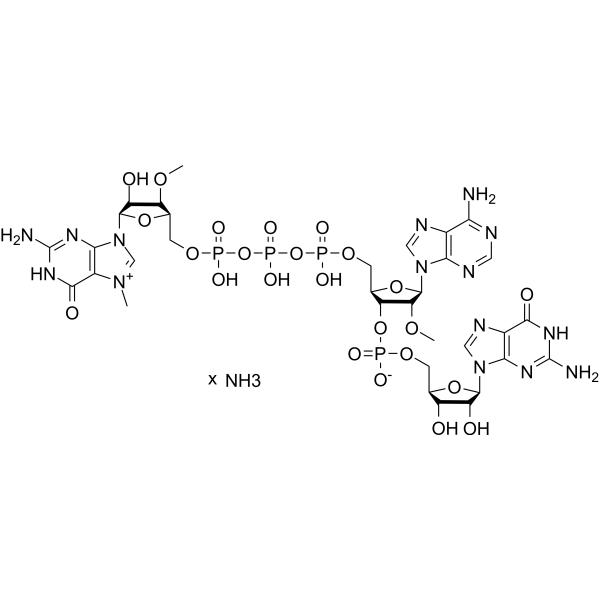
3’OMe-m7GpppAmpG (m7(3'OMeG)(5')ppp(5')(2'OMeA)pG) ammonium solution (100 mM) is a trinucleotide Cap1 analog with the structure m7 (3'OMeG)(5') ppp (5')(2'OMeA) pG, and also functions as a cis-acting ligase ribozyme inhibitor. 3’OMe-m7GpppAmpG ammonium solution (100 mM) effectively reduces free 5'-triphosphate groups on RNA transcripts, thereby enabling efficient co-transcriptional capping of in vitro transcribed mRNA. 3’OMe-m7GpppAmpG ammonium solution (100 mM) is not only widely used in the preparation of modified mRNA including trivalent influenza vaccine candidates, but also applicable to studies related to SARS-CoV-2 infection and other relevant research.
For research use only. We do not sell to patients.
- Purity : 98.24%
- Formula: C33H45N15O24P4.xNH3
-
Storage:
Solution, -20°C, 2 years

To place orders, for customer services and technical support, please contact: MedChemExpress USA
Tel: 609-228-6898 E-mail: [email protected] [email protected]


-
 Biological Activity
-
Chemical Information
- Protocols
- Purity & Documentation
- References
-
 Help & FAQs




Biological Activity
Description
In Vitro
3’OMe-m7GpppAmpG ammonium solution (100 mM) (4 mM; 2 h) supports the production of translationally active HA-encoding mRNA that expresses functional HA protein in HEK293 cells[1].
MedChemExpress (MCE) has not independently confirmed the accuracy of these methods. They are for reference only. Further protocols information, click here.


Chemical Information
-
Appearance Liquid
-
Formula C33H45N15O24P4.xNH3
-
Color Colorless to light yellow
-
SMILES
O[C@@H]1[C@H](OC)[C@@H](COP(OP(OP(OC[C@@H]2[C@@H](OP([O-])(OC[C@@H]3[C@@H](O)[C@@H](O)[C@H](N4C(N=C(N)NC5=O)=C5N=C4)O3)=O)[C@@H](OC)[C@H](N6C(N=CN=C7N)=C7N=C6)O2)(O)=O)(O)=O)(O)=O)O[C@H]1N8C(N=C(N)NC9=O)=C9[N+](C)=C8.[x].N
-
Synonyms
m7(3'OMeG)(5')ppp(5')(2'OMeA)pG ammonium solution (100 mM)
-
Shipping
Room temperature in continental US; may vary elsewhere.
-
Storage
Solution, -20°C, 2 years

Protocols
-
RNA extraction experimental
By lysing cells, releasing RNA, and removing impurities such as proteins and DNA, high-purity RNA products are finally obtained. The commonly used traditional method is the guanidine isothiocyanate/phenol/chloroform method (Trizol), which is suitable for a variety of animal materials including animal tissues, microorganisms, cultured cells, etc., and most plant materials.
-
Research Protocol for Infectious Diseases
Infectious-disease experiments test how pathogens interact with host barriers, innate immune receptors, inflammatory signaling, pathogen replication, and tissue injury; pattern-recognition receptors such as TLRs, RIG-I-like receptors, NOD-like receptors, and inflammasomes detect microbial molecules and activate NF-κB, interferon, and cytokine responses. The central hypothesis is that infection severity reflects the balance between pathogen burden and host response: protective inflammation restricts pathogen growth, whereas excessive or mislocalized inflammation contributes to tissue damage and disease phenotype. Unresolved questions include which host pathways are protective versus pathogenic, why some infection models fail to translate to human disease, and which combined readouts best predict clinically relevant infection outcomes.


Purity & Documentation
-
Data Sheet (271 KB)
-
SDS (252 KB)
- English - EN (252 KB)
- Français - FR (252 KB)
- Deutsch - DE (252 KB)
- Norwegian - NO (252 KB)
- Español - ES (252 KB)
- Swedish - SV (252 KB)
- Italian - IT (252 KB)
- Korean - KR (252 KB)
- Portuguese - PT (252 KB)
-
Handling Instructions (2659 KB)
References

Calculators
Concentration (start) × Volume (start) = Concentration (final) × Volume (final)


3'OMe-m7GpppAmpG ammonium solution (100 mM) Related Classifications
HY-145973A Related Classifications
 Powered by Bioz
Keywords
- 3'OMe-m7GpppAmpG ammonium solution (100 mM)
- m7(3'OMeG)(5')ppp(5')(2'OMeA)pG ammonium solution (100 mM)
- Nucleoside Antimetabolite/Analog
- SARS-CoV
- SARS-CoV-2 infection
- HA protein
- cis-acting ligase ribozyme
- RNA transcripts
- SARS-CoV-2 spike mRNA
- mRNA
- trivalent influenza vaccine
- HEK293 cells
- LNP formulation
- Inhibitor
- inhibitor
- inhibit