



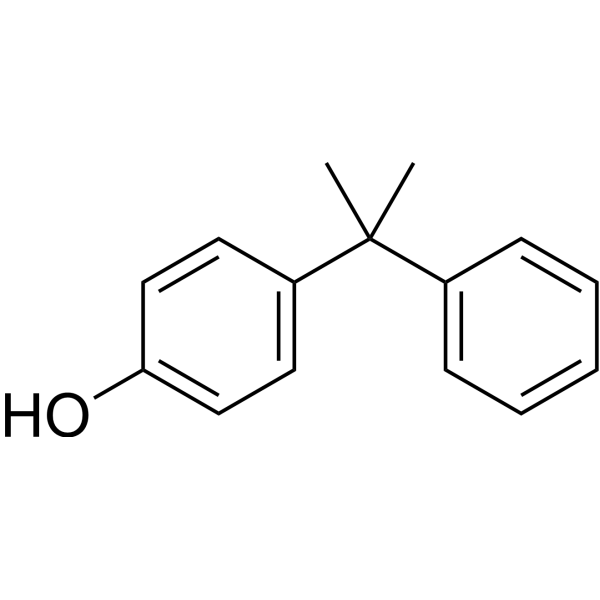
4-Cumylphenol

Based on 1 Customer Validation
4-Cumylphenol is a polycarbonate chain terminator. 4-Cumylphenol is widely used as a material for polycarbonate plastics, surfactants, fungicides and preservatives. 4-Cumylphenol also induces lipid accumulation in mouse adipocytes.
For research use only. We do not sell to patients.
- Purity : 99.70%
- CAS No.: 599-64-4
- Formula: C15H16O
- Molecular Weight:212.29
-
Storage:
4°C, stored under nitrogen
* In solvent : -80°C, 6 months; -20°C, 1 month (stored under nitrogen)

To place orders, for customer services and technical support, please contact: MedChemExpress USA
Tel: 609-228-6898 E-mail: [email protected] [email protected]


-
 Biological Activity
-
Chemical Information
-
Solvent & Solubility
- Protocols
- Purity & Documentation
- References
-
 Help & FAQs




Biological Activity
Description
Cellular Effect
|
Cell Line

|
Type | Value | Description | References |
|---|---|---|---|---|
| HEK293 | EC50 |
4.4 μM
Compound: 15
|
Agonist activity at human Gal4-fused ERalpha expressed in HEK293 cells assessed as transcriptional activation after 24 hrs by luciferase/beta-galactosidase reporter gene assay
Agonist activity at human Gal4-fused ERalpha expressed in HEK293 cells assessed as transcriptional activation after 24 hrs by luciferase/beta-galactosidase reporter gene assay
|
[PMID: 31980362] |
| HEK293 | IC50 |
13 μM
Compound: 15
|
Antagonist activity at human Gal4-fused ERbeta expressed in HEK293 cells assessed as inhibition of E2-induced transcriptional activation after 24 hrs by luciferase/beta-galactosidase reporter gene assay
Antagonist activity at human Gal4-fused ERbeta expressed in HEK293 cells assessed as inhibition of E2-induced transcriptional activation after 24 hrs by luciferase/beta-galactosidase reporter gene assay
|
[PMID: 31980362] |
| HEK293 | IC50 |
24 μM
Compound: 15
|
Antagonist activity at human Gal4-fused ERalpha expressed in HEK293 cells assessed as inhibition of E2-induced transcriptional activation after 24 hrs by luciferase/beta-galactosidase reporter gene assay
Antagonist activity at human Gal4-fused ERalpha expressed in HEK293 cells assessed as inhibition of E2-induced transcriptional activation after 24 hrs by luciferase/beta-galactosidase reporter gene assay
|
[PMID: 31980362] |
| MCF7 | EC50 |
38 nM
Compound: 15
|
Estrogenic activity in human MCF7 cells assessed as cell proliferation after 7 days by WST-8 assay
Estrogenic activity in human MCF7 cells assessed as cell proliferation after 7 days by WST-8 assay
|
[PMID: 23214428] |
In Vitro
4-Cumylphenol (1, 5, 10, 20, 40 µM; 6 days) increase lipid accumulation in 3 T3-L1 cells[3].
MedChemExpress (MCE) has not independently confirmed the accuracy of these methods. They are for reference only. Further protocols information, click here.
-
Cell Line:3 T3-L1 cells
-
Concentration:1, 5, 10, 20, 40 µM
-
Incubation Time:6 days
-
Result:Increase lipid accumulation, which peaked at10 μM with a 204% increase.


Chemical Information
-
CAS No. 599-64-4
-
Appearance Solid
-
Molecular Weight 212.29
-
Formula C15H16O
-
Color White to off-white
-
SMILES
CC(C1=CC=CC=C1)(C2=CC=C(O)C=C2)C
-
Shipping
Room temperature in continental US; may vary elsewhere.
-
Storage
4°C, stored under nitrogen
* In solvent : -80°C, 6 months; -20°C, 1 month (stored under nitrogen)


Solvent & Solubility
In Vitro:
DMSO : ≥ 100 mg/mL (471.05 mM; Hygroscopic DMSO has a significant impact on the solubility of product, please use newly opened DMSO)
* "≥" means soluble, but saturation unknown.
Please refer to the solubility information to select the appropriate solvent. Once prepared, please aliquot and store the solution to prevent product inactivation from repeated freeze-thaw cycles.
Storage method and period of stock solution: -80°C, 6 months; -20°C, 1 month (stored under nitrogen). When stored at -80°C, please use it within 6 months. When stored at -20°C, please use it within 1 month.
Please refer to the solubility information to select the appropriate solvent. Once prepared, please aliquot and store the solution to prevent product inactivation from repeated freeze-thaw cycles.
Storage method and period of stock solution: -80°C, 6 months; -20°C, 1 month (stored under nitrogen). When stored at -80°C, please use it within 6 months. When stored at -20°C, please use it within 1 month.
Concentration (start) × Volume (start) = Concentration (final) × Volume (final)
In Vivo:
Select the appropriate dissolution method based on your experimental animal and administration route.
- For the following dissolution methods, please ensure to first prepare a clear stock solution using an In Vitro approach and then sequentially add co-solvents:
- To ensure reliable experimental results, the clarified stock solution can be appropriately stored based on storage conditions. As for the working solution for In Vivo experiments, it is recommended to prepare freshly and use it on the same day.
- The percentages shown for the solvents indicate their volumetric ratio in the final prepared solution. If precipitation or phase separation occurs during preparation, heat and/or sonication can be used to aid dissolution.
Add each solvent one by one: 10% DMSO 40% PEG300 5% Tween-80 45% Saline
Solubility: 5 mg/mL (23.55 mM); Suspended solution; Need ultrasonic
This protocol yields a suspended solution of 5 mg/mL. Suspended solution can be used for oral and intraperitoneal injection.
Taking 1 mL working solution as an example, add 100 μL DMSO stock solution (50.0 mg/mL) to 400 μL PEG300, and mix evenly; then add 50 μL Tween-80 and mix evenly; then add 450 μL Saline to adjust the volume to 1 mL.
Preparation of Saline: Dissolve 0.9 g sodium chloride in ddH₂O and dilute to 100 mL to obtain a clear Saline solution.
In Vivo Dissolution Calculator
Please enter the basic information of animal experiments:
-
-
-
-
Recommended: Prepare an additional quantity of animals to account for potential losses during experiments.
Please enter your animal formula composition:
-
%DMSO +
Recommended: Keep the proportion of DMSO in working solution below 2% if your animal is weak.
-
%+
-
+%Tween-80 + +
-
%Saline +
The co-solvents required include: DMSO, . All of co-solvents are available by MedChemExpress (MCE). , Tween 80. All of co-solvents are available by MedChemExpress (MCE).
Working solution concentration: 0.22 mg/mL
Method for preparing stock solution: mg drug dissolved in μL DMSO. Stock solution concentration: mg/mL. * In solvent : -80°C, 6 months; -20°C, 1 month (stored under nitrogen)
1. Take μL DMSO stock solution;
2. Add μL .
μL , mix evenly;
3. Then add μL Tween 80, mix evenly;
4. Then add μL
Please ensure that the stock solution in the first step is dissolved to a clear state, and add co-solvents in sequence. You can use ultrasonic heating (ultrasonic cleaner, recommended frequency 20-40 kHz), vortexing, etc. to assist dissolution.

Protocols
-
3T3-L1 preadipocyte-to-adipocyte differentiation
3T3-L1 preadipocytes are induced to differentiate after growth arrest using adipogenic media containing insulin, dexamethasone, and IBMX; differentiation is assessed by lipid-droplet accumulation, triglyceride increase, Oil Red O staining, and adipocyte-marker induction such as PPARγ and C/EBPα.
-
Large-size fat particle sorting
Large-size fat particle sorting is widely used to isolate cells up to 200 μm in diameter. Single-cell flow sorting will allow greater insight into adipocyte heterogeneity by identifying gene expression, protein composition, and metabolic signatures at the single-cell level.
-
Lipid Droplets: Oil Red O/Sudan Dye Lipid Staining
Lipid droplets are intracellular organelles with a neutral-lipid core that stores triacylglycerols and sterol esters, and Oil Red O or Sudan dyes detect these hydrophobic lipid deposits by partitioning into retained lipids in fresh or frozen specimens. Oil Red O stains neutral triglycerides and lipids in frozen tissue sections or air-dried cytologic preparations, while Sudan Black B has also been used as a histochemical fat stain for lipid-rich tissue structures.


Purity & Documentation
-
Data Sheet (273 KB)
-
SDS (394 KB)
- English - EN (394 KB)
- Français - FR (394 KB)
- Deutsch - DE (394 KB)
- Norwegian - NO (394 KB)
- Español - ES (394 KB)
- Swedish - SV (394 KB)
- Italian - IT (394 KB)
- Korean - KR (394 KB)
- Portuguese - PT (394 KB)
-
Handling Instructions (2659 KB)
References
[1]. Yue W, et al. Biodegradation of bisphenol-A polycarbonate plastic by Pseudoxanthomonas sp. strain NyZ600. J Hazard Mater. 2021 Aug 15;416:125775. [Content Brief]
[2]. Chiha M, et al. Sonolytic degradation of endocrine disrupting chemical 4-cumylphenol in water. Ultrason Sonochem. 2011 Sep;18(5):943-50. [Content Brief]
[3]. Ramskov Tetzlaff CN, Svingen T, et al. Bisphenols B, E, F, and S and 4-cumylphenol induce lipid accumulation in mouse adipocytes similarly to bisphenol A. Environ Toxicol. 2020 May;35(5):543-552. [Content Brief]


Complete Stock Solution Preparation Table
Please refer to the solubility information to select the appropriate solvent. Once prepared, please aliquot and store the solution to prevent product inactivation from repeated freeze-thaw cycles.
Storage method and period of stock solution: -80°C, 6 months; -20°C, 1 month (stored under nitrogen). When stored at -80°C, please use it within 6 months. When stored at -20°C, please use it within 1 month.
| Optional Solvent | Concentration Solvent Mass | 1 mg | 5 mg | 10 mg | 25 mg |
|---|---|---|---|---|---|
| DMSO | 1 mM | 4.7105 mL | 23.5527 mL | 47.1054 mL | 117.7634 mL |
| 5 mM | 0.9421 mL | 4.7105 mL | 9.4211 mL | 23.5527 mL | |
| 10 mM | 0.4711 mL | 2.3553 mL | 4.7105 mL | 11.7763 mL | |
| 15 mM | 0.3140 mL | 1.5702 mL | 3.1404 mL | 7.8509 mL | |
| 20 mM | 0.2355 mL | 1.1776 mL | 2.3553 mL | 5.8882 mL | |
| 25 mM | 0.1884 mL | 0.9421 mL | 1.8842 mL | 4.7105 mL | |
| 30 mM | 0.1570 mL | 0.7851 mL | 1.5702 mL | 3.9254 mL | |
| 40 mM | 0.1178 mL | 0.5888 mL | 1.1776 mL | 2.9441 mL | |
| 50 mM | 0.0942 mL | 0.4711 mL | 0.9421 mL | 2.3553 mL | |
| 60 mM | 0.0785 mL | 0.3925 mL | 0.7851 mL | 1.9627 mL | |
| 80 mM | 0.0589 mL | 0.2944 mL | 0.5888 mL | 1.4720 mL | |
| 100 mM | 0.0471 mL | 0.2355 mL | 0.4711 mL | 1.1776 mL |


4-Cumylphenol Related Classifications
HY-W014282 Related Classifications
 Powered by Bioz