



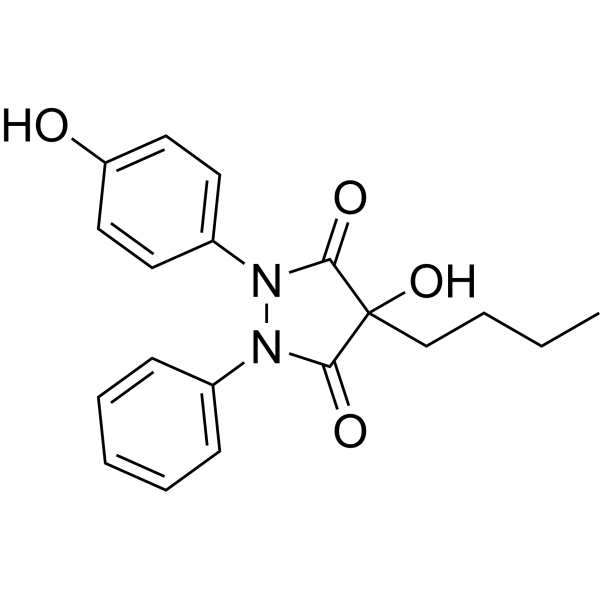
4-Hydroxyoxyphenbutazone
4-Hydroxyoxyphenbutazone kills both replicating and nonreplicating (NR) Mycobacterium tuberculosis (Mtb), including Mtb resistant to standard agents. 4-Hydroxyoxyphenbutazone is a potent inhibitor of cytokine production. 4-Hydroxyoxyphenbutazone is an immunosuppressive agent and has the potential for rheumatoid arthritis research.
Nur für Forschungszwecke. Wir verkaufen nicht an Patienten.
- CAS. Nr.: 55648-39-0
- Formel: C19H20N2O4
- Molecular Weight:340.37
-
Speicherung:
Please store the product under the recommended conditions in the Certificate of Analysis.

To place orders, for customer services and technical support, please contact: MedChemExpress USA
Tel: 609-228-6898 E-mail: [email protected] [email protected]


-
 Biologische Aktivität
-
Chemical Information
- Protokoll
- Reinheit & Dokumentation
- Verweise
-
 Help & FAQs




Biologische Aktivität
Beschreibung
In Vitro
4-Hydroxyoxyphenbutazone kills R Mtb in liquid culture with an MIC of 100 μM in the presence of 0.5% BSA and an MIC of 25 μM at lower BSA concentrations. The bactericidal spectrum of 4-Hydroxyoxyphenbutazone is remarkably narrow, with weak activity against Mycobacterium smegmatis (MIC of 200 μM in 7H9 lacking BSA). 4-Hydroxyoxyphenbutazone was inactive on E. coli, S. enterica var[1].
4-Hydroxyoxyphenbutazone efficiently inhibits both monokines and Th1 and Th2 lymphokines in peripheral mononuclear cells (PBMC)[2].
MedChemExpress (MCE) has not independently confirmed the accuracy of these methods. They are for reference only. Further protocols information, click here.


Chemical Information
-
CAS. Nr. 55648-39-0
-
Molecular Weight 340.37
-
Formel C19H20N2O4
-
SMILES
O=C1N(N(C(C1(CCCC)O)=O)C2=CC=C(C=C2)O)C3=CC=CC=C3
-
Versand
Room temperature in continental US; may vary elsewhere.
-
Speicherung
Please store the product under the recommended conditions in the Certificate of Analysis.

Protokoll
-
Collagen-Induced Arthritis
Collagen-induced arthritis (CIA) is an autoimmune murine model of rheumatoid arthritis in which immunization with type II collagen (CII) emulsified in an adjuvant induces a T cell- and autoantibody-driven inflammatory arthritis characterized by synovial hyperplasia, immune cell infiltration, and joint destruction. The model typically relies on genetically susceptible mouse strains (e. g. , DBA/1) and reproduces key features of human rheumatoid arthritis, including anti-collagen immune responses and progressive joint inflammation. Disease onset generally occurs within ~3-4 weeks after immunization, depending on antigen/adjuvant combinations and protocol variation. The immunopathology is driven by adaptive immune activation against CII, leading to systemic and local joint inflammation mediated by pro-inflammatory cytokines and effector immune cells, making CIA a standard preclinical platform for evaluating immunomodulatory and anti-arthritic interventions.
-
Research Protocol for Inflammation-related Diseases
The NLRP3 inflammasome is a cytosolic innate immune signaling platform that integrates priming signals and danger-signal activation to promote caspase-1 activation, maturation of IL-1β and IL-18, and gasdermin D-mediated pyroptotic cell death. The core experimental logic is to determine whether inflammatory disease phenotypes are driven by increased NLRP3 expression, ASC-containing inflammasome assembly, caspase-1 cleavage, GSDMD cleavage, and extracellular release of IL-1β/IL-18 rather than by nonspecific cell injury alone. The pathway is strongly linked to inflammation-related disease phenotypes because monosodium urate crystals activate NALP3/NLRP3 inflammasome signaling in gout-like crystal inflammation, cholesterol crystals activate NLRP3 inflammasomes in atherogenesis models, and DSS-induced intestinal inflammation has been reported to involve NLRP3 inflammasome activity. However, experimental colitis studies also show context-dependent protective effects of NLRP3 inflammasome co


Reinheit & Dokumentation
Verweise
[1]. Ben Gold, et al. Nonsteroidal anti-inflammatory drug sensitizes Mycobacterium tuberculosis to endogenous and exogenous antimicrobials. [Content Brief]
[2]. Anja Ten Brinke, et al. 4-Hydroxy-oxyphenbutazone is a potent inhibitor of cytokine production. Eur Cytokine Netw. 2005 Jun;16(2):144-51. [Content Brief]

Calculators
Konzentration (Stammlösung) × Volumen (Stammlösung) = Konzentration (Ziellösung) × Volumen (Ziellösung)


4-Hydroxyoxyphenbutazone Related Classifications
HY-108050 Related Classifications
 Powered by Bioz