



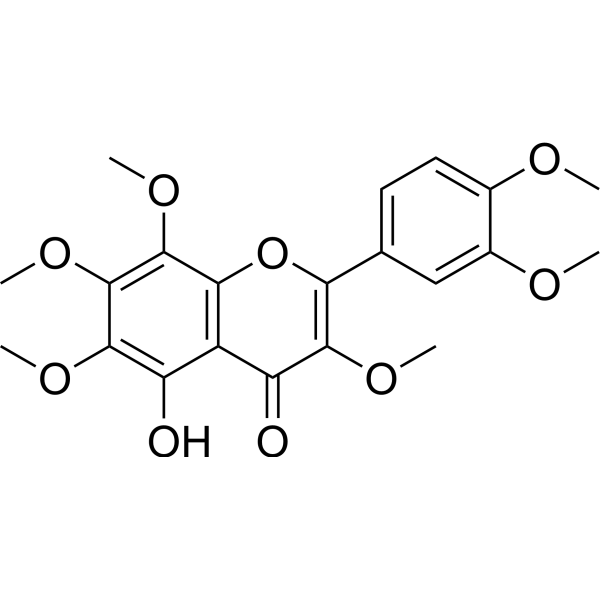
5-OH-HxMF
5-OH-HxMF is a hydroxylated polymethoxyflavone that has anti-inflammatory, anticancer, neurotrophic and neuroprotective activities.
연구목적의 판매만을 진행합니다. 환자를 대상으로 한 판매는 하지 않습니다.
- CAS No.: 1176-88-1
- 화학식: C21H22O9
- 분자량:418.39
-
보관:
Please store the product under the recommended conditions in the Certificate of Analysis.

To place orders, for customer services and technical support, please contact: MedChemExpress USA
Tel: 609-228-6898 E-mail: [email protected] [email protected]


-
 Biological Activity
-
Chemical Information
- Protocol
- 순도&문서
- References
-
 Help & FAQs




Biological Activity
제품 설명
Cellular Effect
|
Cell Line

|
Type | Value | Description | References |
|---|---|---|---|---|
| HL-60 | IC50 |
4.16 μM
Compound: IV, 5-demethylheptaMF
|
Antiproliferative activity against HL60 after 24 hrs
Antiproliferative activity against HL60 after 24 hrs
|
[PMID: 17391969] |
| KB | IC50 |
6 μg/mL
Compound: 5
|
Cytotoxicity against human KB cells
Cytotoxicity against human KB cells
|
[PMID: 7964782] |
| Monocyte | IC50 |
10 μM
Compound: 5-hydroxy-3,6,7,8,3',4'-hexamethoxyflavone
|
Inhibition of TNFalpha expression in LPS-stimulated human monocytes treated 30 mins before LPS challenge measured after 14 hrs by ELISA
Inhibition of TNFalpha expression in LPS-stimulated human monocytes treated 30 mins before LPS challenge measured after 14 hrs by ELISA
|
[PMID: 10096854] |
In Vitro
5-OH-HxMF (5-20 µM; 48 h) effectively induces PC12 neurite outgrowth accompanied with the expression of neuronal differentiation marker protein growth-associated protein-43(GAP-43)[1].
5-OH-HxMF (20 µM; 0-120 min) causes the enhancement of cyclic AMP response element binding protein (CREB) phosphorylation, c-fos gene expression and CRE-mediated transcription[1].
5-OH-HxMF significantly reduces the production of nitric oxide and prostaglandin E2 and downregulates inducible nitric oxide synthase (iNOS) and COX-2 expression in lipopolysaccharide (LPS)-stimulated RAW 264.7 cells. 5-OH-HxMF inhibits the release of pro-inflammatory cytokines, such as tumor necrosis factor-α and IL-1β, and decreases the transcriptional levels. 5-OH-HxMF significantly inhibits the LPS-induced NF-κB translocation from the cytosol to the nucleus, which is associated with the abrogation of inhibitory IκBα degradation and subsequent decreases in nuclear p65 levels[2].
5-OH-HxMF inhibits cell growth and induces apoptosis in human leukemia cells[3].
MedChemExpress (MCE) has not independently confirmed the accuracy of these methods. They are for reference only.
-
Cell Line:PC12 cells
-
Concentration:5 µM, 10 µM, 20 µM
-
Incubation Time:48 h
-
Result:Significantly evoked a dose-dependent increase on neurite outgrowth.
-
Cell Line:PC12 cells
-
Concentration:5 µM, 10 µM, 20 µM
-
Incubation Time:24 h
-
Result:Promoted GAP-43 expression in PC12 cells.
-
Cell Line:PC12 cells
-
Concentration:20 µM
-
Incubation Time:0 min, 30 min, 60 min or 120 min
-
Result:Stimulated phosphorylation of CREB in PC12 cells.
In Vivo
MedChemExpress (MCE) has not independently confirmed the accuracy of these methods. They are for reference only.
-
Animal Model:Female ICR mice treated with 12-O-tetradecanoylphorbol-13-acetate (TPA)[3].
-
Dosage:1 and 3 μmol in 200 μL acetone
-
Administration:Topically treated; twice a week; for 20 weeks
-
Result:Significantly inhibited TPA-induced mouse skin inflammation by decreasing inflammatory parameters.


Chemical Information
-
CAS No. 1176-88-1
-
분자량 418.39
-
화학식 C21H22O9
-
SMILES
O=C1C(OC)=C(OC2=C1C(O)=C(C(OC)=C2OC)OC)C3=CC=C(C(OC)=C3)OC
-
Structure Classification
-
Initial Source
-
선적
Room temperature in continental US; may vary elsewhere.
-
보관
Please store the product under the recommended conditions in the Certificate of Analysis.


순도&문서
References
[1]. Hui-Chi Lai, et al. Neurotrophic effect of citrus 5-hydroxy-3,6,7,8,3',4'-hexamethoxyflavone: promotion of neurite outgrowth via cAMP/PKA/CREB pathway in PC12 cells. PLoS One. 2011;6(11):e28280. [Content Brief]
[2]. Min Jeong Kim, et al. Anti-inflammatory effects of 5-hydroxy-3,6,7,8,3',4'-hexamethoxyflavone via NF-κB inactivation in lipopolysaccharide-stimulated RAW 264.7 macrophage. Mol Med Rep. 2014 Apr;9(4):1197-203. [Content Brief]
[3]. Ching-Shu Lai, et al. Inhibitory effect of citrus 5-hydroxy-3,6,7,8,3',4'-hexamethoxyflavone on 12-O-tetradecanoylphorbol 13-acetate-induced skin inflammation and tumor promotion in mice. Carcinogenesis. 2007 Dec;28(12):2581-8. [Content Brief]

Calculators
Concentration (start) × Volume (start) = Concentration (final) × Volume (final)


5-OH-HxMF Related Classifications
HY-121711 Related Classifications
 Powered by Bioz