



Dipotassium tetrachloroplatinate

Based on 1 Customer Validation
Dipotassium tetrachloroplatinate (Potassium tetrachloroplatinate (Ⅱ)) is an important reagent for the preparation of other platinum coordination complexes. Dipotassium tetrachloroplatinate acts as a radiosensitizer to enhance the killing effect of hyperthermia. Dipotassium tetrachloroplatinate serves as a catalyst. Dipotassium tetrachloroplatinate exhibits antitumor activity.
Para uso exclusivo en investigación. No vendemos a pacientes.
- Pureza : 98.0%
- No. CAS: 10025-99-7
- Fòrmula: K2PtCl4
- Peso molecular:415.09
-
Almacenamiento:
4°C, protect from light, stored under nitrogen
* In solvent : -80°C, 6 months; -20°C, 1 month (protect from light, stored under nitrogen)


To place orders, for customer services and technical support, please contact: MedChemExpress USA
Tel: 609-228-6898 E-mail: [email protected] [email protected]


-
 Actividad biológica
-
Chemical Information
- Protocolo
- Pureza y Documentación
- Referencias
-
 Help & FAQs


-

HY-W094581
Gold(III) chloride trihydrateReducing Agent -

HY-107754
Cesium chloridePotassium Channel Blocker -

HY-W073196
Gold(III) chloride hydrate (48% Au basis)Intermediate -

HY-W019894
Manganese chlorideContrast Agent -

HY-W002072
Palladium (II) acetateCatalyst -
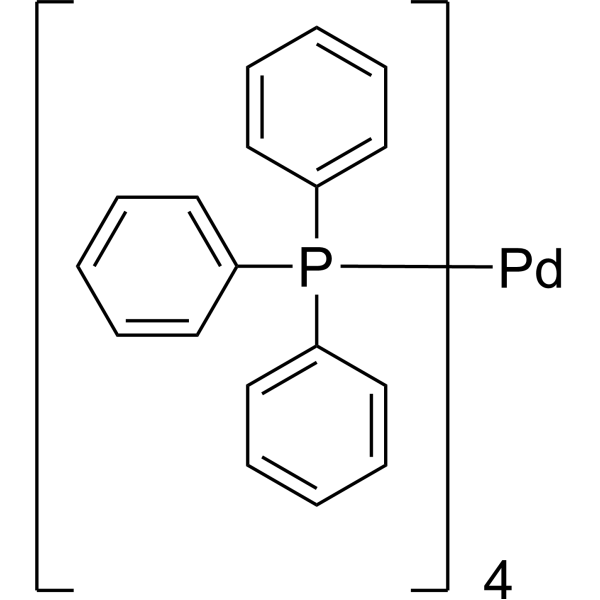
HY-Y1738
Tetrakis(triphenylphosphine)palladiumCatalyst -

HY-Y0344D
Sodium chloride, for cell cultureBiochemical Assay Reagent -

HY-N3025
Zinc sulfate heptahydrateDietary Supplement -

HY-W073196A
Gold(Ⅲ) chloride hydrate (50% Au basis)Intermediate -
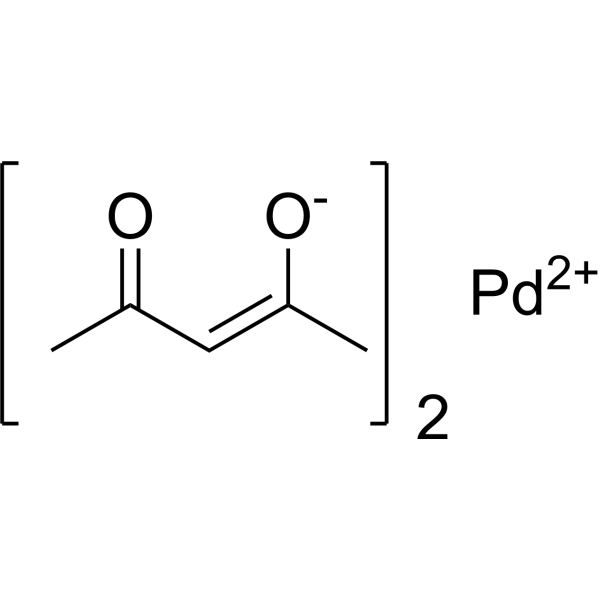
HY-W020952
Palladium(Ⅱ) acetylacetonateAnticancer Agent -

HY-W018864
Tris(dibenzylideneacetonyl)bis-palladiumCatalyst -

HY-Y0406E
Calcium chloride anhydrous, for cell cultureCalcium Chloride


Actividad biológica
Descripciòn
In Vitro


Chemical Information
-
No. CAS 10025-99-7
-
Appearance Solid
-
Peso molecular 415.09
-
Fòrmula K2PtCl4
-
Color Red to reddish brown
-
SMILES
[K][K].Cl[Pt](Cl)(Cl)Cl
-
Synonyms
Potassium tetrachloroplatinate(Ⅱ)
-
Envío
Room temperature in continental US; may vary elsewhere.
-
Almacenamiento
4°C, protect from light, stored under nitrogen
* In solvent : -80°C, 6 months; -20°C, 1 month (protect from light, stored under nitrogen)

Protocolo
-
Subcutaneous Cell-Line-Derived Xenograft
Subcutaneous cell-line-derived xenograft (CDX) models are established by implanting cultured human cancer cell lines into immunodeficient mice, where the injected cells form localized tumors that can be monitored in vivo as a measure of tumorigenic potential, growth kinetics, and treatment response. These models are widely used in oncology research because they allow reproducible tumor formation and enable comparative assessment of tumor growth between different cell lines or genetic manipulations in a controlled in vivo microenvironment. Subcutaneous implantation of cancer cells in immunodeficient mice is a standard approach for evaluating tumor growth behavior and therapeutic response across multiple cancer types, including prostate, esophageal, pancreatic, and colon cancer models.


Pureza y Documentación
-
Ficha de datos (267 KB)
-
SDS (806 KB)
- English - EN (806 KB)
- Français - FR (806 KB)
- Deutsch - DE (806 KB)
- Norwegian - NO (806 KB)
- Español - ES (806 KB)
- Swedish - SV (806 KB)
- Italian - IT (806 KB)
- Korean - KR (806 KB)
- Portuguese - PT (806 KB)
-
Instrucciones de manejo (2659 KB)
Referencias

Calculators
Concentration (start) × Volume (start) = Concentration (final) × Volume (final)


Dipotassium tetrachloroplatinate Related Classifications
HY-112030 Related Classifications
 Powered by Bioz