



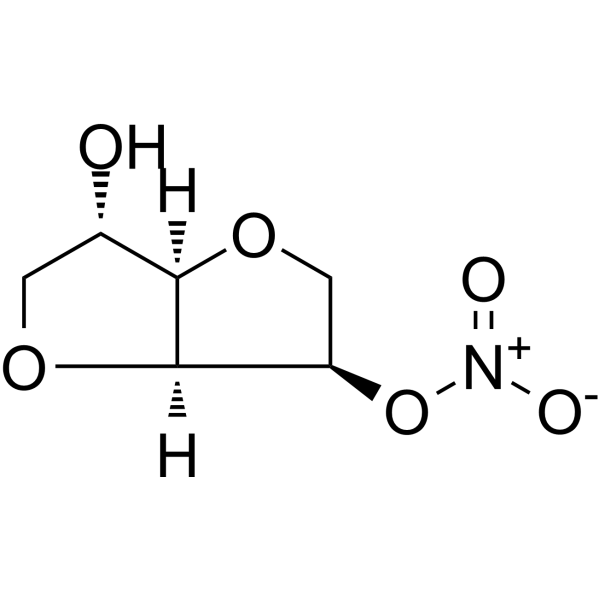
Isosorbide mononitrate
Based on 5 publication(s) in Google Scholar
Isosorbide mononitrate (Isosorbide-5-mononitrate) is an orally active nitric acid compound used for angina pectoris by dilating blood vessels and lowering blood pressure. Isosorbide mononitrate increases the viability and proliferation of HUVECs by decreasing Apoptosis and elevated the expressions of vedf, kdrl, pdgfr in zebrafish embryos. Isosorbide mononitrate is promising for research of heart failure and coronary heart disease.
For research use only. We do not sell to patients.
- Purity : 99.95%
- CAS No.: 16051-77-7
- Formula: C6H9NO6
- Molecular Weight:191.14
-
Storage:Powder -20°C, 3 years , 4°C, 2 years ; In solvent -80°C, 2 years , -20°C, 1 year

To place orders, for customer services and technical support, please contact: MedChemExpress USA
Tel: 609-228-6898 E-mail: [email protected] [email protected]


-
 Biological Activity
-
Chemical Information
-
Solvent & Solubility
- Protocols
- Purity & Documentation
- References
-
 Help & FAQs


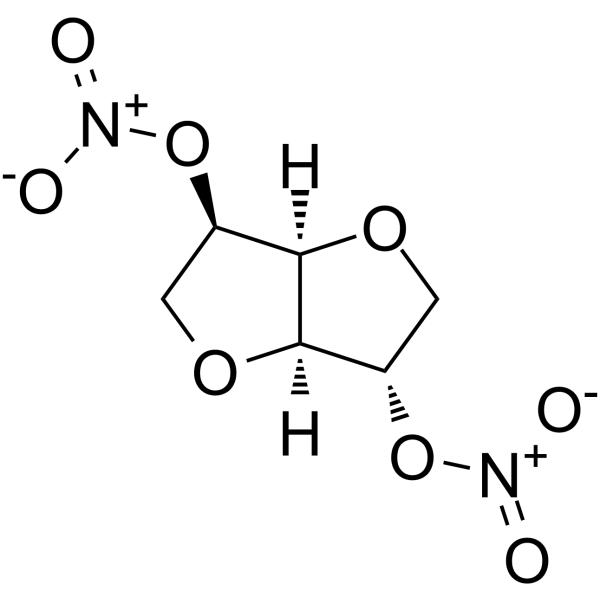

Publications Citing Use of MedChemExpress (MCE) Isosorbide mononitrate
More

Biological Activity
Description
In Vitro
Isosorbide mononitrate (0.5-50 μM, 5 min) inhibited angiogenesis in the chick chorioallantoic membrane dose-dependently[3].
Isosorbide mononitrate (4 ng/mL-5 μg/mL, 24 h) increases HUVECS viability and proliferation and decreases HUVECS apoptosis[4].
MedChemExpress (MCE) has not independently confirmed the accuracy of these methods. They are for reference only. Further protocols information, click here.
In Vivo
Isosorbide mononitrate (500 μg/mL, 24 h) up-regulates expressions of vegf-a, kdrl, and pdgfr in zebrafish embryos[4].
MedChemExpress (MCE) has not independently confirmed the accuracy of these methods. They are for reference only.
-
Animal Model:Mice implanted intramuscularly with LLC[3]
-
Dosage:200, 600 μg
-
Administration:i.p., daily for 14 days
-
Result:Decreased in the size of the primary tumour and a reduction in the number and size of metastatic foci in the mouse lungs.
Clinical Trial
| NCT Number | Sponsor | Condition | Start Date |
Phase

|
|---|---|---|---|---|
| NCT01329991 | Plexxikon| | 2011-05 | PHASE1 |


Chemical Information
-
CAS No. 16051-77-7
-
Appearance Solid
-
Molecular Weight 191.14
-
Formula C6H9NO6
-
Color White to off-white
-
SMILES
O=[N+]([O-])O[C@H]1[C@](OC[C@@H]2O)([H])[C@]2([H])OC1
-
Synonyms
Isosorbide-5-mononitrate
-
Shipping
Room temperature in continental US; may vary elsewhere.
-
Storage
Powder -20°C 3 years 4°C 2 years In solvent -80°C 2 years -20°C 1 year


Publications (5)
-
Journal Impact Factor
-
Most Recent
-
Nat Commun
Aortic disease in Marfan syndrome is caused by overactivation of sGC-PRKG signaling by NO. [Abstract]2021 May 11;12(1):2628. PMID: 33976159 -
J Exp Clin Cancer Res
2023 Jan 14;42(1):22. PMID: 36639681 -
Anal Chim Acta
A systematic study of the absorbance of the nitro functional group in the vacuum UV region. [Abstract]2021 Nov 15:1185:339042. PMID: 34711315 -
Anal Chim Acta
Thermal and spectroscopic analysis of nitrated compounds and their break-down products using gas chromatography/vacuum UV spectroscopy (GC/VUV). [Abstract]2021 Jan 25:1143:117-123. PMID: 33384109 -
Pharm Biol
Qing-Xin-Jie-Yu Granule attenuates myocardial infarction-induced inflammatory response by regulating the MK2/TTP pathway. [Abstract]2025 Dec;63(1):128-140. PMID: 39980416


Solvent & Solubility
In Vitro:
DMSO : 100 mg/mL (523.18 mM; Need ultrasonic; Hygroscopic DMSO has a significant impact on the solubility of product, please use newly opened DMSO)
H2O : 50 mg/mL (261.59 mM; Need ultrasonic)
Please refer to the solubility information to select the appropriate solvent. Once prepared, please aliquot and store the solution to prevent product inactivation from repeated freeze-thaw cycles.
Storage method and period of stock solution: -80°C, 2 years; -20°C, 1 year. When stored at -80°C, please use it within 2 years. When stored at -20°C, please use it within 1 year.
* Note: If you choose water as the stock solution, please dilute it to the working solution, then filter and sterilize it with a 0.22 μm filter before use.
Please refer to the solubility information to select the appropriate solvent. Once prepared, please aliquot and store the solution to prevent product inactivation from repeated freeze-thaw cycles.
Storage method and period of stock solution: -80°C, 2 years; -20°C, 1 year. When stored at -80°C, please use it within 2 years. When stored at -20°C, please use it within 1 year.
* Note: If you choose water as the stock solution, please dilute it to the working solution, then filter and sterilize it with a 0.22 μm filter before use.
Concentration (start) × Volume (start) = Concentration (final) × Volume (final)
In Vivo:
Select the appropriate dissolution method based on your experimental animal and administration route.
- For the following dissolution methods, please ensure to first prepare a clear stock solution using an In Vitro approach and then sequentially add co-solvents:
- To ensure reliable experimental results, the clarified stock solution can be appropriately stored based on storage conditions. As for the working solution for In Vivo experiments, it is recommended to prepare freshly and use it on the same day.
- The percentages shown for the solvents indicate their volumetric ratio in the final prepared solution. If precipitation or phase separation occurs during preparation, heat and/or sonication can be used to aid dissolution.
Add each solvent one by one: 10% DMSO 40% PEG300 5% Tween-80 45% Saline
Solubility: ≥ 2.5 mg/mL (13.08 mM); Clear solution
This protocol yields a clear solution of ≥ 2.5 mg/mL (saturation unknown).
Taking 1 mL working solution as an example, add 100 μL DMSO stock solution (25.0 mg/mL) to 400 μL PEG300, and mix evenly; then add 50 μL Tween-80 and mix evenly; then add 450 μL Saline to adjust the volume to 1 mL.
Preparation of Saline: Dissolve 0.9 g sodium chloride in ddH₂O and dilute to 100 mL to obtain a clear Saline solution.
Add each solvent one by one: 10% DMSO 90% (20% SBE-β-CD in Saline)
Solubility: ≥ 2.5 mg/mL (13.08 mM); Clear solution
This protocol yields a clear solution of ≥ 2.5 mg/mL (saturation unknown).
Taking 1 mL working solution as an example, add 100 μL DMSO stock solution (25.0 mg/mL) to 900 μL 20% SBE-β-CD in Saline, and mix evenly.
Preparation of 20% SBE-β-CD in Saline (4°C, storage for one week): 2 g SBE-β-CD powder is dissolved in 10 mL Saline, completely dissolve until clear.
For the following dissolution methods, please prepare the working solution directly:
It is recommended to prepare fresh solutions and use them promptly within a short period of time.
The percentages shown for the solvents indicate their volumetric ratio in the final prepared solution. If precipitation or phase separation occurs during preparation, heat and/or sonication can be used to aid dissolution.
Add each solvent one by one: PBS
Solubility: 33.33 mg/mL (174.37 mM); Clear solution; Need ultrasonic
In Vivo Dissolution Calculator
Please enter the basic information of animal experiments:
-
-
-
-
Recommended: Prepare an additional quantity of animals to account for potential losses during experiments.
Working solution concentration: 0.22 mg/mL
This product has good water solubility, please refer to the measured solubility data in water/PBS/Saline for details.

Protocols
-
Apoptosis
Apoptosis, also called programmed cell death, is generally characterized by distinct morphological characteristics.
-
TUNEL staining for apoptotic DNA fragmentation
TUNEL staining detects DNA strand breaks by using terminal deoxynucleotidyl transferase to add labeled nucleotides to exposed 3′-OH DNA termini, generating either microscopic staining in fixed cells or tissue sections, or fluorescence/cytometric signal in cell suspensions. TUNEL positivity reflects DNA fragmentation but should not be interpreted alone as definitive apoptosis, because TUNEL can also label necrotic, autolytic, mechanically damaged, or DNA-repair-associated DNA breaks.
-
Annexin V plus membrane-impermeant dye apoptosis staining
Annexin V-based apoptosis assays rely on the detection of phosphatidylserine (PS) externalization from the inner leaflet of the plasma membrane to the outer leaflet, an early biochemical hallmark of apoptosis. Fluorescently labeled Annexin V binds PS in a calcium-dependent manner, enabling identification of early apoptotic cells by flow cytometry or fluorescence microscopy. When combined with a membrane-impermeant DNA-binding dye (e. g. , propidium iodide), this approach allows discrimination between viable (Annexin V−/dye−), early apoptotic (Annexin V+/dye−), and late apoptotic or necrotic (Annexin V+/dye+) cell populations by assessing membrane integrity and PS exposure.
-
Apoptosis Solutions
Apoptosis is a regulated, generally non-lytic cell-death pathway that removes unwanted, damaged, infected, or abnormal cells through coordinated morphological changes, caspase activation, DNA fragmentation, and membrane remodeling. The intrinsic apoptosis pathway is controlled mainly by mitochondrial outer membrane permeabilization, BCL-2 family proteins, cytochrome c release, apoptosome formation, caspase-9 activation, and downstream executioner caspase-3/7 activation. The extrinsic apoptosis pathway is initiated by death receptors such as Fas, TNFR, and TRAIL receptors, which recruit adaptor proteins and activate caspase-8 before engaging executioner caspases or mitochondrial amplification through BID cleavage. Apoptosis is linked to many phenotypes, including cancer cell killing, tissue homeostasis, immune regulation, neurodegeneration, infection response, and treatment-induced cytotoxicity; unresolved questions include how apoptosis interacts with necroptosis, pyroptosis, ferroptos
-
Research Protocol for Cardiovascular Diseases
Cardiovascular disease can be modeled as maladaptive cardiac remodeling, where ischemic injury or pressure overload activates inflammatory signaling, fibroblast activation, extracellular-matrix deposition, cardiomyocyte hypertrophy, vascular remodeling, and progressive ventricular dysfunction. The TGF-β/SMAD axis is a central profibrotic pathway after myocardial injury and pressure overload, while innate immune and cytokine pathways regulate leukocyte recruitment, scar formation, and adverse remodeling. Key unresolved questions include which inflammatory signals are reparative versus harmful, when fibrosis is protective versus maladaptive, and whether pathway inhibition improves function without weakening necessary infarct healing or compensatory remodeling.
-
Cell Viability Determination by MTT Colorimetric Assay
The following protocol uses the MTT colorimetric assay as a classic literature-established method for assessing cell viability/metabolic activity in cultured mammalian cells. MTT[3-(4,5-dimethylthiazol-2-yl)-2,5-diphenyltetrazolium bromide] is reduced by metabolically active cells to a colored formazan product; the amount of formazan is quantified spectrophotometrically and provides an indirect measure of metabolically active viable cells. Importantly, MTT reduction reflects cellular oxidoreductase/metabolic activity rather than an absolute direct count of living cells, so changes in cellular metabolism can alter the signal independently of cell number.


Purity & Documentation
-
Data Sheet (298 KB)
-
SDS (630 KB)
- English - EN (630 KB)
- Français - FR (630 KB)
- Deutsch - DE (630 KB)
- Norwegian - NO (630 KB)
- Español - ES (630 KB)
- Swedish - SV (630 KB)
- Italian - IT (630 KB)
- Korean - KR (630 KB)
- Portuguese - PT (630 KB)
-
Handling Instructions (2659 KB)
References
[1]. Redfield MM, et al. Isosorbide Mononitrate in Heart Failure with Preserved Ejection Fraction. N Engl J Med. 2015 Dec 10;373(24):2314-24. [Content Brief]
[2]. Abshagen UW. Pharmacokinetics of isosorbide mononitrate. Am J Cardiol. 1992 Nov 27;70(17):61G-66G. [Content Brief]
[3]. Pipili-Synetos E, et al. Inhibition of angiogenesis, tumour growth and metastasis by the NO-releasing vasodilators, isosorbide mononitrate and dinitrate. Br J Pharmacol. 1995 Sep;116(2):1829-34. [Content Brief]
[4]. Lv H, et al. Isosorbide mononitrate promotes angiogenesis in embryonic development of zebrafish. Genet Mol Biol. 2020 Jul 24;43(3):20190233. [Content Brief]


Complete Stock Solution Preparation Table
Please refer to the solubility information to select the appropriate solvent. Once prepared, please aliquot and store the solution to prevent product inactivation from repeated freeze-thaw cycles.
Storage method and period of stock solution: -80°C, 2 years; -20°C, 1 year. When stored at -80°C, please use it within 2 years. When stored at -20°C, please use it within 1 year.
| Optional Solvent | Concentration Solvent Mass | 1 mg | 5 mg | 10 mg | 25 mg |
|---|---|---|---|---|---|
| H2O / DMSO | 1 mM | 5.2318 mL | 26.1588 mL | 52.3177 mL | 130.7942 mL |
| 5 mM | 1.0464 mL | 5.2318 mL | 10.4635 mL | 26.1588 mL | |
| 10 mM | 0.5232 mL | 2.6159 mL | 5.2318 mL | 13.0794 mL | |
| 15 mM | 0.3488 mL | 1.7439 mL | 3.4878 mL | 8.7196 mL | |
| 20 mM | 0.2616 mL | 1.3079 mL | 2.6159 mL | 6.5397 mL | |
| 25 mM | 0.2093 mL | 1.0464 mL | 2.0927 mL | 5.2318 mL | |
| 30 mM | 0.1744 mL | 0.8720 mL | 1.7439 mL | 4.3598 mL | |
| 40 mM | 0.1308 mL | 0.6540 mL | 1.3079 mL | 3.2699 mL | |
| 50 mM | 0.1046 mL | 0.5232 mL | 1.0464 mL | 2.6159 mL | |
| 60 mM | 0.0872 mL | 0.4360 mL | 0.8720 mL | 2.1799 mL | |
| 80 mM | 0.0654 mL | 0.3270 mL | 0.6540 mL | 1.6349 mL | |
| 100 mM | 0.0523 mL | 0.2616 mL | 0.5232 mL | 1.3079 mL |
* Note: If you choose water as the stock solution, please dilute it to the working solution, then filter and sterilize it with a 0.22 μm filter before use.


Isosorbide mononitrate Related Classifications
HY-B0642 Related Classifications
 Powered by Bioz