



Lysozyme from chicken egg white
Based on 11 publication(s) in Google Scholar
Lysozyme from chicken egg white is a bactericidal enzyme, and it lyses gram-positive bacteria. Lysozyme from chicken egg white can also be used for the research of HIV infection and pulmonary emphysema.
For research use only. We do not sell to patients.
- CAS No.: 12650-88-3
-
Storage:
Please store the product under the recommended conditions in the Certificate of Analysis.

To place orders, for customer services and technical support, please contact: MedChemExpress USA
Tel: 609-228-6898 E-mail: [email protected] [email protected]


-
 Biological Activity
-
Chemical Information
-
Solvent & Solubility
- Protocols
- Purity & Documentation
- References
-
 Help & FAQs


-
HY-15921
IPTGAllolactose Mimic -
HY-108882
DNase I, Bovine pancreasEnzyme -
HY-K0011
Protease Inhibitor Cocktail, mini-Tablet (EDTA-Free) -
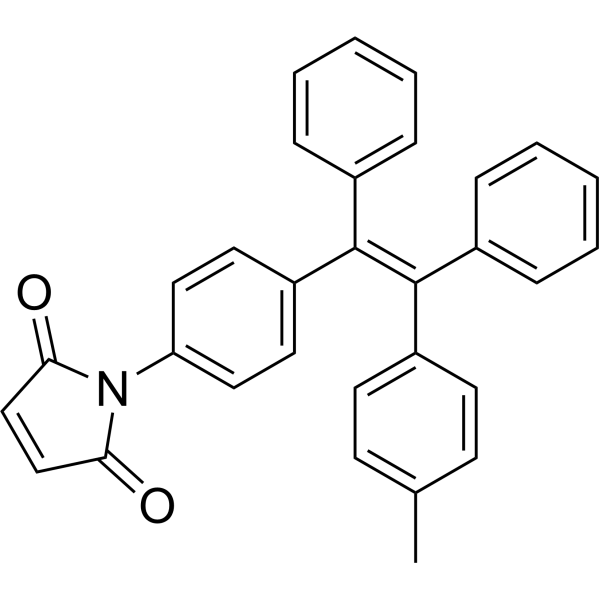
HY-143218
TPE-MIFluorigenic Dye -
HY-K0010
Protease Inhibitor Cocktail (EDTA-Free, 100× in DMSO) -
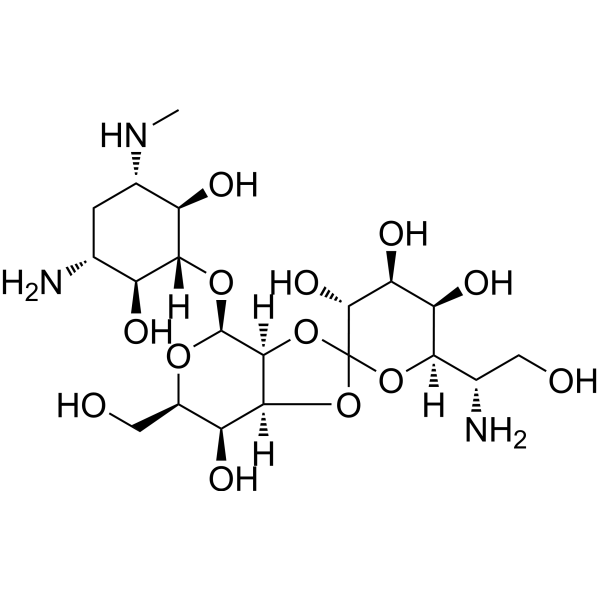
HY-B0490
Hygromycin BAntibiotic -
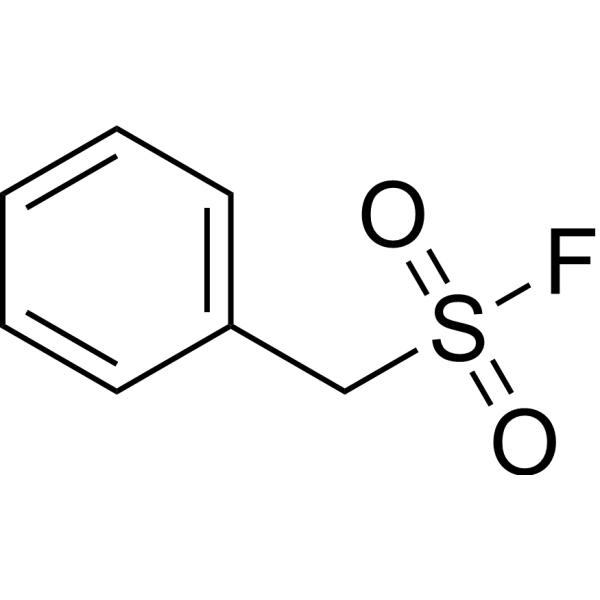
HY-B0496
PMSFCathepsin Inhibitor -
HY-K1004
SYBR Green I Nucleic Acid Gel Stain -
HY-15531
VenetoclaxBCL-2 Inhibitor -
HY-10431
SB-431542TGF-β Receptor Kinase Inhibitor -
HY-100579
Ferrostatin-1Ferroptosis Inhibitor -
HY-10071
Y-27632ROCK Inhibitor
Publications Citing Use of MedChemExpress (MCE) Lysozyme from chicken egg white
More- Cancer Cell. 2025 Jul 17:S1535-6108(25)00273-9. [Abstract]
- Pharmaceutics. 2026 Jun 11;18(6):719. [Abstract]
- Pharmaceutics. 2026 Feb;18(2):275.
- Pharmaceutics. 2023 Mar 20;15(3):995. [Abstract]
- Appl Surf Sci. 2020, 145332.
- J Drug Deliv Sci Technol. 21 July 2021, 102714.
- iScience. 2024 Mar 27;27(5):109596. [Abstract]
- iScience. 2022 Oct 9;25(11):105311. [Abstract]
- STAR Protoc. 2023 Jun 21;4(3):102358. [Abstract]
- ArXiv. 2025 Oct 3.
- Universite Grenoble Alpes. 2025 Sep 30.
 Customer Validation & Images

-
Bio/Physico-chemical Assay
-
Bio/Physico-chemical Assay
-
Bio/Physico-chemical Assay
-
Bio/Physico-chemical Assay
-
Bio/Physico-chemical Assay


Biological Activity
Description
IC50 & Target
Bacteria[1]
In Vitro
Lysozyme is an ubiquitous enzyme. The hen egg is the most abundant source of Lysozyme, which constitutes approximately 3.4% of the albumen proteins. Lysozyme is a natural antimicrobial that hydrolyzes the β(1-4) glycosidic linkage between N-acetylmuramic acid and N-acetylglucosamine found in the peptidoglycan layer of the bacterial cell wall and causing cell lysis. The bactericidal effect of Lysozyme is primarily limited to gram-positive bacteria, including pathogens such as Listeria monocytogenes and certain Clostridium species as well as some spoilage organisms, including thermophilic spore-forming bacteria and certain yeasts. The gram-negative bacteria are more resistant to Lysozyme action because of their complex cell wall structure[1].
Lysozyme (1 mg/mL) impairs the ability of hyaluronan (HA) to prevent elastase injury to elastic fibers[3].
MedChemExpress (MCE) has not independently confirmed the accuracy of these methods. They are for reference only. Further protocols information, click here.
In Vivo


Chemical Information
-
CAS No. 12650-88-3
-
Appearance Solid
-
Color White to off-white
-
SMILES
[Lysozyme(chicken egg white)]
-
Structure Classification
-
Initial Source
chicken egg white
-
Shipping
Room temperature in continental US; may vary elsewhere.
-
Storage
Please store the product under the recommended conditions in the Certificate of Analysis.


Publications (11)
-
Journal Impact Factor
-
Most Recent
-
Cancer Cell
2025 Jul 17:S1535-6108(25)00273-9. PMID: 40712567 -
Pharmaceutics
Development and Optimization of Ionic Strength-Responsive Lipid-Polymer Hybrid Nanoparticles for Buccal Protein Delivery. [Abstract]2026 Jun 11;18(6):719. PMID: 42357335 -
-
Pharmaceutics
Quality by Design-Based Development of Solid Self-Emulsifying Drug Delivery System (SEDDS) as a Potential Carrier for Oral Delivery of Lysozyme. [Abstract]2023 Mar 20;15(3):995. PMID: 36986855 -
-
-
iScience
Radiotolerance of N-cycle bacteria and their transcriptomic response to low-dose space-analogue ionizing irradiation. [Abstract]2024 Mar 27;27(5):109596. PMID: 38638570 -
iScience
Optimization of RNA extraction for bacterial whole transcriptome studies of low-biomass samples. [Abstract]2022 Oct 9;25(11):105311. PMID: 36345334
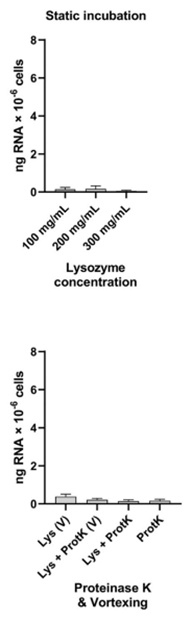
Lysozyme from chicken egg white purchased from MedChemExpress. Usage Cited in: iScience. 2022 Oct 9;25(11):105311. [Abstract]
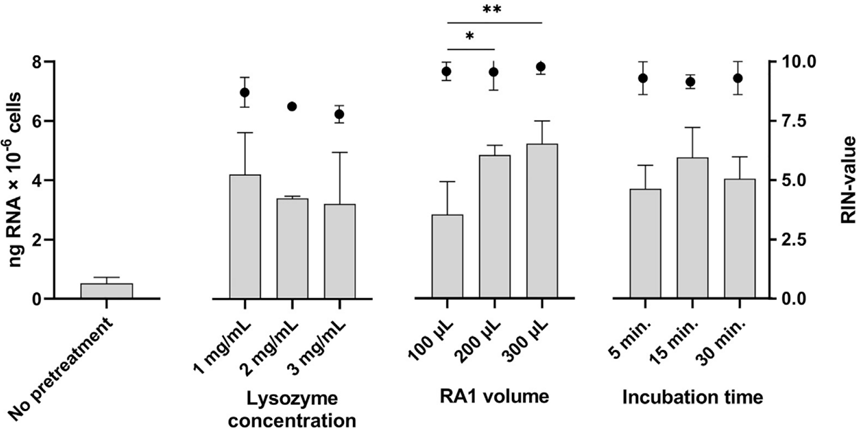
Amount of RNA in ng per 106 cells from 5 mL N. europaea cultures extracted with NucleoSpin RNA XS kit preceded by enzymatic digestion with lysozyme (1-3 mg/mL) solution. The effect on RNA yield and quality of different lysozyme concentrations, different volumes of RA1 buffer after lysozyme digestion and different lysozyme incubation times are shown.
Lysozyme from chicken egg white purchased from MedChemExpress. Usage Cited in: iScience. 2022 Oct 9;25(11):105311. [Abstract]
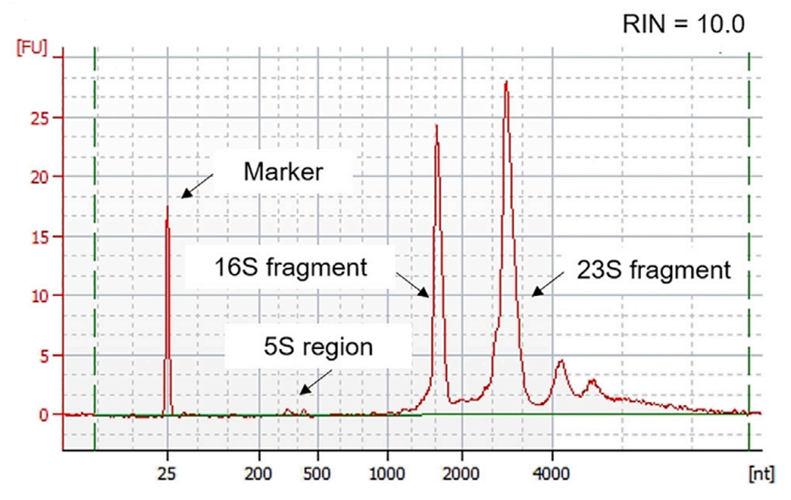
Examples of electropherograms generated from RNA samples with the Agilent BioAnalyzer 2100 represents an RNA sample extracted with the NS XS kit after pretreatment with a 1 mg/mL lysozyme solution and 15 min of incubation at 37°C with a RIN of 10.0.
Lysozyme from chicken egg white purchased from MedChemExpress. Usage Cited in: iScience. 2022 Oct 9;25(11):105311. [Abstract]
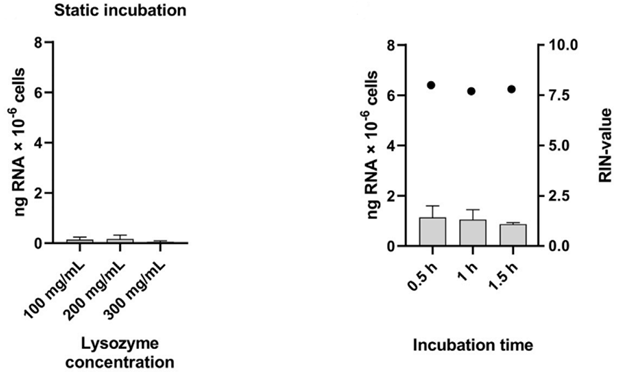
The protocol on N. winogradskyi cultures using higher lysozyme concentrations, with different incubation times with 1 mg/mL lysozyme solution.
Lysozyme from chicken egg white purchased from MedChemExpress. Usage Cited in: iScience. 2022 Oct 9;25(11):105311. [Abstract]
The protocol on N. winogradskyi cultures using higher lysozyme concentrations, with the addition of Proteinase K (ProtK) to a 15 mg/mL lysozyme solution and/or vortexing (indicated by V).
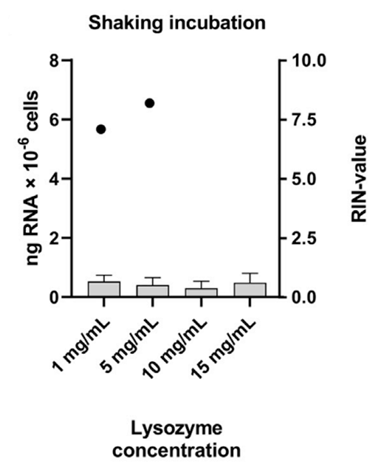
Lysozyme from chicken egg white purchased from MedChemExpress. Usage Cited in: iScience. 2022 Oct 9;25(11):105311. [Abstract]
The protocol on N. winogradskyi cultures using various lysozyme concentrations during shaking incubation at 1,400 rpm for 15 min.
-
STAR Protoc
RNA extraction protocol from low-biomass bacterial Nitrosomonas europaea and Nitrobacter winogradskyi cultures for whole transcriptome studies. [Abstract]2023 Jun 21;4(3):102358. PMID: 37347668 -
-


Solvent & Solubility
In Vitro:
H2O : 10 mg/mL (Need ultrasonic and warming)

Protocols
-
Research Protocol for Infectious Diseases
Infectious-disease experiments test how pathogens interact with host barriers, innate immune receptors, inflammatory signaling, pathogen replication, and tissue injury; pattern-recognition receptors such as TLRs, RIG-I-like receptors, NOD-like receptors, and inflammasomes detect microbial molecules and activate NF-κB, interferon, and cytokine responses. The central hypothesis is that infection severity reflects the balance between pathogen burden and host response: protective inflammation restricts pathogen growth, whereas excessive or mislocalized inflammation contributes to tissue damage and disease phenotype. Unresolved questions include which host pathways are protective versus pathogenic, why some infection models fail to translate to human disease, and which combined readouts best predict clinically relevant infection outcomes.
-
Gram Staining of Tissue Sections
Gram staining of tissue sections is a histochemical technique used to differentiate Gram-positive and Gram-negative bacteria within histological specimens based on differences in bacterial cell wall structure and dye retention, adapted from classical bacteriological Gram staining into tissue-compatible “histological Gram stain” variants. In tissue applications, modifications of the Brown-Hopps and Brown-Brenn methods are commonly used to improve differentiation of microorganisms embedded within host connective tissue and to reduce overstaining or loss of Gram-negative signal, which are known limitations of earlier approaches. The principle relies on crystal violet-iodine complex retention in Gram-positive organisms and subsequent decolorization and counterstaining steps that allow contrast visualization of Gram-negative organisms against tissue background.


Purity & Documentation
-
Data Sheet (271 KB)
-
SDS (419 KB)
- English - EN (419 KB)
- Français - FR (419 KB)
- Deutsch - DE (419 KB)
- Norwegian - NO (419 KB)
- Español - ES (419 KB)
- Swedish - SV (419 KB)
- Italian - IT (419 KB)
- Korean - KR (419 KB)
- Portuguese - PT (419 KB)
-
Handling Instructions (2659 KB)
References
[1]. Banerjee P, et al. Influence of carbon dioxide on the activity of chicken egg white lysozyme. Poult Sci. 2011 Apr;90(4):889-95. [Content Brief]
[2]. Jing T, et al. Magnetic molecularly imprinted nanoparticles for recognition of lysozyme. Biosens Bioelectron. 2010 Oct 15;26(2):301-6. [Content Brief]
[3]. Cantor JO, et al. The effect of lysozyme on elastase-mediated injury. Exp Biol Med (Maywood). 2002 Feb;227(2):108-13. [Content Brief]

Calculators
Concentration (start) × Volume (start) = Concentration (final) × Volume (final)


Lysozyme from chicken egg white Related Classifications
HY-B2237 Related Classifications
 Powered by Bioz