



Cancer Targeted Therapy
Cancer targeted therapy is the foundation of precision medicine; it uses drugs or other substances to target specific genes and proteins that control cancer cells’ growth, division and spreading. Compared to traditional chemotherapy drugs, targeted-drugs can specifically act on cancer cells with high efficacy without damaging normal cells. Drugs used in cancer targeted therapy mainly includes small molecules and macromolecules (e.g., monoclonal antibodies), which can target cancer cells and constituents in the tumor microenvironment to activate the immune system. Anti-angiogenesis drugs, such as those targeting vascular endothelial growth factor (VEGF), epidermal growth factor receptor (EGFR), transforming growth factor (TGF)-α, TGF-β, Tumor necrosis factor (TNF)-α, and platelet-derived endothelial growth factor (PDGFR) inhibit the proliferation and metastasis of cancer cells. In recent years, the proportion of antibody drugs in cancer treatment has gradually become prominent. Antibody-drug conjugates (ADCs) are a new type of targeted drugs that are composed of monoclonal antibody, cytotoxic drug and linker. ADCs can deliver drugs to tumor cells and minimize the toxicity to normal tissues. Proteolysis-targeting chimera (PROTAC) is a useful technology for targeted protein degradation. PROTAC exploits the ubiquitin-proteasome system and forms a ternary complex with a hijacked E3 ubiquitin ligase and target protein, leading to polyubiquitination and degradation of the target protein.
Targeted therapy is a useful strategy in treatment of cancer either alone or in combination with standard chemotherapy. At present, targeted therapy has proved significant clinical success in the treatment of many types of cancer, including breast cancer, colorectal cancer, leukemia, ovarian cancer and lung cancer.
-
BTK ligand-17
 0 ImagesCat. No.: HY-175788
BTK ligand-17 (The Target Protein Ligand Moiety of Catadegbrutinib) is a BTK ligand. BTK can be used as Ligands for Target Protein for PROTAC to develop and design degradative agents for PROTAC BTKs, such as Catadegbrutinib (HY-160141). BTK ligand-17 can also be used in cancer research.
-
hsa-miR-4724-5p inhibitor
 0 ImagesCat. No.: HY-RI01320
hsa-miR-4724-5p inhibitors are chemically-modified oligonucleotides that hybridize with mature miRNAs. The miRNA inhibitors have full-length nucleotide 2'-methoxy modification. The miRNA inhibitors strongly compete with mature miRNAs to prevent the complementary pairing of miRNAs and their target genes, thereby inhibiting miRNAs from functioning.
-
hsa-miR-6506-5p antagomir
 0 ImagesCat. No.: HY-RI01940A
hsa-miR-6506-5p antagomirs are chemically-modified oligonucleotides that hybridize with mature miRNAs. The miRNA antagomirs have 2 phosphorothioates at the 5' end, 4 phosphorothioates at the 3' end, 1 cholesterol group at the 3' end, and full-length nucleotide 2'-methoxy modification. The miRNA antagomirs strongly compete with mature miRNAs to prevent the complementary pairing of miRNAs and their target genes, thereby inhibiting miRNAs from functioning. Stability of miRNA antagomirs appears to be significantly higher than miRNA inhibitors, they exhibits enhanced cellular uptake, stability and regulatory activity in vivo.
-
MC-PEG2-C2-NHS ester
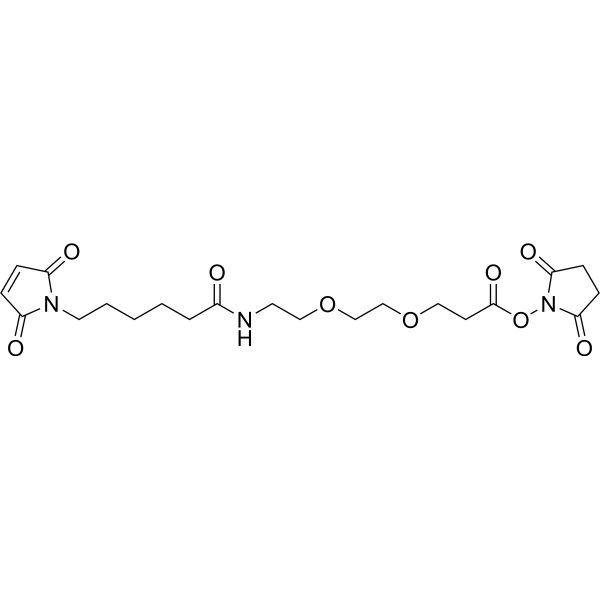 0 ImagesCat. No.: HY-126510CAS No.: 1263044-56-9
MC-PEG2-C2- NHS ester is a nonclaevable 2-unit PEG linker used in the synthesis of antibody-drug conjugates (ADCs).

-
CK2-IN-17
 0 ImagesCat. No.: HY-184823CAS No.: 1417634-25-3
CK2-IN-17 is a protein kinase CK2 inhibitor with an IC50 of 9.5 μM against human targets. CK2-IN-17 regulates the activity of protein kinase CK2 by interacting with its ATP-binding site. CK2-IN-17 can be used in studies related to protein kinase CK2-mediated pathways, such as tumors.
-
CDK9 ligand 3
 0 ImagesCat. No.: HY-170979CAS No.: 3039540-24-1
CDK9 ligand 3 is the ligand for CDK9 and can be used for synthesis of PROTAC degrader PROTAC CDK9 degrader-11 (HY-170978).
-
hsa-miR-7845-5p inhibitor
 0 ImagesCat. No.: HY-RI02425
hsa-miR-7845-5p inhibitors are chemically-modified oligonucleotides that hybridize with mature miRNAs. The miRNA inhibitors have full-length nucleotide 2'-methoxy modification. The miRNA inhibitors strongly compete with mature miRNAs to prevent the complementary pairing of miRNAs and their target genes, thereby inhibiting miRNAs from functioning.
-
mmu-miR-344d-3-5p inhibitor
 0 ImagesCat. No.: HY-RI03047
mmu-miR-344d-3-5p inhibitors are chemically-modified oligonucleotides that hybridize with mature miRNAs. The miRNA inhibitors have full-length nucleotide 2'-methoxy modification. The miRNA inhibitors strongly compete with mature miRNAs to prevent the complementary pairing of miRNAs and their target genes, thereby inhibiting miRNAs from functioning.
-
mmu-miR-6972-3p inhibitor
 0 ImagesCat. No.: HY-RI03672
mmu-miR-6972-3p inhibitors are chemically-modified oligonucleotides that hybridize with mature miRNAs. The miRNA inhibitors have full-length nucleotide 2'-methoxy modification. The miRNA inhibitors strongly compete with mature miRNAs to prevent the complementary pairing of miRNAs and their target genes, thereby inhibiting miRNAs from functioning.
-
Tubulin/MMP-IN-1
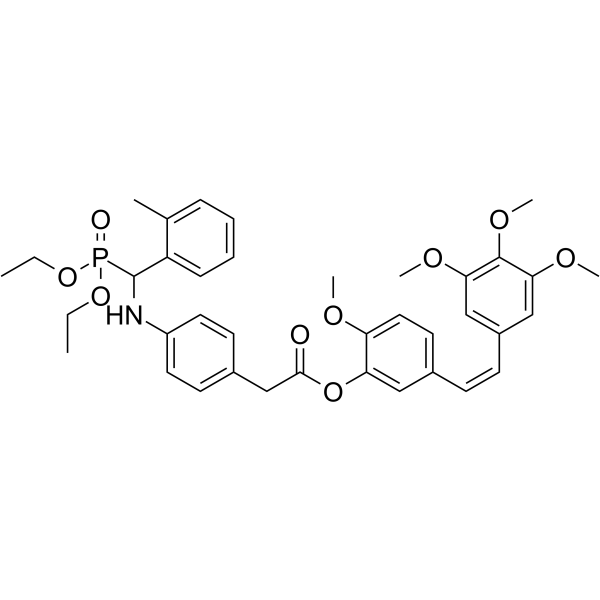 0 ImagesCat. No.: HY-146006CAS No.: 3034896-75-5
Tubulin/MMP-IN-1 (compound 15g) is a potent inhibitor of tubulin and MMP. Tubulin/MMP-IN-1 has the potential for the research of cancer diseases. Tubulin/MMP-IN-1 suppresses tubulin polymerization, induces cell cycle arrest at the G2/M phase, leads to reactive oxidative stress (ROS) generation of HepG2 cells, and results in apoptosis by the mitochondrial-dependent apoptotic pathway.
-
PROTAC AR-NTD degrader 1
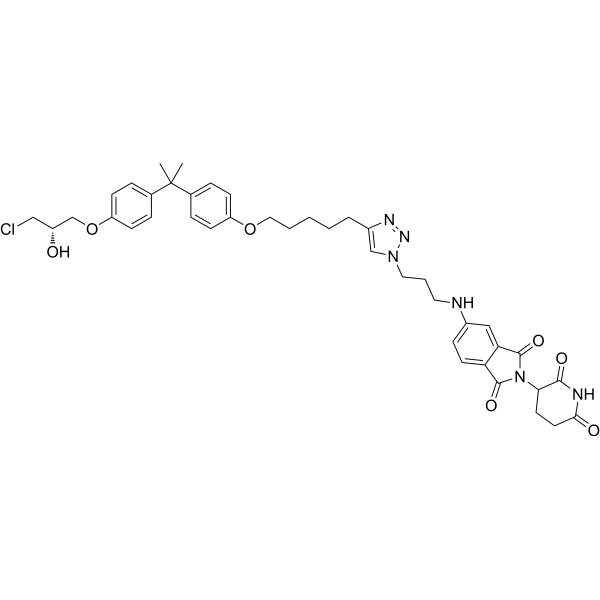 0 ImagesCat. No.: HY-149434CAS No.: 3032601-92-3
PROTAC AR-NTD degrader 1 is a PROTAC degrader that recruits cereblon and targets the N-terminal domain of the androgen receptor (AR-NTD), thereby inducing the degradation of AR-FL and AR-V7 proteins. PROTAC AR-NTD degrader 1 can be used for studies related to androgen receptor degradation and prostate cancer.
-
BET-IN-18
 0 ImagesCat. No.: HY-155891CAS No.: 874594-37-3
BET-IN-18 (Compound 3) is a pan-BET bromodomain small-molecule inhibitor, with Ki values of 0.69 μM and 0.37 μM, and Kd values of 1.6 μM and 8.4 μM against BrdT (1) and Brd4 (1) bromodomains, respectively. BET-IN-18 potently and competitively inhibits the binding of the known BET inhibitor (+)-JQ1 (HY-13030) to Brd4 (1) and BrdT (1), with IC50 values of 1.0 μM and 2.3 μM, respectively. BET-IN-18 also competitively inhibits the binding of acetylated histone substrates to Brd4 (1) (IC50 = 0.90 μM). BET-IN-18 can be used in the research of multiple myeloma.
-
Lumichrome (Standard)
 0 Images
Lumichrome (Standard) is the analytical standard of Lumichrome. This product is intended for research and analytical applications. Lumichrome, a photodegradation product of Riboflavin, is an endogenous compound in humans. Lumichrome inhibits human lung cancer cell growth and induces apoptosis via a p53-dependent mechanism. Lumichrom is the inhibitor for AKT/β-catenin signaling pathway. Lumichrom is the inhibitor for AKT/β-catenin signaling pathway.

-
hsa-miR-1306-5p antagomir
 0 ImagesCat. No.: HY-RI00238A
hsa-miR-1306-5p antagomirs are chemically-modified oligonucleotides that hybridize with mature miRNAs. The miRNA antagomirs have 2 phosphorothioates at the 5' end, 4 phosphorothioates at the 3' end, 1 cholesterol group at the 3' end, and full-length nucleotide 2'-methoxy modification. The miRNA antagomirs strongly compete with mature miRNAs to prevent the complementary pairing of miRNAs and their target genes, thereby inhibiting miRNAs from functioning. Stability of miRNA antagomirs appears to be significantly higher than miRNA inhibitors, they exhibits enhanced cellular uptake, stability and regulatory activity in vivo.
-
hsa-miR-381-5p antagomir
 0 ImagesCat. No.: HY-RI00859A
hsa-miR-381-5p antagomirs are chemically-modified oligonucleotides that hybridize with mature miRNAs. The miRNA antagomirs have 2 phosphorothioates at the 5' end, 4 phosphorothioates at the 3' end, 1 cholesterol group at the 3' end, and full-length nucleotide 2'-methoxy modification. The miRNA antagomirs strongly compete with mature miRNAs to prevent the complementary pairing of miRNAs and their target genes, thereby inhibiting miRNAs from functioning. Stability of miRNA antagomirs appears to be significantly higher than miRNA inhibitors, they exhibits enhanced cellular uptake, stability and regulatory activity in vivo.
-
Mal-PEG8-Val-Ala-Exatecan
 0 Images
Mal-PEG8-Val-Ala-Exatecan (Compound 1033) is a Drug-Linker Conjugates for ADC, which is composed of Exatecan (HY-13631) and a linker. Mal-PEG8-Val-Ala-Exatecan can be used for ADC synthesis.
-
hsa-miR-4999-5p inhibitor
 0 ImagesCat. No.: HY-RI01480
hsa-miR-4999-5p inhibitors are chemically-modified oligonucleotides that hybridize with mature miRNAs. The miRNA inhibitors have full-length nucleotide 2'-methoxy modification. The miRNA inhibitors strongly compete with mature miRNAs to prevent the complementary pairing of miRNAs and their target genes, thereby inhibiting miRNAs from functioning.



