



Cancer Targeted Therapy
Cancer targeted therapy is the foundation of precision medicine; it uses drugs or other substances to target specific genes and proteins that control cancer cells’ growth, division and spreading. Compared to traditional chemotherapy drugs, targeted-drugs can specifically act on cancer cells with high efficacy without damaging normal cells. Drugs used in cancer targeted therapy mainly includes small molecules and macromolecules (e.g., monoclonal antibodies), which can target cancer cells and constituents in the tumor microenvironment to activate the immune system. Anti-angiogenesis drugs, such as those targeting vascular endothelial growth factor (VEGF), epidermal growth factor receptor (EGFR), transforming growth factor (TGF)-α, TGF-β, Tumor necrosis factor (TNF)-α, and platelet-derived endothelial growth factor (PDGFR) inhibit the proliferation and metastasis of cancer cells. In recent years, the proportion of antibody drugs in cancer treatment has gradually become prominent. Antibody-drug conjugates (ADCs) are a new type of targeted drugs that are composed of monoclonal antibody, cytotoxic drug and linker. ADCs can deliver drugs to tumor cells and minimize the toxicity to normal tissues. Proteolysis-targeting chimera (PROTAC) is a useful technology for targeted protein degradation. PROTAC exploits the ubiquitin-proteasome system and forms a ternary complex with a hijacked E3 ubiquitin ligase and target protein, leading to polyubiquitination and degradation of the target protein.
Targeted therapy is a useful strategy in treatment of cancer either alone or in combination with standard chemotherapy. At present, targeted therapy has proved significant clinical success in the treatment of many types of cancer, including breast cancer, colorectal cancer, leukemia, ovarian cancer and lung cancer.
-
IKKβ-IN-6
 0 ImagesCat. No.: HY-181836CAS No.: 3117527-91-7
IKKβ-IN-6 is an antitumor agent. IKKβ-IN-6 inhibits IKKβ (IC50: 18.24 μM), thereby suppressing the phosphorylation of p65 and IκBα, blocking the nuclear translocation of p65, and subsequently regulating genes controlled by NF-κB. IKKβ-IN-6 also targets topoisomerase I (Topo I), induces DNA damage, ROS accumulation, loss of mitochondrial membrane potential, and S-phase arrest. IKKβ-IN-6 is applicable to related research on colorectal cancer.
-
TGF-βR1/VEGFR2-IN-1
 0 ImagesCat. No.: HY-187187
TGF-βR1/VEGFR2-IN-1 is a dual inhibitor targeting TGF-βR1/VEGFR2, with an IC50 of 232.5 nM against human TGF-βR1 and an IC50 of 371.4 nM against human VEGFR2. TGF-βR1/VEGFR2-IN-1 mediates antiproliferative effects by inhibiting the TGF-βR1 and VEGFR2 signaling pathways. TGF-βR1/VEGFR2-IN-1 can be used in research related to colorectal cancer, non-small cell lung cancer, cervical cancer, and hepatocellular carcinoma.
-
8β,9α-Dihydroxylindan-4(5),7(11)-dien-8alpha,12-olide
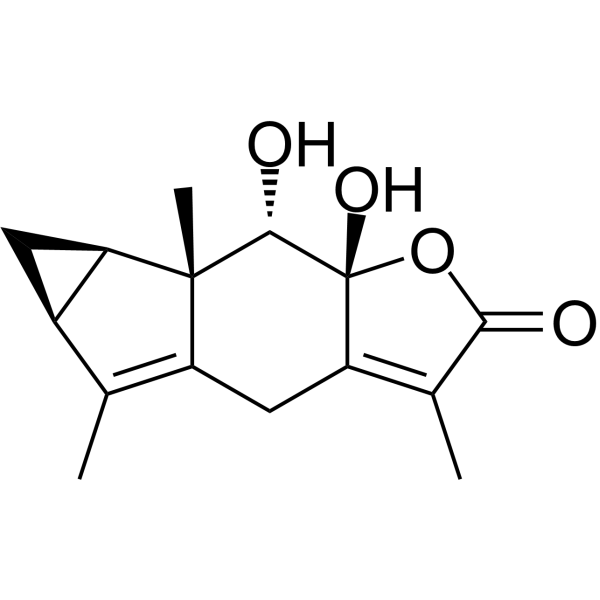 0 ImagesCat. No.: HY-N10868CAS No.: 956707-04-3
8β,9α-Dihydroxylindan-4(5),7(11)-dien-8alpha,12-olide (compound 3), a sesquiterpene, has anti-LIMK1 activity. 8β,9α-Dihydroxylindan-4(5),7(11)-dien-8alpha,12-olide has inhibitory property on cell motility.
-
WEE1-IN-12
 0 ImagesCat. No.: HY-174448CAS No.: 3069940-37-7
WEE1-IN-12 (Compound 87) is a Wee1 kinase inhibitor with an IC50 of 2.0 nM. WEE1-IN-12 can inhibit the proliferation of HT29 cells (IC50: 1.07 μM), and when used in combination with Gemcitabine (HY-17026), the effect is better (IC50: 0.34 μM). WEE1-IN-12 can be used in the research of tumors such as colon cancer.
-
mPGES1-IN-10
 0 ImagesCat. No.: HY-178505
mPGES1-IN-10 (Compound 7d) is a potent microsomal prostaglandin E2 synthase-1 (mPGES-1) inhibitor with an IC50 value of 1.0 μM. mPGES1-IN-10 is promising for research of chronic inflammation-related diseases and malignancies such as colorectal cancer.
-
PLX-4104
 0 Images
PLX-4104 is an orally active BRD4 molecular glue degrader with a DC50 of 2 nM. PLX-4104 selectively promotes BRD4 degradation via DCAF11 recruitment, triggering ubiquitination and proteasomal breakdown. PLX-4104 inhibits cancer cell proliferation. PLX-4104 induces complete regression of AML xenograft tumors. PLX-4104 can be used for the research of acute myeloid leukemia.
-
MC-PSE
 0 ImagesCat. No.: HY-D3136
MC-PSE is a fluorescent probe that can be used for glutathione (GSH) detection, NIR-II fluorescence imaging and ratiometric photoacoustic imaging. MC-PSE spontaneously forms J-aggregates in aqueous solution through π-π stacking, and its phenylselenyl group acts as a fluorescence quencher and GSH recognition receptor, thereby eliminating intrinsic fluorescence and generating a maximum absorption peak at 1000 nm. The excitation/emission wavelengths of MC-PSE are Ex = 808 nm and Em = 940 nm. MC-PSE can be applied in tumor-related research.
-
hsa-miR-4660 antagomir
 0 ImagesCat. No.: HY-RI01216A
hsa-miR-4660 antagomirs are chemically-modified oligonucleotides that hybridize with mature miRNAs. The miRNA antagomirs have 2 phosphorothioates at the 5' end, 4 phosphorothioates at the 3' end, 1 cholesterol group at the 3' end, and full-length nucleotide 2'-methoxy modification. The miRNA antagomirs strongly compete with mature miRNAs to prevent the complementary pairing of miRNAs and their target genes, thereby inhibiting miRNAs from functioning. Stability of miRNA antagomirs appears to be significantly higher than miRNA inhibitors, they exhibits enhanced cellular uptake, stability and regulatory activity in vivo.
-
hsa-miR-604 inhibitor
 0 ImagesCat. No.: HY-RI01837
hsa-miR-604 inhibitors are chemically-modified oligonucleotides that hybridize with mature miRNAs. The miRNA inhibitors have full-length nucleotide 2'-methoxy modification. The miRNA inhibitors strongly compete with mature miRNAs to prevent the complementary pairing of miRNAs and their target genes, thereby inhibiting miRNAs from functioning.
-
hsa-miR-8065 antagomir
 0 ImagesCat. No.: HY-RI02457A
hsa-miR-8065 antagomirs are chemically-modified oligonucleotides that hybridize with mature miRNAs. The miRNA antagomirs have 2 phosphorothioates at the 5' end, 4 phosphorothioates at the 3' end, 1 cholesterol group at the 3' end, and full-length nucleotide 2'-methoxy modification. The miRNA antagomirs strongly compete with mature miRNAs to prevent the complementary pairing of miRNAs and their target genes, thereby inhibiting miRNAs from functioning. Stability of miRNA antagomirs appears to be significantly higher than miRNA inhibitors, they exhibits enhanced cellular uptake, stability and regulatory activity in vivo.
-
mmu-miR-350-5p antagomir
 0 ImagesCat. No.: HY-RI03079A
mmu-miR-350-5p antagomirs are chemically-modified oligonucleotides that hybridize with mature miRNAs. The miRNA antagomirs have 2 phosphorothioates at the 5' end, 4 phosphorothioates at the 3' end, 1 cholesterol group at the 3' end, and full-length nucleotide 2'-methoxy modification. The miRNA antagomirs strongly compete with mature miRNAs to prevent the complementary pairing of miRNAs and their target genes, thereby inhibiting miRNAs from functioning. Stability of miRNA antagomirs appears to be significantly higher than miRNA inhibitors, they exhibits enhanced cellular uptake, stability and regulatory activity in vivo.
-
mmu-miR-6986-3p antagomir
 0 ImagesCat. No.: HY-RI03704A
mmu-miR-6986-3p antagomirs are chemically-modified oligonucleotides that hybridize with mature miRNAs. The miRNA antagomirs have 2 phosphorothioates at the 5' end, 4 phosphorothioates at the 3' end, 1 cholesterol group at the 3' end, and full-length nucleotide 2'-methoxy modification. The miRNA antagomirs strongly compete with mature miRNAs to prevent the complementary pairing of miRNAs and their target genes, thereby inhibiting miRNAs from functioning. Stability of miRNA antagomirs appears to be significantly higher than miRNA inhibitors, they exhibits enhanced cellular uptake, stability and regulatory activity in vivo.
-
rno-miR-295-3p antagomir
 0 ImagesCat. No.: HY-RI04325A
rno-miR-295-3p antagomirs are chemically-modified oligonucleotides that hybridize with mature miRNAs. The miRNA antagomirs have 2 phosphorothioates at the 5' end, 4 phosphorothioates at the 3' end, 1 cholesterol group at the 3' end, and full-length nucleotide 2'-methoxy modification. The miRNA antagomirs strongly compete with mature miRNAs to prevent the complementary pairing of miRNAs and their target genes, thereby inhibiting miRNAs from functioning. Stability of miRNA antagomirs appears to be significantly higher than miRNA inhibitors, they exhibits enhanced cellular uptake, stability and regulatory activity in vivo.
-
Propargyl-PEG3-Boc
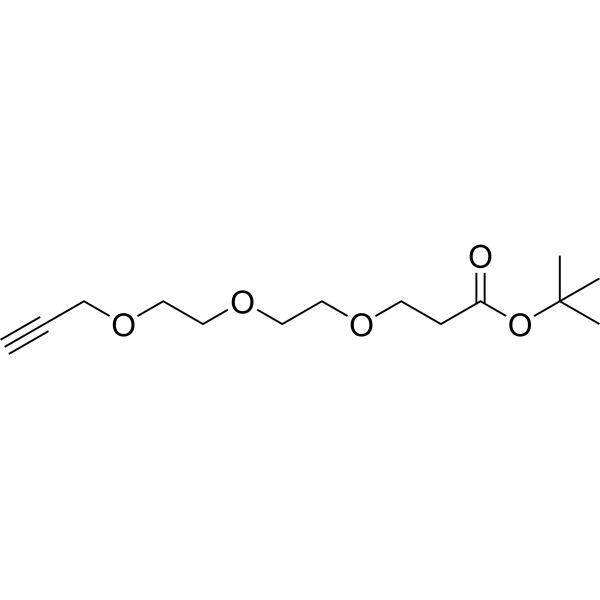 0 ImagesCat. No.: HY-140027CAS No.: 1374658-84-0
-
Sirt1/2-IN-1
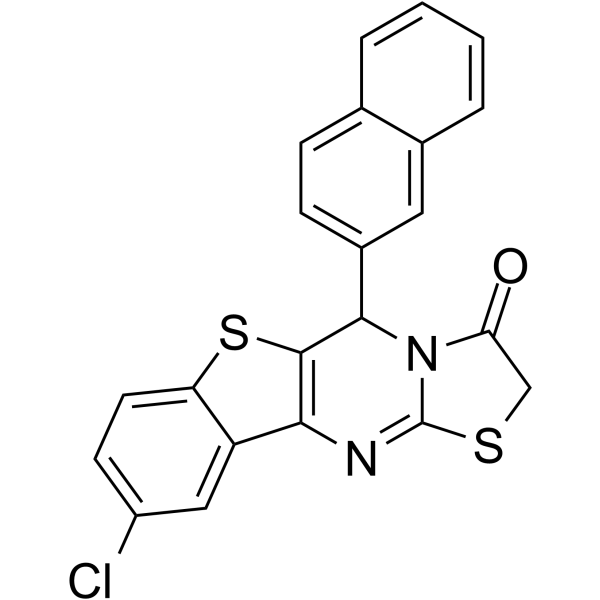 0 ImagesCat. No.: HY-146013CAS No.: 2402779-21-7

-
Thalidomide-NH-C2-2-azaspiro[3.3]heptane
![Thalidomide-NH-C2-2-azaspiro[3.3]heptane](https://file.medchemexpress.com/product_pic/hy-168312.gif "Click to View Thalidomide-NH-C2-2-azaspiro[3.3]heptane Product Detail") 0 ImagesCat. No.: HY-168312CAS No.: 2573305-00-5
0 ImagesCat. No.: HY-168312CAS No.: 2573305-00-5
-
WRN inhibitor 18
 0 ImagesCat. No.: HY-169424CAS No.: 3064599-42-1
WRN inhibitor 18 (compound 306) is an orally available inhibitor of WRN with in vivo anticancer activity.
-
HYNIC-iPSMA
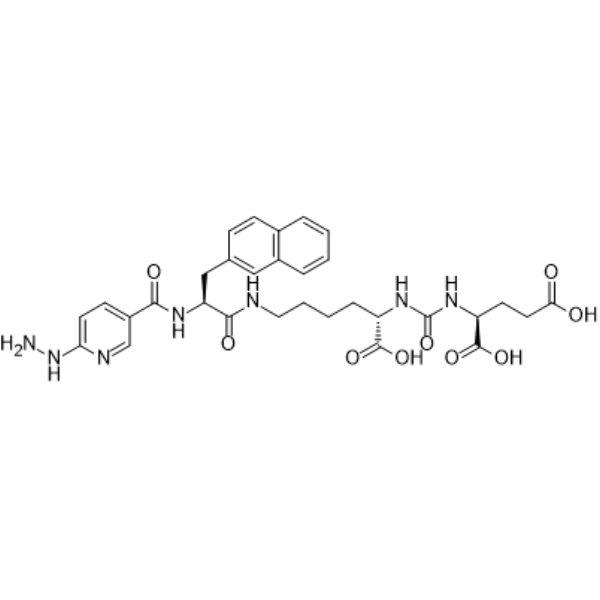 0 ImagesCat. No.: HY-P5292CAS No.: 2192215-74-8
HYNIC-iPSMA is a PSMA-targeted ligand for tumor molecular imaging, with a Ki value of 3.11 nM. HYNIC-iPSMA consists of two components: HYNIC (6-hydrazinonicotinamide) and iPSMA (Inhibitor of Prostate-Specific Membrane Antigen). HYNIC acts as a chelating moiety to link radionuclides to the targeting molecule; iPSMA is a specific inhibitor that targets Prostate-Specific Membrane Antigen (PSMA). 68Ga-labeled iPSMA is used for prostate cancer detection via PET imaging, while the further developed 99mTc-EDDA/HYNIC-iPSMA TFA exhibits excellent specificity and sensitivity. HYNIC-iPSMA can be used for the synthesis and research of radionuclide-conjugated drugs (RDC).
-
hsa-miR-298 antagomir
 0 ImagesCat. No.: HY-RI00507A
hsa-miR-298 antagomirs are chemically-modified oligonucleotides that hybridize with mature miRNAs. The miRNA antagomirs have 2 phosphorothioates at the 5' end, 4 phosphorothioates at the 3' end, 1 cholesterol group at the 3' end, and full-length nucleotide 2'-methoxy modification. The miRNA antagomirs strongly compete with mature miRNAs to prevent the complementary pairing of miRNAs and their target genes, thereby inhibiting miRNAs from functioning. Stability of miRNA antagomirs appears to be significantly higher than miRNA inhibitors, they exhibits enhanced cellular uptake, stability and regulatory activity in vivo.



