



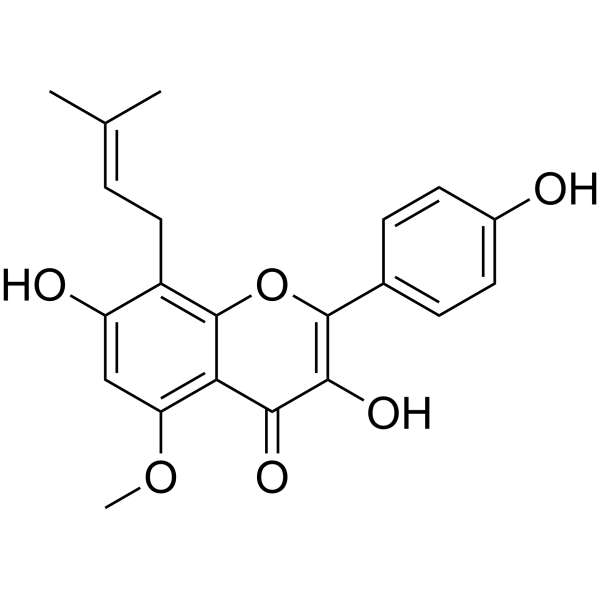
Sophoflavescenol

Based on 1 Customer Validation
Sophoflavescenol is a prenylated flavonol, which shows great inhibitory activity with IC50 of 0.013 μM against Phosphodiesterase 5 (PDE5), and also inhibits RLAR, HRAR, AGE, BACE1, AChE and BChE with IC50s of 0.30 μM, 0.17 μM, 17.89 μg/mL, 10.98 μM, 8.37 μM and 8.21 μM, respectively.
For research use only. We do not sell to patients.
- Purity : 98.78%
- CAS No.: 216450-65-6
- Formula: C21H20O6
- Molecular Weight:368.38
-
Storage:
4°C, sealed storage, away from moisture and light
* In solvent : -80°C, 6 months; -20°C, 1 month (sealed storage, away from moisture and light)

To place orders, for customer services and technical support, please contact: MedChemExpress USA
Tel: 609-228-6898 E-mail: [email protected] [email protected]


-
 Biological Activity
-
Chemical Information
-
Solvent & Solubility
- Protocols
- Purity & Documentation
- References
-
 Help & FAQs




Biological Activity
Description
IC50 & Target
|
BACE1 |
AChE |
BChE |
PDE5 |
Cellular Effect
|
Cell Line

|
Type | Value | Description | References |
|---|---|---|---|---|
| Vero | EC50 |
>300 μg/mL
Compound: 1
|
Antiviral activity against HSV1 in african green monkey Vero cells assessed as virus-induced cytopathic effect after 3 days by MTT assay
Antiviral activity against HSV1 in african green monkey Vero cells assessed as virus-induced cytopathic effect after 3 days by MTT assay
|
[PMID: 9868163] |
In Vitro
Sophoflavescenol shows cytotoxicity against human leukaemia (HL-60), Lewis lung carcinoma (LLC), and human lung adenocarcinoma epithelial (A549) cells. Sophoflavescenol exerts notable anti-inflammatory activity by inhibiting nitric oxide generation and tert-butylhydroperoxide-induced ROS generation rather than inhibiting nuclear factor kappa B activation in RAW 264.7 cells[1]. Sophoflavescenol exhibits remarkable inhibition of RLAR activity with an IC50 value of 0.30 μM, compared with 0.07 μM for epalrestat, a well known ARI. Sophoflavescenol also shows potent inhibitory activity with an IC50 value of 0.17 μM, comparable to epalrestat (0.15 μM) in the HRAR assay. In the AGE assay, sophoflavescenol (IC50 17.89 μg/mL) is a more potent inhibitor of AGE formation than aminoguanidine (IC50 81.05 μg/mL). Sophoflavescenol exerts both potent AChE and BChE inhibitory effects with respective IC50 values of 8.37 and 8.21 μM. Sophoflavescenol also exhibits good BACE1 inhibition in a dose-dependent manner with an IC50 value of 10.98 μM[2]. Sophoflavescenol is a mixed inhibitor (Ki=0.005 μM) against cGMP PDE5. Sophoflavescenol shows greatest selectivity toward PDE5, 31.5- and 196.2-fold over PDE3 and PDE4, respectively[3].
MedChemExpress (MCE) has not independently confirmed the accuracy of these methods. They are for reference only. Further protocols information, click here.
In Vivo


Chemical Information
-
CAS No. 216450-65-6
-
Appearance Solid
-
Molecular Weight 368.38
-
Formula C21H20O6
-
Color Light yellow to yellow
-
SMILES
O=C1C(O)=C(C2=CC=C(O)C=C2)OC3=C(C/C=C(C)\C)C(O)=CC(OC)=C13
-
Structure Classification
-
Initial Source
-
Shipping
Room temperature in continental US; may vary elsewhere.
-
Storage
4°C, sealed storage, away from moisture and light
* In solvent : -80°C, 6 months; -20°C, 1 month (sealed storage, away from moisture and light)


Solvent & Solubility
In Vitro:
DMSO : 25 mg/mL (67.86 mM; ultrasonic and warming and heat to 60°C; Hygroscopic DMSO has a significant impact on the solubility of product, please use newly opened DMSO)
Please refer to the solubility information to select the appropriate solvent. Once prepared, please aliquot and store the solution to prevent product inactivation from repeated freeze-thaw cycles.
Storage method and period of stock solution: -80°C, 6 months; -20°C, 1 month (sealed storage, away from moisture and light). When stored at -80°C, please use it within 6 months. When stored at -20°C, please use it within 1 month.
Please refer to the solubility information to select the appropriate solvent. Once prepared, please aliquot and store the solution to prevent product inactivation from repeated freeze-thaw cycles.
Storage method and period of stock solution: -80°C, 6 months; -20°C, 1 month (sealed storage, away from moisture and light). When stored at -80°C, please use it within 6 months. When stored at -20°C, please use it within 1 month.
Concentration (start) × Volume (start) = Concentration (final) × Volume (final)
In Vivo:
Select the appropriate dissolution method based on your experimental animal and administration route.
- For the following dissolution methods, please ensure to first prepare a clear stock solution using an In Vitro approach and then sequentially add co-solvents:
- To ensure reliable experimental results, the clarified stock solution can be appropriately stored based on storage conditions. As for the working solution for In Vivo experiments, it is recommended to prepare freshly and use it on the same day.
- The percentages shown for the solvents indicate their volumetric ratio in the final prepared solution. If precipitation or phase separation occurs during preparation, heat and/or sonication can be used to aid dissolution.
Add each solvent one by one: 10% DMSO 40% PEG300 5% Tween-80 45% Saline
Solubility: 2.5 mg/mL (6.79 mM); Clear solution; Need ultrasonic
This protocol yields a clear solution of 2.5 mg/mL.
Taking 1 mL working solution as an example, add 100 μL DMSO stock solution (25.0 mg/mL) to 400 μL PEG300, and mix evenly; then add 50 μL Tween-80 and mix evenly; then add 450 μL Saline to adjust the volume to 1 mL.
Preparation of Saline: Dissolve 0.9 g sodium chloride in ddH₂O and dilute to 100 mL to obtain a clear Saline solution.
In Vivo Dissolution Calculator
Please enter the basic information of animal experiments:
-
-
-
-
Recommended: Prepare an additional quantity of animals to account for potential losses during experiments.
Please enter your animal formula composition:
-
%DMSO +
Recommended: Keep the proportion of DMSO in working solution below 2% if your animal is weak.
-
%+
-
+%Tween-80 + +
-
%Saline +
The co-solvents required include: DMSO, . All of co-solvents are available by MedChemExpress (MCE). , Tween 80. All of co-solvents are available by MedChemExpress (MCE).
Working solution concentration: 0.22 mg/mL
Method for preparing stock solution: mg drug dissolved in μL DMSO. Stock solution concentration: mg/mL. * In solvent : -80°C, 6 months; -20°C, 1 month (sealed storage, away from moisture and light)
1. Take μL DMSO stock solution;
2. Add μL .
μL , mix evenly;
3. Then add μL Tween 80, mix evenly;
4. Then add μL
Please ensure that the stock solution in the first step is dissolved to a clear state, and add co-solvents in sequence. You can use ultrasonic heating (ultrasonic cleaner, recommended frequency 20-40 kHz), vortexing, etc. to assist dissolution.

Protocols
-
Cell Cytotoxicity Assay
Cytotoxicity assays are usually based on the assessment of cell membrane damage, which can also be indirectly detected by measuring cell viability. Detection methods include MTT assay, CKK-8 assay, LDH assay and ATP assay, etc.


Purity & Documentation
-
Data Sheet (278 KB)
-
SDS (252 KB)
- English - EN (252 KB)
- Français - FR (252 KB)
- Deutsch - DE (252 KB)
- Norwegian - NO (252 KB)
- Español - ES (252 KB)
- Swedish - SV (252 KB)
- Italian - IT (252 KB)
- Korean - KR (252 KB)
- Portuguese - PT (252 KB)
-
Handling Instructions (2659 KB)
References
[1]. Jung HA, et al. Anti-tumorigenic activity of sophoflavescenol against Lewis lung carcinoma in vitro and in vivo. Arch Pharm Res. 2011 Dec;34(12):2087-99 [Content Brief]
[2]. Jung HA, et al. Antidiabetic complications and anti-Alzheimer activities of sophoflavescenol, a prenylated flavonol from Sophora flavescens, and its structure-activity relationship. Phytother Res. 2011 May;25(5):709-15. [Content Brief]
[3]. Shin HJ, et al. A prenylated flavonol, sophoflavescenol: a potent and selective inhibitor of cGMP phosphodiesterase 5. Bioorg Med Chem Lett. 2002 Sep 2;12(17):2313-6. [Content Brief]


Complete Stock Solution Preparation Table
Please refer to the solubility information to select the appropriate solvent. Once prepared, please aliquot and store the solution to prevent product inactivation from repeated freeze-thaw cycles.
Storage method and period of stock solution: -80°C, 6 months; -20°C, 1 month (sealed storage, away from moisture and light). When stored at -80°C, please use it within 6 months. When stored at -20°C, please use it within 1 month.
| Optional Solvent | Concentration Solvent Mass | 1 mg | 5 mg | 10 mg | 25 mg |
|---|---|---|---|---|---|
| DMSO | 1 mM | 2.7146 mL | 13.5729 mL | 27.1459 mL | 67.8647 mL |
| 5 mM | 0.5429 mL | 2.7146 mL | 5.4292 mL | 13.5729 mL | |
| 10 mM | 0.2715 mL | 1.3573 mL | 2.7146 mL | 6.7865 mL | |
| 15 mM | 0.1810 mL | 0.9049 mL | 1.8097 mL | 4.5243 mL | |
| 20 mM | 0.1357 mL | 0.6786 mL | 1.3573 mL | 3.3932 mL | |
| 25 mM | 0.1086 mL | 0.5429 mL | 1.0858 mL | 2.7146 mL | |
| 30 mM | 0.0905 mL | 0.4524 mL | 0.9049 mL | 2.2622 mL | |
| 40 mM | 0.0679 mL | 0.3393 mL | 0.6786 mL | 1.6966 mL | |
| 50 mM | 0.0543 mL | 0.2715 mL | 0.5429 mL | 1.3573 mL | |
| 60 mM | 0.0452 mL | 0.2262 mL | 0.4524 mL | 1.1311 mL |


Sophoflavescenol Related Classifications
HY-N2284 Related Classifications
 Powered by Bioz