



BCRP
Breast cancer resistance protein; ABCG2
Breast cancer resistance protein (BCRP/ABCG2/MXR/ABCP) is an ATP-dependent efflux transporter, which belongs to the large ATP-binding cassette (ABC) transporter family present on cell membranes, and it is classified into the G subfamily of these transporters. BCRP is expressed in a variety of normal cells and acts as a xenobiotic efflux transporter. BCRP is often associated with cancer chemotherapeutic resistance. BCRP confers multidrug resistance (MDR) to a series of antitumor agents such as Mitoxantrone, Daunorubicin, SN-38, and Topotecan, and often limits the efficacy of chemotherapy.
BCRP physiologically functions as a part of a self-defense mechanism for the organism. It enhances elimination of toxic xenobiotic substances and harmful agents in the gut and biliary tract, as well as through the blood-brain, placental, and possibly blood-testis barriers. BCRP recognizes and transports numerous anticancer drugs including conventional chemotherapeutic and targeted small therapeutic molecules relatively new in clinical use. Thus, BCRP expression in cancer cells directly causes MDR by active efflux of anticancer drugs. Because BCRP is also known to be a stem cell marker, its expression in cancer cells could be a manifestation of metabolic and signaling pathways that confer multiple mechanisms of drug resistance, self-renewal (stemness), and invasiveness (aggressiveness), and thereby impart a poor prognosis. Therefore, blocking BCRP-mediated active efflux may provide a therapeutic benefit for cancers.
All Product Categories
-
BCRP Related Products (84)
Related Products (84)

-
Antibodies (2)
-
2,4-Dibromoestradiol
 0 ImagesCat. No.: HY-121645CAS No.: 19590-55-7Synonyms: NSC1030542,4-Dibromoestradiol (NSC103054) is a compound that is involved in the function of ABCG2 transporter.
-
INCB-056868
 0 ImagesCat. No.: HY-172233CAS No.: 2252320-89-9INCB-056868 is the metabolite M11 of Epacadostat (HY-15689). INCB-056868 can also serve as a substrate for BCRP. INCB-056868 is promising for research of metabolic diseases.
-
Triclabendazole sulfoxide (Standard)
 0 ImagesCat. No.: HY-136450RCAS No.: 100648-13-3Synonyms: TCBZ-SO (Standard)Triclabendazole sulfoxide (Standard) is the analytical standard of Triclabendazole sulfoxide. This product is intended for research and analytical applications. Triclabendazole sulfoxide (TCBZ-SO) is an orally active ABCG2 inhibitor with antiparasitic activity. Triclabendazole sulfoxide inhibits ABCG2-mediated active efflux and ATPase activity. Triclabendazole sulfoxide increases the intracellular accumulation of Mitoxantrone (HY-13502). Triclabendazole sulfoxide reduces the apical-directed transepithelial transport of Nitrofurantoin and Danofloxacin, while increasing their basolateral-directed transepithelial transport. Triclabendazole sulfoxide elevates the plasma levels of sulfasalazine in wild-type mice. Triclabendazole sulfoxide decreases ABCG2-mediated secretion of Nitrofurantoin into milk in wild-type lactating mice. Triclabendazole sulfoxide can be used in the research of insecticidal agents and cancers such as breast cancer.
-
ML230 (Standard)
 0 ImagesCat. No.: HY-111678RCAS No.: 1776055-05-0Synonyms: CID44640177 (Standard); SID 88095709 (Standard)ML230 (Standard) is the analytical standard of ML230 (HY-111678). This product is intended for research and analytical applications. ML230 (CID44640177; SID 88095709) is a selective inhibitor of ATP-binding cassette (ABC) transporter ABCG2, and 36-fold selective for ABCG2 over ABCB1 with EC50s values of 0.13 μM and 4.65 μM, respectively.
-
BCRP-IN-2
 0 ImagesCat. No.: HY-169860CAS No.: 2953730-35-1BCRP-IN-2 has BCRP inhibitory activity and shows even greater inhibition of BCRP after activation by ultraviolet light. BCRP-IN-2 can be a valuable probe for studying the interactions of quinazolinamine derivatives with BCRP, as it stimulates ATP hydrolysis of the BCRP transport protein, increasing the accumulation of mitoxantrone (HY-13502) in H460/MX20 cells with BCRP overexpression.
-
Nedisertib (Standard)
 0 ImagesCat. No.: HY-101570RCAS No.: 1637542-33-6Synonyms: Peposertib (Standard); M3814 (Standard)Nedisertib (Standard) is the analytical standard of Nedisertib (HY-101570). This product is intended for research and analytical applications. Nedisertib (Peposertib) is an orally active selective DNA-dependent protein kinase (DNA-PK) inhibitor with an IC50 value of less than 3 nM. Nedisertib also acts as a modulator of ABCG2, capable of reversing ABCG2-mediated multidrug resistance (MDR), thus providing new strategies for combination therapy. By inhibiting DNA double-strand break repair, Nedisertib can enhance the efficacy of chemotherapy and radiotherapy. Nedisertib exhibits antitumor activity.
-
Dipyridamole Mono-O-β-D-glucuronide
 0 ImagesCat. No.: HY-W740060CAS No.: 63912-02-7Dipyridamole Mono-O-β-D-glucuronide (compound M4) is a derivative of the phosphodiesterase (PDE) and BCRP inhibitor Dipyridamole (HY-B0312) and is an O-glucuronide.
-
Nuvisertib (Standard)
 0 ImagesSynonyms: TP-3654 (Standard)Nuvisertib (Standard) (TP-3654 (Standard)) is the analytical standard of Nuvisertib (HY-101126). This product is intended for research and analytical applications. Nuvisertib (TP-3654) is an orally active second-generation pan-PIM kinase inhibitor with Ki values of 5 nM, 239 nM, and 42 nM against PIM-1, PIM-2, and PIM-3, respectively. Nuvisertib inhibits JAK-independent inflammatory and survival signaling pathways, reduces the production of proinflammatory cytokines, restores apoptotic sensitivity, inhibits mTORC1, MYC, and TGF-β signaling pathways, and decreases the expression of fibrosis markers. Nuvisertib selectively impairs the transport function of ABCG2, resensitizes multidrug-resistant cancer cells to cytotoxic drugs, and overcomes JAK2 inhibitor resistance. Nuvisertib can be used in research related to myelofibrosis, renal cell carcinoma, multidrug-resistant cancer, advanced solid tumors, urothelial carcinoma, and prostate adenocarcinoma.
-
3,7,2',4'-Tetramethoxy-5-hydroxyflavone
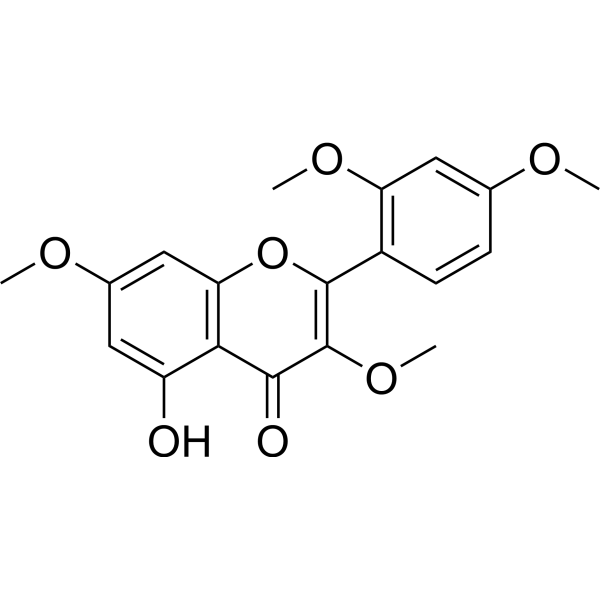 0 ImagesCat. No.: HY-149469CAS No.: 19056-75-8
-
Zamicastat (Standard)
 0 ImagesCat. No.: HY-106004RCAS No.: 1080028-80-3Synonyms: BIA 5-1058 (Standard)Zamicastat (Standard) is the analytical standard of Zamicastat (HY-106004). This product is intended for research and analytical applications. Zamicastat (BIA 5-1058) is a dopamine β-hydroxylase (DBH) inhibitor and can cross the blood-brain barrier (BBB) to cause central as well as peripheral effects. Zamicastat is also a concentration-dependent dual P-gp and BCRP inhibitor with IC50 values of 73.8 μM and 17.0 μM, respectively. Zamicastat reduces high blood pressure.
-
1-Hydroxyacridin-9(10H)-one
 0 ImagesCat. No.: HY-W843469CAS No.: 65582-54-91-Hydroxyacridin-9 (10H)-one (Compound 2a) is an Acridone (HY-W007771) derivative. 1-Hydroxyacridin-9 (10H)-one does not inhibit ABCG2-mediated efflux of Mitoxantrone (HY-13502), with an IC50 > 20 μM.
-
(S)-ML753286 (Standard)
 0 ImagesCat. No.: HY-100390RCAS No.: 1699720-85-8(S)-ML753286 (Standard) is the analytical standard of (S)-ML753286 (HY-100390). This product is intended for research and analytical applications. (S)-ML753286 is a breast cancer resistance protein (BCRP) inhibitor with an IC50 of 0.6 μM on BCRP efflux transporter.
-
MZ82
 0 ImagesCat. No.: HY-168572CAS No.: 2944457-11-6
-
Pradigastat (Standard)
 0 ImagesCat. No.: HY-16278RCAS No.: 956136-95-1Synonyms: LCQ-908 (Standard)Pradigastat (Standard) is the analytical standard of Pradigastat. This product is intended for research and analytical applications. Pradigastat (LCQ-908) is a selective and orally effective diacylglyceryl acyltransferase 1 (DGAT1) inhibitor with IC50 at 0.157 µM. Pradigastat is primarily used to study diseases associated with abnormal triglyceride metabolism. Pradigastat has anti-obesity and anti-diabetic effects. Pradigastat inhibited BCRP, OATP1B1, OATP1B3 and OAT3 activities with IC50 of 5 µM, 1.66µM, 3.34µM and 0.973µM, respectively. In addition, Pradigastat has antiviral activity and can inhibit hepatitis C virus replication in vitro.
-
ABCG2-IN-3
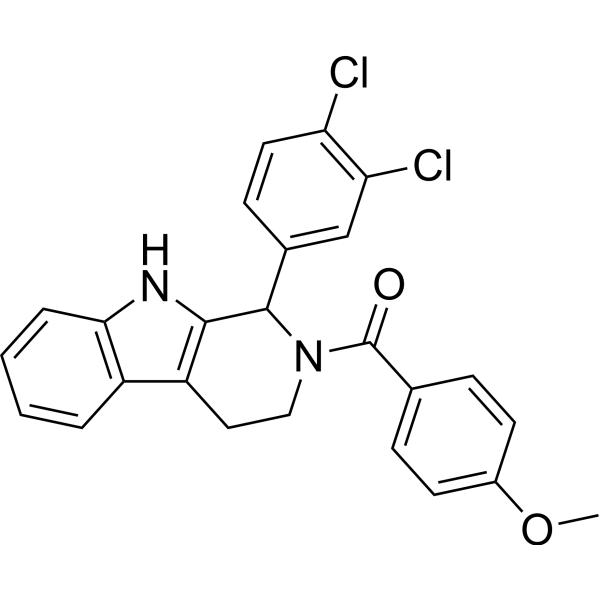 0 ImagesCat. No.: HY-119724CAS No.: 1942919-63-2ABCG2-IN-3 (Compound 52) is a selective inhibitor for breast cancer resistance protein (ABCG2), with an IC50 of 0.238 µM. ABCG2-IN-3 reverses the ABCG2-mediated resistance toward SN-38 and inhibit the ATPase activity.
-
CP-100356 hydrochloride (Standard)
 0 ImagesCat. No.: HY-108347RCAS No.: 142715-48-8CP-100356 hydrochloride (Standard) is the analytical standard of CP-100356 (hydrochloride) (HY-108347). This product is intended for research and analytical applications. CP-100356 hydrochloride is an orally active dual MDR1 (P-gp)/BCRP inhibitor, with an IC50s of 0.5 and 1.5 µM for inhibiting MDR1-mediated Calcein-AM transport and BCRP-mediated Prazosin transport, respectively. CP-100356 hydrochloride is also a weak inhibitor of OATP1B1 (IC50=∼66 µM). CP-100356 hydrochloride is devoid of inhibition against MRP2 and major human P450 enzymes (IC50>15 µM).
-
NSC265473
 0 ImagesCat. No.: HY-123526CAS No.: 61786-74-1Synonyms: NSC305458NSC 265473 is an ABCG2 substrate.
-
Ko 143 (Standard)
 0 ImagesCat. No.: HY-10010RCAS No.: 461054-93-3Ko 143 (Standard) is the analytical standard of Ko 143 (HY-10010). This product is intended for research and analytical applications. Ko 143 is a potent and selective ATP-binding cassette subfamily G member 2 (ABCG2/BCRP) inhibitor. Ko 143 displays >200-fold selectivity over P-gp and MRP-1 transporters.
-
5,7,3'-Trihydroxy-4'-Methoxy-8-prenylflavanone
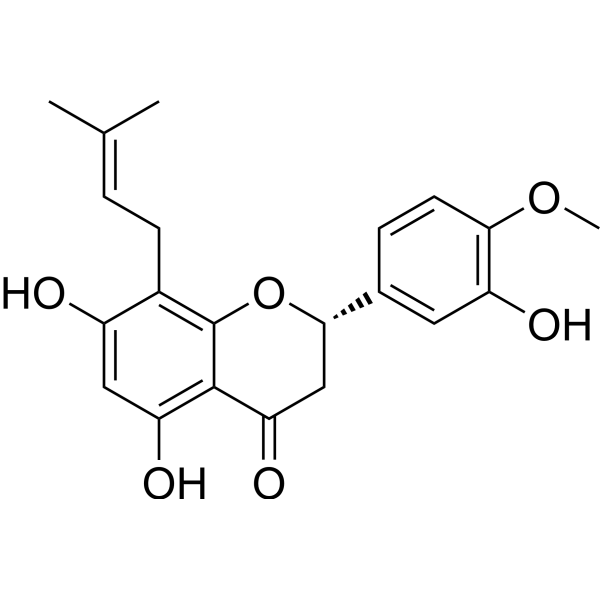 0 ImagesCat. No.: HY-N2651CAS No.: 1268140-15-35,7,3'-Trihydroxy-4'-Methoxy-8-prenylflavanone (compound 1), a flavonoid, is a potent ABCG2 inhibitor with an IC50 of 6.6 μM.
-
Vedroprevir
 0 ImagesCat. No.: HY-16773CAS No.: 1098189-15-1Synonyms: GS-9451Vedroprevir (GS-9451) is an inhibitor for HCV NS3/4A protease with an IC50 of 3.2 nM. Vedroprevir is also an inhibitor for breast cancer resistant protein (BCRP) with an IC50 of 1.4 μM. Vedroprevir inhibits P-gp, MRP1 and MRP2 with IC50 of 34, 14.9 and 12 μM, respectively. Vedroprevir exhibits good pharmacokinetic characteristics in rats and dogs.




