



CDK
Cyclin dependent kinase
CDKs (Cyclin-dependent kinases) are serine-threonine kinases first discovered for their role in regulating the cell cycle. They are also involved in regulating transcription, mRNA processing, and the differentiation of nerve cells. CDKs are relatively small proteins, with molecular weights ranging from 34 to 40 kDa, and contain little more than the kinase domain. In fact, yeast cells can proliferate normally when their CDK gene has been replaced with the homologous human gene. By definition, a CDK binds a regulatory protein called a cyclin. Without cyclin, CDK has little kinase activity; only the cyclin-CDK complex is an active kinase.
There are around 20 Cyclin-dependent kinases (CDK1-20) known till date. CDK1, 4 and 5 are involved in cell cycle, and CDK 7, 8, 9 and 11 are associated with transcription.
CDK levels remain relatively constant throughout the cell cycle and most regulation is post-translational. Most knowledge of CDK structure and function is based on CDKs of S. pombe (Cdc2), S. cerevisia (CDC28), and vertebrates (CDC2 and CDK2). The four major mechanisms of CDK regulation are cyclin binding, CAK phosphorylation, regulatory inhibitory phosphorylation, and binding of CDK inhibitory subunits (CKIs).
CDK Isoform Specific Products
-
CDK
(488)
View all products
-
CDK1
(187)
View all products
-
CDK2
(302)
View all products
-
CDK3
(28)
View all products
-
CDK4
(223)
View all products
-
CDK5
(96)
View all products
-
CDK6
(168)
View all products
-
CDK7
(115)
View all products
-
CDK8
(55)
View all products
-
CDK9
(200)
View all products
-
CDK11
(8)
View all products
-
CDK12
(50)
View all products
-
CDK13
(25)
View all products
-
CDK14
(6)
View all products
-
CDK16
(8)
View all products
-
CDK19
(25)
View all products
-
CDC
(21)
View all products
-
CLK
(31)
View all products
-
Pho85
(1)
View all products
-
CDK10
(1)
View all products
-
CDK15
(1)
View all products
-
CDK17
(2)
View all products
-
CDK18
(1)
View all products
-
CDK20
(1)
View all products
-
PITSLRE
(1)
View all products
All Product Categories
-
CDK Inhibitors
(1060)
View all products
-
CDK Agonists
(3)
View all products
-
CDK Antagonists
(2)
View all products
-
CDK Activators
(15)
View all products
-
CDK Modulators
(14)
View all products
-
CDK Degraders
(83)
View all products
-
CDK Controls
(4)
View all products
-
CDK Substrate
(1)
View all products
-
CDK Ligands
(15)
View all products
-
Cyclin-Dependent Kinases (CDKs) Proteins
(81)
View all products
-
Cyclin Dependent Kinase 1 (CDK1) Proteins
(9)
View all products
-
Cyclin-Dependent Kinase 2 (CDK2) Proteins
(12)
View all products
-
Cyclin-Dependent Kinase 3 (CDK3) Proteins
(6)
View all products
-
Cyclin-Dependent Kinase 4 (CDK4) Proteins
(5)
View all products
-
Cyclin-Dependent Kinase 5 (CDK5) Proteins
(5)
View all products
-
Cyclin-Dependent Kinase 6 (CDK6) Proteins
(6)
View all products
-
Cyclin-Dependent Kinase 7 (CDK7) Proteins
(4)
View all products
-
CDK Related Products (1316)
Related Products (1316)

-
Recombinant Proteins (83)
-
Antibodies (42)
-
CDK Isoform Comparison
-
FAK1/2 ligand-1
 0 ImagesCat. No.: HY-184307FAK1/2 Ligand-1 is a FAK1/FAK2 ligand with KD values of 2.9 μM and 2.5 μM for binding to FAK1 and FAK2, respectively. FAK1/2 Ligand-1 induces G2/M phase arrest, activates DNA damage-related signaling pathways, and reduces the phosphorylation level of CDK1. Antitumor agent-220 is applicable to the research of triple-negative breast cancer.

-
Cucurbitacin E (Standard)
 0 ImagesCat. No.: HY-N0417RCAS No.: 18444-66-1Synonyms: α-Elaterin (Standard); α-Elaterine (Standard)Cucurbitacin E (Standard) is the analytical standard of Cucurbitacin E. This product is intended for research and analytical applications. Cucurbitacin E is a natural compound which from Cucurbitaceae plants. Cucurbitacin E significantly suppresses the activity of the cyclin B1/CDC2 complex.
-
Tubulin-IN-66
 0 ImagesCat. No.: HY-182753CAS No.: 3110538-32-1Tubulin-IN-66 is a tubulin (tubulin) and P-gp inhibitor with antiproliferative activity against cancer cells. Tubulin-IN-66 covalently binds to the Colchicine (HY-16569)-binding site at Cys239 of the β-tubulin subunit, inhibits tubulin polymerization and disrupts the microtubule network. Tubulin-IN-66 inhibits P-gp function to overcome multidrug resistance. Tubulin-IN-66 arrests the cell cycle at the G2/M phase and induces apoptosis (apoptosis). Tubulin-IN-66 inhibits colony formation and migration of cancer cells. Tubulin-IN-66 can be used in the research of tumors such as breast cancer.
![[pThr3]-CDK5 Substrate TFA](https://file.medchemexpress.com/product_pic/hy-p1906a.gif "Click to View [pThr3]-CDK5 Substrate TFA Product Detail")
-
PC8
 0 ImagesCat. No.: HY-181999PC8 is a selective dual inhibitor of PARP1/CDK6, with an IC50 of 0.126 μM for PARP1 and 0.197 μM for CDK6. PC8 does not alter PARP1 expression, but reduces the expression of its downstream target PAR. PC8 inhibits the canonical Wnt/β-catenin signaling pathway. PC8 induces intracellular ROS accumulation and exacerbates DNA damage. PC8 inhibits the proliferation of triple-negative breast cancer (TNBC) cells. PC8 can be used for the research of triple-negative breast cancer.
-
CDK20/CycH Recombinant Human Active Protein Kinase
 0 ImagesCat. No.: HY-E70675CDK20 is a major controller of cell cycle checkpoints, which regulate cell growth and proliferation and perform a role in the development of many malignancies. CDK20 is thought to have Cyclin-dependent activating kinase (CAK) activity for CDK2 when it is complexed with Cyclin H. CDK20/CycH Recombinant Human Active Protein Kinase can be used to study the function of CDK20/CycH.
-
Cdk2/Cyclin Inhibitory Peptide I
 0 ImagesCat. No.: HY-P3730CAS No.: 237392-84-6Cdk2/Cyclin Inhibitory Peptide I (Tat-LFG), a CDK2 inhibitor, kills U2OS osteosarcoma cells in a dose-dependent manner.
-
CAIX/CDK-2-IN-1
 0 ImagesCat. No.: HY-179022CAIX/CDK-2-IN-1 is a dual-acting inhibitor of carbonic anhydrase IX (CA IX) and cyclin-dependent kinase-2 (CDK-2) with IC50 values of 0.29 μM and 0.32 μM. The zein nanoparticls of CAIX/CDK-2-IN-1 can induce cancer cells apoptosis. CAIX/CDK-2-IN-1 can be used for the research of cancer, such as lung cancer.


-
CDK12 ligand-3
 0 ImagesCat. No.: HY-177786CAS No.: 3093763-27-7CDK12 ligand-3 is a molecular glucose degrading agent that targets the CDK12 protein (DC50 = 35 nM). CDK12 ligand-3 degrades CDK12, CDK13 and their regulatory subunit Cyclin K in a concentration dependent manner, and inhibits RNA polymerase II CTD (Ser2) phosphorylation. CDK12 ligand-3 exhibits potent anti proliferative activity against Jurkat cells. CDK12 ligand-3 can be used for research on cancers such as leukemia.
-
BNNC
 0 ImagesCat. No.: HY-184452BNNC is a Photomolecular glue. BNNC selectively releases (R)-CR8 (HY-18340) (a Cyclin K molecular glue) and BSS-Et in hypoxic tumor microenvironments, thereby triggering Cyclin K degradation dependent on the ubiquitin-proteasome pathway. BNNC generates ROS and singlet oxygen in hypoxic tumor cells under light irradiation. BNNC enhances DNA damage and Apoptosis through the combined effects of Cyclin K degradation and phototherapy. BNNC enhances the tumor selectivity of molecular glue via specific activation in hypoxic tumor microenvironments. BNNC can be used in breast cancer-related research.
-
CDK1-IN-8
 0 ImagesCat. No.: HY-179521CAS No.: 3077717-99-5
-
PIN1-IN-7
 0 ImagesCat. No.: HY-184932PIN1-IN-8 is a covalent inhibitor of Pin1, with IC50 values of 4.19 μM and 1.54 μM against purified Pin1 and Pin1 enzymatic activity, respectively. PIN1-IN-7 exerts antiproliferative effects and induces apoptosis by downregulating c-Myc and Cyclin D1. PIN1-IN-7 can be used in the research of triple-negative breast cancer.
-
Cdc7-IN-12
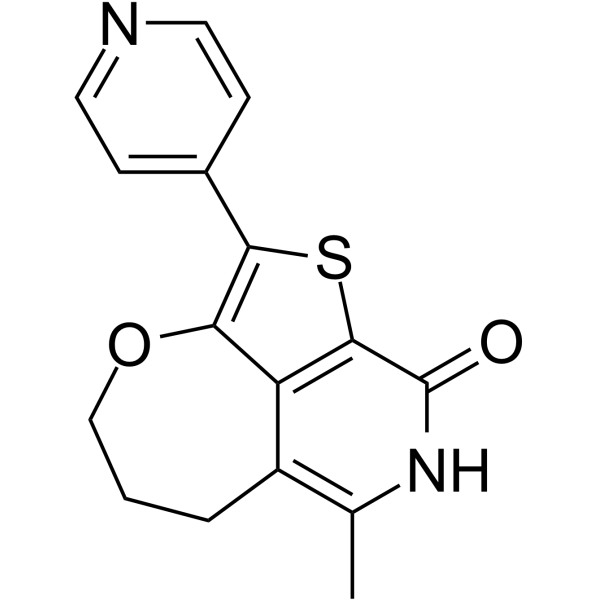 0 ImagesCat. No.: HY-143385CAS No.: 2764865-33-8Cdc7-IN-12 (compound 1) is a potent CDC7 inhibitor with an IC50 of <1 nM. Cdc7-IN-12 shows antiproliferative activities with IC50 of 100-1000 nM in COLO205 cells. Cdc7-IN-12 has the potential for the research of cancer.
-
ODN BW001 sodium
 0 ImagesCat. No.: HY-150213AODN BW001 sodium is an oligodeoxynucleotide (ODN). ODN BW001 sodium plays a regulatory role in the proliferation and activation of osteoblast.
-
Akt/mTOR-IN-1
 0 ImagesCat. No.: HY-161857Akt/mTOR-IN-1 (Compound 8r) is an AKT/mTOR signaling pathway inhibitor exhibiting an IC50 value of 0.8 µM with anticancer activity. Akt/mTOR-IN-1 can decrease the expression of Caspase 3 and increase the expression of the autophagic protein Cyclin B1, thereby inducing cell autophagy and apoptosis. Akt/mTOR-IN-1 can be used in research related to non-small cell lung cancer (NSCLC).
-
CDK-IN-19
 0 ImagesCat. No.: HY-17679CAS No.: 672324-11-7
-
CDK12 R722C/CycK Recombinant Human Active Protein Kinase
 0 ImagesCat. No.: HY-E70658CDK12 R722C/CycK Recombinant Human Active Protein Kinase is a cyclin-dependent kinase and regulates the expression of genes involved in DNA repair and is required for the maintenance of genomic stability.




