Nav1.7
NaV1.7, encoded by SCN9A, is a voltage-gated sodium channel strongly linked to human nociception, because loss-of-function mutations cause congenital inability to experience pain[1]. Mechanistically, NaV1.7 supports nociceptor excitability and pain signaling, and human studies show that NaV1.7 loss can produce a profound loss of functional nociceptors[2]. In disease models and inherited pain syndromes, gain-of-function SCN9A mutations are associated with paroxysmal extreme pain disorder and related painful phenotypes[3]. Compared with related isoforms, human dorsal root ganglion neurons show higher NaV1.7 expression and lower NaV1.8 expression than mouse dorsal root ganglion neurons, which is relevant for translational pain research[4]. For experimental applications, inflammatory mediators such as NGF and IL-6 sensitize adult dorsal root ganglion neurons, and combined NaV1.7/NaV1.8 blockade strongly affects thermally evoked firing[5]. Structural studies of NaV1.7 antagonists map drug-binding sites and support rational inhibitor design[6].
References:
- [1]. Cox JJ, et al. An SCN9A channelopathy causes congenital inability to experience pain. Nature. 2006 Dec 14;444(7121):894-8. [Content Brief]
- [2]. McDermott LA, et al. Defining the Functional Role of NaV 1.7 in Human Nociception. Neuron. 2019 Mar 6;101(5):905-919.e8. [Content Brief]
- [3]. Fertleman CR, et al. SCN9A mutations in paroxysmal extreme pain disorder: allelic variants underlie distinct channel defects and phenotypes. Neuron. 2006 Dec 7;52(5):767-74. [Content Brief]
- [4]. Chang W, et al. Expression and Role of Voltage-Gated Sodium Channels in Human Dorsal Root Ganglion Neurons with Special Focus on Nav1.7, Species Differences, and Regulation by Paclitaxel. Neurosci Bull. 2018 Feb;34(1):4-12. [Content Brief]
- [5]. Atmaramani RR, et al. Conserved Expression of Nav1.7 and Nav1.8 Contribute to the Spontaneous and Thermally Evoked Excitability in IL-6 and NGF-Sensitized Adult Dorsal Root Ganglion Neurons In Vitro. Bioengineering (Basel). 2020 May 16;7(2):44. [Content Brief]
- [6]. Wu Q, et al. Structural mapping of Nav 1.7 antagonists. Nat Commun. 2023 Jun 3;14(1):3224. [Content Brief]
-
Nav1.7 Related Products (64)
Related Products (64)

-
Nav1.7-IN-13
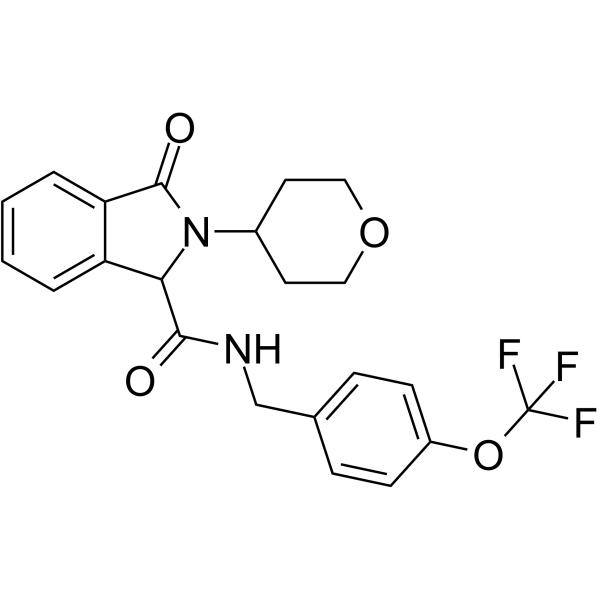
 0 ImagesCat. No.: HY-162347CAS No.: 2776235-57-3Nav1.7-IN-13 (compound 3g) is a sodium channel inhibitor that significantly inhibits Veratridine (HY-N6691)-induced neuronal activity. Nav1.7-IN-13 inhibits total Na+ current in DRG neurons in a concentration-dependent manner; slows down the activation of Navs. Nav1.7-IN-13 significantly alleviated mechanical pain behavior in a rat model of nerve injury (SNI) and had analgesic activity.
-
GTx1-15
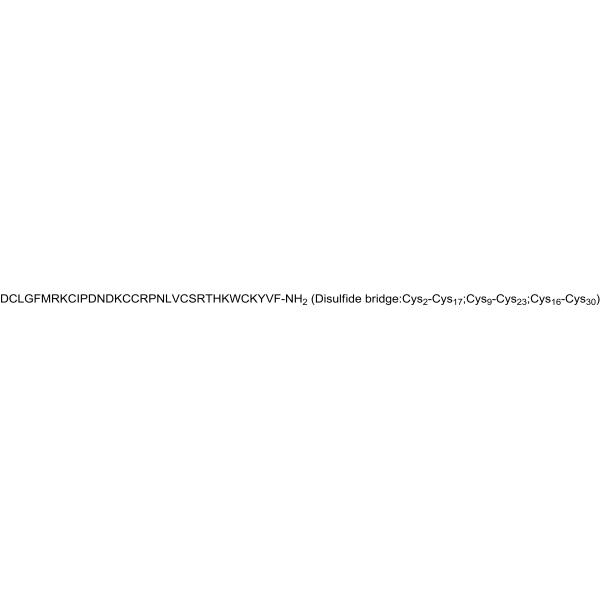 0 ImagesCat. No.: HY-P5793GTx1-15 is an inhibitor cystine knot (ICK) peptide that inhibits the voltage-dependent calcium channel Cav3.1 and the voltage-dependent sodium channels Nav1.3 and Nav1.7.
-
DA-0218
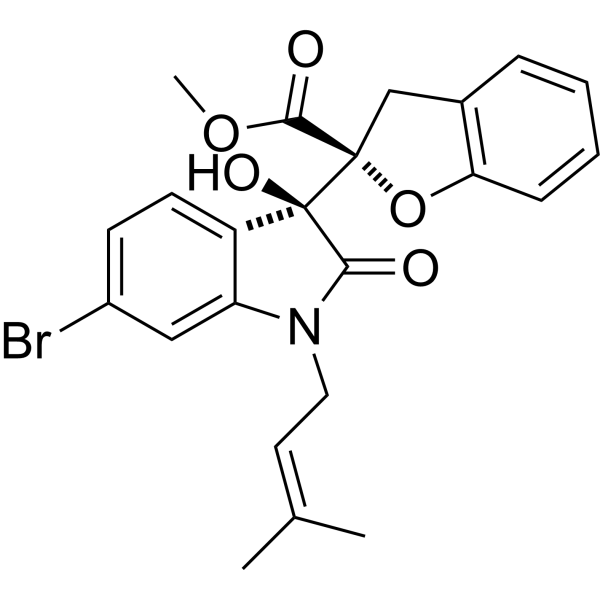
 0 ImagesCat. No.: HY-182710CAS No.: 1081317-31-8DA-0218 is a Nav1.7 inhibitor. DA-0218 exerts state-dependent inhibitory effects. DA-0218 alleviates formalin-induced inflammatory pain behavior and Paclitaxel-induced mechanical hyperalgesia in mice. DA-0218 inhibits Histamine-induced acute pruritus and lymphoma-induced chronic pruritus in mice. DA-0218 can be used in research related to inflammatory pain, neuropathic pain, acute pruritus and chronic pruritus.