



Biochemical Assay Reagents
Biochemical agents refers to the life science research related to biological material or organic compounds. Due to a wide range of life sciences, rapid development, and therefore a wide variety of such agents, complex in nature. There are electrophoresis reagents, chromatography reagents, centrifuged reagents, immunological reagent, labeled reagent, staining agents, penetration agents and carcinogens variable, insecticides, culture, buffering agents, electron microscopy reagents, protein and nucleic acid precipitating agent, condensing agent ultrafiltration membrane, clinical diagnostic reagents, dyes, antioxidants, preservatives, detergents and surfactants, standard biochemical reagents, biochemical reagents quality control materials, separation material, etc..
All Product Categories
-
Biochemical Assay Reagents Inhibitors
(10)
View all products
-
Biochemical Assay Reagents Modulator
(1)
View all products
-
Biochemical Assay Reagents Chemicals
(7)
View all products
-
Biochemical Assay Reagents Inducer
(1)
View all products
-
Biochemical Assay Reagents Controls
(59)
View all products
-
Biochemical Assay Reagents Substrates
(4)
View all products
-
Biochemical Assay Reagents Ligands
(2)
View all products
-
Biochemical Assay Reagents Related Products (16057)
Related Products (16057)

-
Antibodies (44)
-
Dazoxiben-CoA
 0 ImagesCat. No.: HY-CE01314Synonyms: Dazoxiben-coenzyme ADazoxiben-CoA (Dazoxiben-coenzyme A) is a coenzyme A derivative.
-
18:1 Stigmasteryl glucose
 0 ImagesCat. No.: HY-N15839CAS No.: 111103-97-018:1 stigmasteryl glucose is a glycosylated sterol.
-
1,2,3-Tri-O-benzoyl-α-L-fucopyranose,Trichloroacetimidate
 0 ImagesCat. No.: HY-W777009CAS No.: 180476-30-61,2,3-Tri-O-benzoyl-α-L-fucopyranose,Trichloroacetimidate is a class of biochemical reagents used in glycobiology research. Glycobiology studies the structure, synthesis, biology, and evolution of sugars. It involves carbohydrate chemistry, enzymology of glycan formation and degradation, protein-glycan recognition, and the role of glycans in biological systems. This field is closely related to basic research, biomedicine, and biotechnology.
-
Z-Gly-Pro-Gly-Gly-Pro-Ala-OH
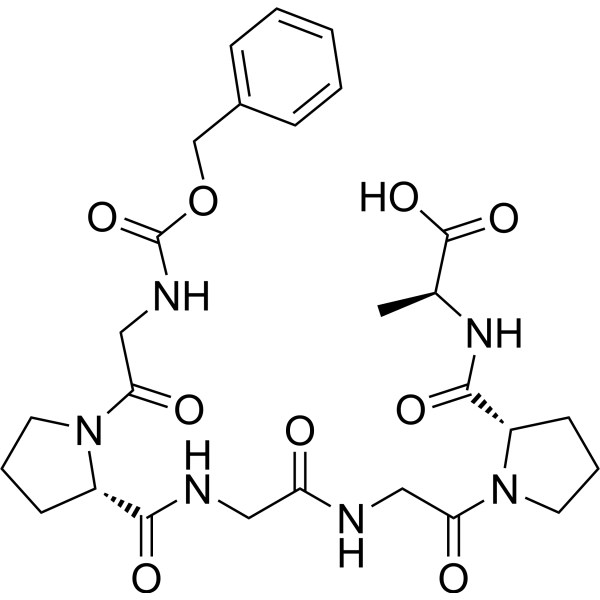 0 ImagesCat. No.: HY-P2718CAS No.: 13075-38-2Z-Gly-Pro-Gly-Gly-Pro-Ala-OH is a collagenase substrate that induces planulae to settle.
-
3-Indoxyl phosphate (bis(2-amino-2-methyl-1,3-propanediol))
 0 ImagesCat. No.: HY-163976CAS No.: 107475-12-73-Indoxyl phosphate (bis(2-amino-2-methyl-1,3-propanediol)) is a biochemical assay reagent.
-
Glucose-PEG5000-Biotin
 0 ImagesCat. No.: HY-183160CGlucose-PEG5000-Biotin is a conjugate composed of glucose, PEG chains, and biotin. Glucose-PEG5000-Biotin combines the targeted recognition capabilities of glucose with the high-affinity binding ability of biotin to avidin/streptavidin, enabling applications such as targeted drug delivery systems and nanoparticle modification.
-
N-Succinyl-methionine-CoA
 0 ImagesCat. No.: HY-CE01600Synonyms: N-Succinyl methionine-coenzyme AN-Succinyl-methionine-CoA (N-Succinyl methionine-coenzyme A) is a coenzyme A derivative.

-
(2E,21Z,24Z,27Z,30Z)-Hexatriacontapentaenoyl-CoA
 0 ImagesCat. No.: HY-CE00249ASynonyms: (2E,21Z,24Z,27Z,30Z)-Hexatriacontapentaenoyl-coenzyme A(2E,21Z,24Z,27Z,30Z)-Hexatriacontapentaenoyl-CoA ((2E,21Z,24Z,27Z,30Z)-Hexatriacontapentaenoyl-coenzyme A) is an unsaturated fatty acyl-CoA.
-
N-Carbamyl-D-methionine-CoA
 0 ImagesCat. No.: HY-CE01586Synonyms: N-Carbamyl-D-methionine-coenzyme AN-Carbamyl-D-methionine-CoA (N-Carbamyl-D-methionine-coenzyme A) is a coenzyme A derivative.
-
Folic acid/OVA
 0 ImagesCat. No.: HY-NP182Folic acid/OVA is a conjugate of Folic acid (HY-16637) and ovalbumin that improves the stability and solubility of folic acid.
-
Poly(ethylene glycol) diacrylate (MW 1500)
 0 ImagesCat. No.: HY-W110542KCAS No.: 26570-48-9Synonyms: PEGDA (MW 1500)Poly (ethylene glycol) diacrylate (MW 1500) (PEGDA (MW 1500)) is a polyethylene glycol-based diacrylate macromonomer and permselective reagent. Poly (ethylene glycol) diacrylate (MW 1500) enables rapid fabrication of artificial hydrogels via photopolymerization or free radical-induced crosslinking. Poly (ethylene glycol) diacrylate (MW 1500) is used in research related to drug delivery, tissue engineering, and antifouling coatings.
-
13-Hydroxyoctadecanoyl-CoA
 0 ImagesCat. No.: HY-CE00836Synonyms: 13-Hydroxyoctadecanoyl-coenzyme A13-Hydroxyoctadecanoyl-CoA (13-Hydroxyoctadecanoyl-coenzyme A) is a coenzyme A derivative.
-
Decanoyl m-Nitroaniline
 0 ImagesCat. No.: HY-W479534CAS No.: 72298-61-4Synonyms: DemNADecanoyl m-Nitroaniline (DemNA) is a nitroaniline fatty acid amides which can be used to measure fatty acid amide hydrolase (FAAH) activity (Ab = 410 nm).
-
Selenomethionine-selenoxide-CoA
 0 ImagesCat. No.: HY-CE01878Synonyms: Selenomethionine selenoxide-coenzyme ASelenomethionine-selenoxide-CoA (Selenomethionine selenoxide-coenzyme A) is a coenzyme A derivative.
-
mPEG500-Mannose
 0 ImagesCat. No.: HY-183019AmPEG500-Mannose is a polymeric derivative formed by the chemical coupling of methoxy polyethylene glycol (mPEG) and mannose. mPEG500-Mannose combines the biocompatibility of polyethylene glycol with the specificity of mannose in biorecognition, and is widely used in fields such as biomaterial modification and targeted delivery systems.
-
Methyl 2-cyclohexyl-2-hydroxyphenylacetate
 0 ImagesCat. No.: HY-W157189CAS No.: 10399-13-0Methyl 2-cyclohexyl-2-hydroxyphenylacetate is a biochemical reagent.
-
2,3,4,6-Tetra-O-acetyl-D-mannopyranosyl fluoride
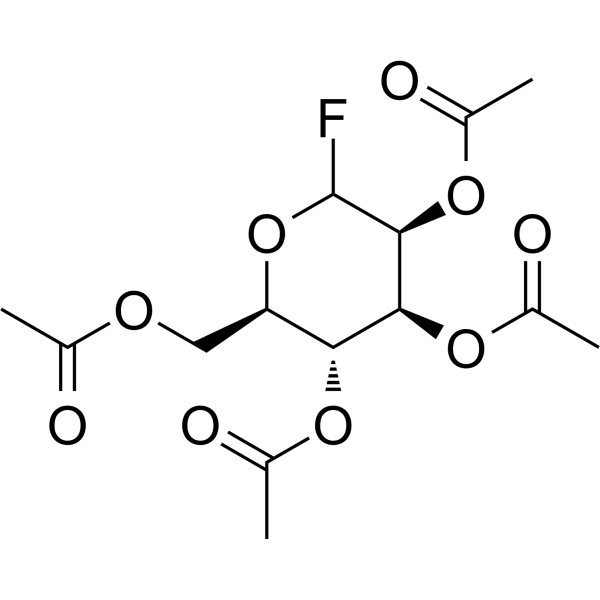 0 ImagesCat. No.: HY-W145569CAS No.: 174511-17-2Synonyms: (3,4,5-Triacetyloxy-6-fluorooxan-2-yl)methyl acetate2,3,4,6-Tetra-O-acetyl-D-mannopyranosyl Fluoride is a biochemical reagent that can be used as a biological material or organic compound for life science related research.
-
12:0 Biotinyl LPA ammonium
 0 ImagesCat. No.: HY-N16000CAS No.: 799812-69-412:0 Biotinyl LPA ammonium is a biotinylated lipid.




