



Biochemical Assay Reagents
Biochemical agents refers to the life science research related to biological material or organic compounds. Due to a wide range of life sciences, rapid development, and therefore a wide variety of such agents, complex in nature. There are electrophoresis reagents, chromatography reagents, centrifuged reagents, immunological reagent, labeled reagent, staining agents, penetration agents and carcinogens variable, insecticides, culture, buffering agents, electron microscopy reagents, protein and nucleic acid precipitating agent, condensing agent ultrafiltration membrane, clinical diagnostic reagents, dyes, antioxidants, preservatives, detergents and surfactants, standard biochemical reagents, biochemical reagents quality control materials, separation material, etc..
All Product Categories
-
Biochemical Assay Reagents Inhibitors
(10)
View all products
-
Biochemical Assay Reagents Modulator
(1)
View all products
-
Biochemical Assay Reagents Chemicals
(7)
View all products
-
Biochemical Assay Reagents Inducer
(1)
View all products
-
Biochemical Assay Reagents Controls
(59)
View all products
-
Biochemical Assay Reagents Substrates
(4)
View all products
-
Biochemical Assay Reagents Ligands
(2)
View all products
-
Biochemical Assay Reagents Related Products (16056)
Related Products (16056)

-
Antibodies (44)
-
21-Methyltetracosanoyl-CoA
 0 ImagesCat. No.: HY-CE00811Synonyms: 21-Methyltetracosanoyl-coenzyme A21-Methyltetracosanoyl-CoA (21-Methyltetracosanoyl-coenzyme A) is a coenzyme A derivative.
-
Phenylmethyl 2,3:5,6-bis-O-(1-methylethylidene)-α-D-mannofuranoside
 0 ImagesCat. No.: HY-W357110CAS No.: 20689-02-5Phenylmethyl 2,3:5,6-bis-O-(1-methylethylidene)-α-D-mannofuranoside is a class of biochemical reagents used in glycobiology research. Glycobiology studies the structure, synthesis, biology, and evolution of sugars. It involves carbohydrate chemistry, enzymology of glycan formation and degradation, protein-glycan recognition, and the role of glycans in biological systems. This field is closely related to basic research, biomedicine, and biotechnology.
-
AJICAP reagent 6b
 0 ImagesCat. No.: HY-P12261AJICAP reagent 6b is an Fc-affinity peptide reagent that site-specifically modifies Lys288 of native antibodies via thiophenyl ester chemistry. AJICAP reagent 6b enables site-specific conjugation of native antibodies at Lys288 with high conversion yield and reduced aggregation. AJICAP reagent 6b can be used for the research of cancer.
-
3α,6α-Mannopentaose
 0 ImagesCat. No.: HY-W726076CAS No.: 112828-69-03α,6α-Mannopentaose is a class of biochemical reagents used in glycobiology research. Glycobiology studies the structure, synthesis, biology, and evolution of sugars. It involves carbohydrate chemistry, enzymology of glycan formation and degradation, protein-glycan recognition, and the role of glycans in biological systems. This field is closely related to basic research, biomedicine, and biotechnology.
-
Iproplatin
 0 ImagesCat. No.: HY-130071CAS No.: 62928-11-4Synonyms: CHIPIproplatin (CHIP) is an anti-cancer agent with reduced toxicity in testicular and ovarian cancers. The major reduced product of Iproplatin by glutathione is chloro-bis (isopropylamine) glutathionatoplatinum (II). Iproplatin is promising for research of Thrombocytopenia and a wide range of cancers.
-
(3R,13Z)-3-Hydroxydocosenoyl-CoA
 0 ImagesCat. No.: HY-CE00214Synonyms: (3R,13Z)-3-Hydroxydocosenoyl-coenzyme A(3R,13Z)-3-Hydroxydocosenoyl-CoA ((3R,13Z)-3-Hydroxydocosenoyl-coenzyme A) is a 3-hydroxy fatty acyl-CoA.
-
(9Z,12Z,15Z)-3-Oxoicosatrienoyl-CoA
 0 ImagesCat. No.: HY-CE00288Synonyms: (9Z,12Z,15Z)-3-Oxoicosatrienoyl-coenzyme A(9Z,12Z,15Z)-3-Oxoicosatrienoyl-CoA ((9Z,12Z,15Z)-3-Oxoicosatrienoyl-coenzyme A) is a 3-oxo-fatty acyl-CoA.
-
PLLA1000-PEG1000-SPDP
 0 ImagesCat. No.: HY-167337PLLA1000-PEG1000-SPDP is a polylactic acid derivative that can form micelles in water and the SPDP moiety can react with thiols. PLLA1000-PEG1000-SPDP can be used in drug delivery research.
-
Ac-Lys(CoA)-NH2
 0 ImagesCat. No.: HY-CE01449CAS No.: 279256-67-6Synonyms: Ac-Lys(coenzyme A)-NH2Ac-Lys(CoA)-NH2 (Ac-Lys(coenzyme A)-NH2) is a coenzyme A derivative.
-
Acetyl-CoA carboxylase
 0 ImagesCat. No.: HY-E72075Acetyl-CoA carboxylase (EC 6.4.1.2) is a ligase that can convert hydrogencarbonate, acetyl-CoA and ATP into malonyl-CoA, ADP, phosphate and H+.
-
D-Mannitol,2,5-anhydro,1,3,4,6-tetraacetate
 0 ImagesCat. No.: HY-W701771CAS No.: 65729-88-6D-Mannitol,2,5-anhydro,1,3,4,6-tetraacetate is a class of biochemical reagents used in glycobiology research. Glycobiology studies the structure, synthesis, biology, and evolution of sugars. It involves carbohydrate chemistry, enzymology of glycan formation and degradation, protein-glycan recognition, and the role of glycans in biological systems. This field is closely related to basic research, biomedicine, and biotechnology.
-
20-Methyltetracosanoyl-CoA
 0 ImagesCat. No.: HY-CE00801Synonyms: 20-Methyltetracosanoyl-coenzyme A20-Methyltetracosanoyl-CoA (20-Methyltetracosanoyl-coenzyme A) is a coenzyme A derivative.
-
PAMAM dendrimer G0.5 carboxylate sodium (8.78% w/w in water)
 0 ImagesCat. No.: HY-169477CAS No.: 339334-01-9PAMAM Dendrimer G0.5 Carboxylate sodium is a polyamidoamine (PAMAM) dendrimer with carboxylate termini. PAMAM Dendrimer G0.5 Carboxylate sodium conjugated with DACHPt is cytotoxic to A2780 ovarian cancer cells, MCF-7 breast cancer cells, Caco-2 colon cancer cells and BJ fibroblasts with IC50 values of 0.03, 1.6, 0.18 and 3 µM, respectively.
-
Z-LRGG-AMC
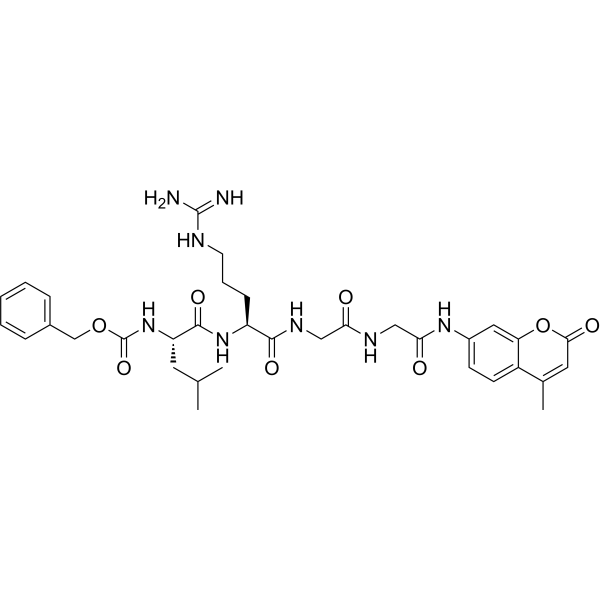 0 ImagesCat. No.: HY-P2176CAS No.: 167698-68-2Synonyms: Z-Leu-Arg-Gly-Gly-AMCZ-LRGG-AMC (Z-Leu-Arg-Gly-Gly-AMC) is a fluorescent substrate that hydrolyzes and releases free fluorescent 7-amino-4-methylcoumarin (AMC). Detection wavelength of AMC: Ex/Em=360/460 nm.
-
Tioxamast
 0 ImagesCat. No.: HY-105030CAS No.: 74531-88-7Synonyms: F 1865Tioxamast is an anti-allergic agent. Tioxamast can inhibit the synthesis and release of allergy mediators. Tioxamast blocks passive pulmonary anaphylactic shock induced by antigen aerosol in guinea-pig model.
-
10-Hydroxydodecanoyl-CoA
 0 ImagesCat. No.: HY-CE00511Synonyms: 10-Hydroxydodecanoyl-coenzyme A10-Hydroxydodecanoyl-CoA (10-Hydroxydodecanoyl-coenzyme A) is a coenzyme A derivative.

-
16:0-a15:0 PC
 0 ImagesCat. No.: HY-N15924CAS No.: 2260669-88-116:0-a15:0 PC is a branched lipid.
-
Erdosteine-CoA
 0 ImagesCat. No.: HY-CE01760Synonyms: Erdosteine-coenzyme AErdosteine-CoA (Erdosteine-coenzyme A) is a coenzyme A derivative.
-
FA2[3]G1 & FA2[6]G1 glycan (G1F), APTS labelled
![FA2[3]G1 & FA2[6]G1 glycan (G1F), APTS labelled](https://file.medchemexpress.com/product_pic/hy-158479.gif "Click to View FA2[3]G1 & FA2[6]G1 glycan (G1F), APTS labelled Product Detail") 0 ImagesCat. No.: HY-158479Synonyms: FA2[3]G1 & FA2[6]G1 N-linked oligosaccharide, APTS labelledFA2[3]G1 & FA2[6]G1 glycan (G1F), APTS labelled (FA2[3]G1 & FA2[6]G1 N-linked oligosaccharide, APTS labelled) is a N-polysaccharide protein and a multifunctional fluorescent linker. The resulting conjugates exhibit high sensitivity and specificity by mimicking the antennal elements of N-glycans.
0 ImagesCat. No.: HY-158479Synonyms: FA2[3]G1 & FA2[6]G1 N-linked oligosaccharide, APTS labelledFA2[3]G1 & FA2[6]G1 glycan (G1F), APTS labelled (FA2[3]G1 & FA2[6]G1 N-linked oligosaccharide, APTS labelled) is a N-polysaccharide protein and a multifunctional fluorescent linker. The resulting conjugates exhibit high sensitivity and specificity by mimicking the antennal elements of N-glycans.




