



ELOVL-6
ELOVL6 (elongation of very long-chain fatty acids protein 6) catalyzes the elongation of C12-C16 saturated and monounsaturated fatty acids, functioning as a microsomal rate-limiting enzyme in fatty acid biosynthesis[1][2][3]. Mechanistically, ELOVL6 activity modulates lipid composition in hepatocytes, mammary epithelial cells, and chondrocytes, thereby influencing energy metabolism, insulin sensitivity, and cellular differentiation[1][2][3]. Compared with other ELOVL isoforms, ELOVL6 shows distinct substrate specificity for medium-chain fatty acids, while ELOVL2, ELOVL5, and ELOVL4 preferentially elongate polyunsaturated fatty acids or very long-chain fatty acids[4][3]. In disease models, overexpression of ELOVL6 contributes to nonalcoholic steatohepatitis (NASH) progression by promoting hepatosteatosis, oxidative stress, and inflammasome activation[1]. Additionally, ELOVL6 positively correlates with breast cancer aggressiveness and poor prognosis, indicating its role in lipid-mediated oncogenic signaling[5]. In hematopoietic and leukemia models, ELOVL6 regulates CXCL12-CXCR4-dependent chemotaxis through PI3K-Rac1 signaling, with pharmacologic inhibition impairing cell migration[6]. For experimental applications, ELOVL6 modulation via overexpression or knockdown has been employed to investigate lipid synthesis, chondrocyte differentiation, and metabolic phenotypes in mammalian and aquatic systems[2][3]. Tissue-specific expression studies reveal elevated ELOVL6 in liver, intestine, mammary gland, and hepatopancreas, highlighting its relevance for metabolic research and functional genomics[7][3][8]. Collectively, ELOVL6 represents a key elongase with isoform-specific biological functions, disease associations, and versatile utility in experimental models[1][2][3][8].
References:
- [1]. Ferraz RB, et al. The repertoire of the elongation of very long-chain fatty acids (Elovl) protein family is conserved in tambaqui (Colossoma macropomum): Gene expression profiles offer insights into the sexual differentiation process. Comp Biochem Physiol B Biochem Mol Biol. 2022 Aug-Sep;261:110749. [Content Brief]
- [2]. Lin Z, et al. Cloning and expression characterization of elongation of very long-chain fatty acids protein 6 (elovl6) with dietary fatty acids, ambient salinity and starvation stress in Scylla paramamosain. Front Physiol. 2023 Jul 12;14:1221205. [Content Brief]
- [3]. Feng YH, et al. Elovl6 is a poor prognostic predictor in breast cancer. Oncol Lett. 2016 Jul;12(1):207-212. [Content Brief]
- [4]. Matsuzaka T, et al. Elovl6 promotes nonalcoholic steatohepatitis. Hepatology. 2012 Dec;56(6):2199-208. [Content Brief]
- [5]. Layman EJ. Ethical Issues and the Electronic Health Record. Health Care Manag (Frederick). 2020 Oct/Dec;39(4):150-161. doi: 10.1097/HCM.0000000000000302. PMID: 33079766. et al. Ethical Issues and the Electronic Health Record. Health Care Manag (Frederick). 2020 Oct/Dec;39(4):150-161. [Content Brief]
- [6]. Ribes-Navarro A, et al. Biosynthesis of Long-Chain Polyunsaturated Fatty Acids in Marine Gammarids: Molecular Cloning and Functional Characterisation of Three Fatty Acyl Elongases. Mar Drugs. 2021 Apr 16;19(4):226. [Content Brief]
- [7]. Kikuchi M, et al. Crucial Role of Elovl6 in Chondrocyte Growth and Differentiation during Growth Plate Development in Mice. PLoS One. 2016 Jul 28;11(7):e0159375. [Content Brief]
- [8]. Fan X, et al. Elongase of very long chain fatty acids 6 (ELOVL6) promotes lipid synthesis in buffalo mammary epithelial cells. J Anim Physiol Anim Nutr (Berl). 2022 Jan;106(1):1-11. [Content Brief]
- [9]. Ting SY, et al. Two Elongases, Elovl4 and Elovl6, Fulfill the Elongation Routes of the LC-PUFA Biosynthesis Pathway in the Orange Mud Crab (Scylla olivacea). J Agric Food Chem. 2020 Apr 8;68(14):4116-4130. [Content Brief]
All Product Categories
-
ELOVL-6 Related Products (2)
Related Products (2)

-
ELOVL6-IN-5
 0 ImagesCat. No.: HY-160912CAS No.: 1135000-36-0ELOVL6-IN-5 is an orally active and selective elongase enzyme of long-chain fatty acid family 6 (ELOVL6) inhibitor with IC50 values of 85 nM and 38 nM for human and mouse ELOVL6, respectively. ELOVL6-IN-5 shows >60-fold selectivity over other ELOVL family enzymes (ELOVL1, 2, 3, 5) and no effect on other lipid synthesis enzymes like ACC1, ACC2. ELOVL6-IN-5 reduces hepatic fatty acid composition ratio of C18 to C16 in diet-induced obesity (DIO) and KKAy mice. ELOVL6 inhibition by ELOVL6-IN-5 does not improve insulin resistance. ELOVL6-IN-5 can be used for the research of metabolic disease.
-
ELOVL6-IN-1
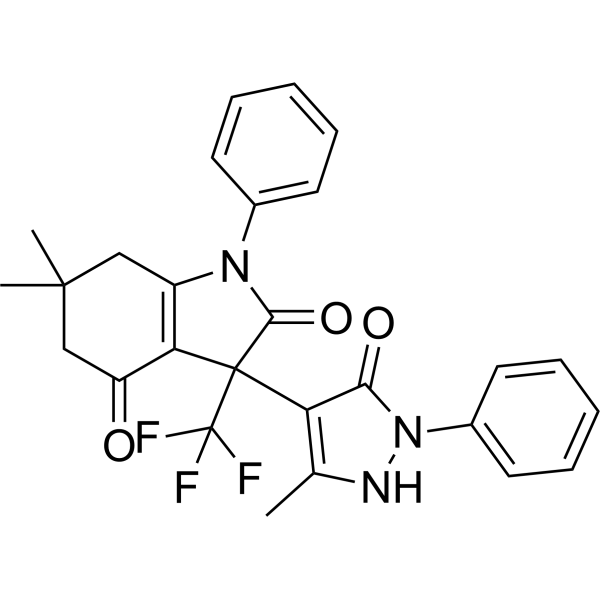 0 ImagesELOVL6-IN-1 is a selective ELOVL6 inhibitor with an IC50 of 290 nM for the human target. ELOVL6-IN-1 can be used for research related to type 2 diabetes.



