



Glutaminase
Glutaminase is the initial enzyme in glutamine metabolism, which catalyzes the hydrolysis of glutamine to glutamate in cells. Glutaminase plays a key role in cancer cell metabolism, growth, and proliferation. In mammalian cells, there are two paralogous GLS genes, GLS1 (or GLS) and GLS2. GLS1 encodes two alternatively spliced isozymes: kidney glutaminase (KGA) and glutaminase C (GAC). GLS2 also encodes two isozymes: liver glutaminase (LGA) and glutaminase B.
GLS1 is ubiquitously expressed in various tissues, and its expression can be induced by the oncogene MYC. GLS1 is frequently activated and/or overexpressed in various types of cancer, including hepatocellular carcinoma (HCC). GLS1 has been reported to promote tumorigenesis in different types of cancer, including HCC, which is mainly attributable to its glutaminase activity and role in promoting glutamine metabolism. GLS has emerged as a critical enzyme in a number of cancer types. Elevated GLS2 enzymatic activity has also been correlated with tumor cell growth in vitro and in vivo. N-Myc activates GLS2 to promote conversion of glutamine to glutamate in MYCN-amplified neuroblastoma cells. Abrogation of GLS2 function profoundly inhibits glutaminolysis and dramatically decreases cell proliferation and survival in vitro and in vivo. However, there is controversy over the role of GLS2 as a tumor suppressor. Enzymatic activity independent of GLS2 is up-regulated via p53 or p63 and plays a role of tumor suppressor.
All Product Categories
-
Glutaminase Related Products (74)
Related Products (74)

-
Antibodies (6)
-
Glutaminase C-IN-2
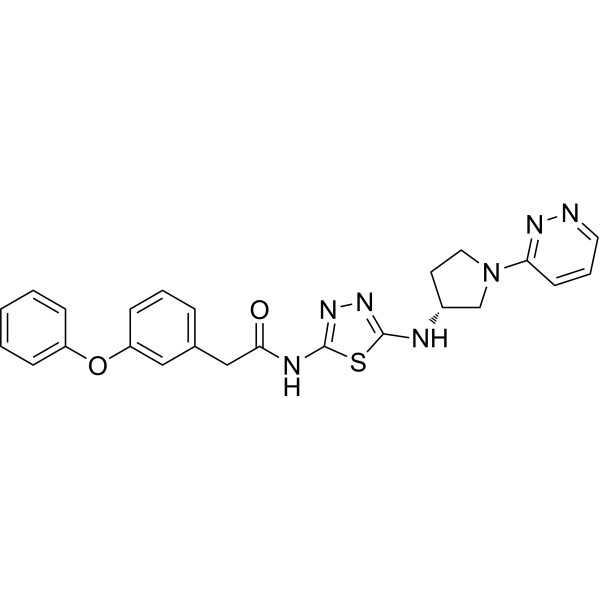 0 ImagesCat. No.: HY-149602CAS No.: 3056437-77-2Glutaminase C-IN-2 (compound 11) is glutaminase C (GAC) allosteric inhibitor with an IC50 of 10.64 nM. Glutaminase C-IN-2 regulates the cellular metabolite, thereby increasing reactive oxygen species (ROS) by blocking glutamine metabolism. Glutaminase C-IN-2 has anticancer effects.
-
A-446
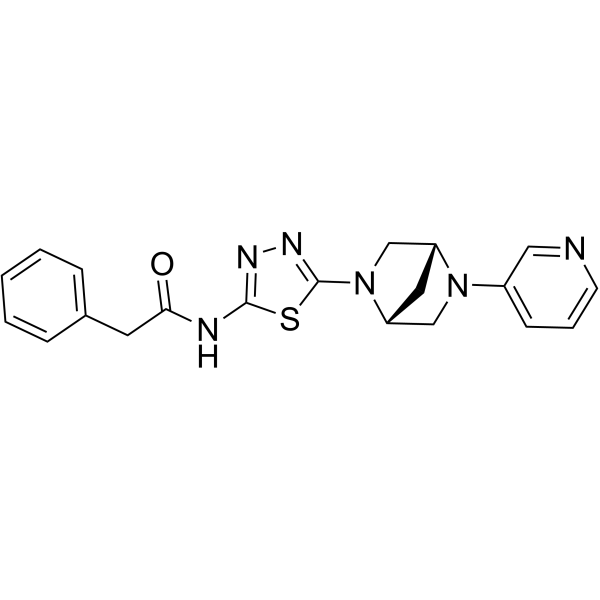 0 ImagesCat. No.: HY-148241A-446, a chemical probe, is a potent glutaminase (GLS) inhibitor with an IC50 value of 31 nM.
-
PROTAC TG2 degrader-1
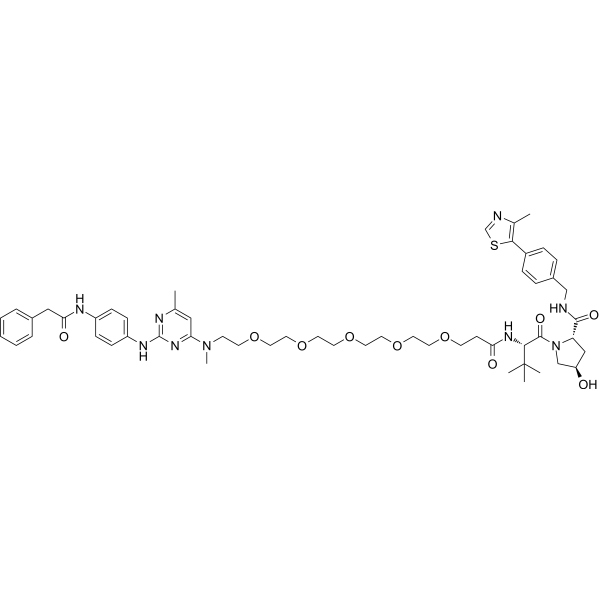 0 ImagesCat. No.: HY-155643CAS No.: 3033465-55-0PROTAC TG2 degrader-1 is a tissue transglutaminase (TG2) PROTAC degrader with a Kd of 68.9 μM. PROTAC TG2 degrader-1 recruits the VHL E3 ubiquitin ligase to the fibronectin-binding site of TG2, forms a ternary complex, and induces proteasome-dependent degradation of TG2. PROTAC TG2 degrader-1 inhibits ovarian cancer cell migration and adhesion to fibronectin, without producing a significant inhibitory effect on cell proliferation. PROTAC TG2 degrader-1 can be used in related research on ovarian cancer.
-
Barbinervic acid
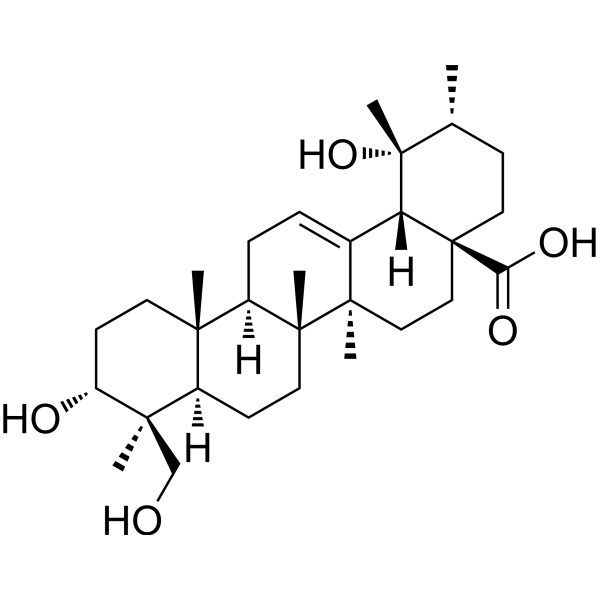 0 ImagesCat. No.: HY-N2916CAS No.: 64199-78-6Barbinervic acid is a glutaminase inhibitor with an IC50 of 14 μM. Barbinervic acid can be used for the study of neurodegenerative diseases.
-
mTOR/GLS1-IN-1
 0 ImagesCat. No.: HY-179003mTOR/GLS1-IN-1 (Compoud 9d) is a potent dual targeted mTOR/GLS1 inhibitor. Has anti proliferative activity against various tumor cells. mTOR/GLS1-IN-1 dose dependently induces ROS accumulation, induces autophagosome formation, and induces apoptosis. mTOR/GLS1-IN-1 can increase Fe2+, decrease GPX4, and induce ferroptosis. mTOR/GLS1-IN-1 can inhibit cell migration, invasion, and angiogenesis. mTOR/GLS1-IN-1 can be used in the research of cancer, such as breast cancer.
-
Cystamine-d8 dihydrochloride
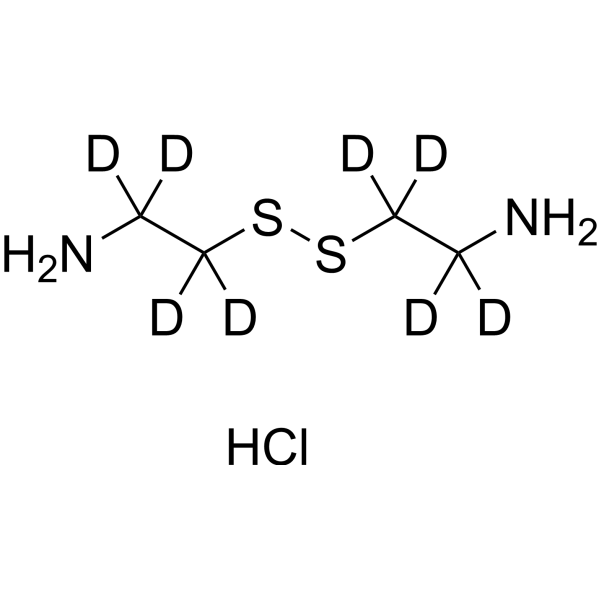 0 ImagesCat. No.: HY-W020050SCAS No.: 2712126-51-5Cystamine-d8 (dihydrochloride) is the deuterium labeled Cystamine (dihydrochloride). Cystamine (dihydrochloride) is the disulfide form of the free thiol, cysteamine. Cystamine is an orally active transglutaminase (Tgase) inhibitor. Cystamine also has inhibition activity for caspase-3 with an IC50 value of 23.6 μM. Cystamine can be used for the research of severals diseases including Huntington's disease (HD).
-
IPN60090 dihydrochloride (Standard)
 0 ImagesCat. No.: HY-103671ARCAS No.: 2102101-72-2IPN60090 dihydrochloride (Standard) is the analytical standard of IPN60090 dihydrochloride (HY-103671A). This product is intended for research and analytical applications. IPN-60090 dihydrochloride is an orally active and highly selective inhibitor of glutaminase 1 (GLS1; IC50=31 nM), with no activity observed against GLS-2. IPN-60090 dihydrochloride exhibits excellent physicochemical and pharmacokinetic properties in vivo. IPN-60090 dihydrochloride can be used for solid tumors research, such as lung and ovarian cancers.
-
BPTES (Standard)
 0 ImagesBPTES (Standard) is the analytical standard of BPTES. This product is intended for research and analytical applications. BPTES is an allosteric and selective glutaminase inhibitor with an IC50 of 0.16 μM.
-
Telaglenastat (Standard)
 0 ImagesSynonyms: CB-839 (Standard)Telaglenastat (Standard) is the analytical standard of Telaglenastat. This product is intended for research and analytical applications. Telaglenastat (CB-839) is a first-in-class, selective, reversible and orally active glutaminase 1 (GLS1) inhibitor. Telaglenastat selectively inhibits GLS1 splice variants KGA (kidney-type glutaminase) and GAC (glutaminase C) compared to GLS2. The IC50s are 23 nM and 28 nM for endogenous glutaminase in mouse kidney and brain, respectively. Telaglenastat inuduces autophagy and has antitumor activity.
-
L-Phosphinothricin
 0 ImagesCat. No.: HY-160735CAS No.: 35597-44-5L-Phosphinothricin is a glutamine synthetase inhibitor and a non-selective herbicide. L-Phosphinothricin acts as a competitive inhibitor, induces toxic ammonium ion accumulation in plants and bacteria, and indirectly blocks the photosynthesis process. L-Phosphinothricin exerts herbicidal activity against both monocotyledonous and dicotyledonous plant species, is primarily absorbed through plant leaves, exhibits limited translocation in plants, and undergoes rapid degradation by soil microorganisms with no root uptake. L-Phosphinothricin can be used for research on weed control in agricultural and non-crop scenarios.
-
IPN60090 (Standard)
 0 ImagesCat. No.: HY-103671RCAS No.: 1853164-83-6IPN60090 (Standard) is the analytical standard of IPN60090 (HY-103671). This product is intended for research and analytical applications. IPN-60090 is an orally active and highly selective inhibitor of glutaminase 1 (GLS1; IC50=31 nM), with no activity observed against GLS-2. IPN-60090 exhibits excellent physicochemical and pharmacokinetic properties in vivo. IPN-60090 can be used for solid tumors research, such as lung and ovarian cancers.
-
L-Methionine-DL-sulfoximine (Standard)
 0 ImagesCat. No.: HY-B1692RCAS No.: 15985-39-4Synonyms: MSX (Standard); MSO (Standard)L-Methionine-DL-sulfoximine (Standard) is the analytical standard of L-Methionine-DL-sulfoximine (HY-B1692). This product is intended for research and analytical applications. L-Methionine-DL-sulfoximine (MSX; MSO), a highly specific and irreversible inhibitor of Glutamine synthetase (GS), is also a potent convulsant which metabolically and morphologically primarily affects astroglia. L-Methionine-DL-sulfoximine has been employed to inhibit the Gln-dependent ammonia-stimulated neuronal toxicity in vitro, potentiating Gln deficit-dependent depression. L-Methionine-DL-sulfoximine tremendously increases the rate of release of fixed nitrogen in cyanobacteria. L-Methionine-DL-sulfoximine is a promising candidate for research in biofertilizers and convulsive seizures (CS).
-
THDP17
 0 ImagesCat. No.: HY-114929CAS No.: 104741-27-7THDP17 is an orally active glutaminase inhibitor. THDP17 decreases ammonia production through glutaminase inhibition.
-
Duazomycin sodium (Standard)
 0 ImagesCat. No.: HY-105723ARCAS No.: 2839447-07-1Synonyms: Duazomycin A sodium (Standard)Duazomycin sodium (Standard) is the analytical standard of Duazomycin sodium (HY-105723A). This product is intended for research and analytical applications. Duazomycin (Duazomycin A) sodium is a glutamine antagonist. Duazomycin sodium can significantly enhance the effectiveness of 6-Mercaptopurine (6-MP) (HY-13677) in experimental allergic encephalomyelitis (EAE) without increasing toxicity.




