



Glycosyltransferase
Glycosyltransferases (GTs) are key enzymes in the biosynthesis of ginsenosides, which can catalyze the transfer of glycans from donor molecules to acceptor molecules, and form a variety of biologically active glycoside compounds.
All Product Categories
-
Glycosyltransferase Related Products (56)
Related Products (56)

-
Antibodies (4)
-
Iliparcil
 0 ImagesIliparcil has a potent antithrombotic activity in the Wessler model in rats. Iliparcil has oral activity.
-
β-1,4-Galactosyltransferase, neisseria meningitides
 0 Imagesbeta-1,4-Galactosyltransferase (LgtB) (EC 2.4.1.90) (B4GALT1 (LgtB)) is often used in biochemical studies. beta-1,4-Galactosyltransferase (LgtB) catalyzes the reaction involving UDP-galactose and N-acetylglucosamine for the production of galactose beta-1,4-N-acetylglucosamine.
-
ST6 Gal Sialyltransferase 1
 0 ImagesCat. No.: HY-E70148Synonyms: ST6GAL1ST6 Gal Sialyltransferase 1 (EC:2.4.3.1, ST6GAL1) catalyzes the transfer of sialic acid from CMP-sialic acid to galactose-containing substrates.
-
Bilirubin diglucuronide
 0 ImagesCat. No.: HY-N11424CAS No.: 17459-92-6Bilirubin diglucuronide is a bilirubin glycoside conjugate with a 1-O-acyl β-D-glucuronide structure. Bilirubin diglucuronide is the major conjugated bilirubin (HY-N0323) and predominant pigment excreted in the bile of adult humans, rats, dogs and cats. Bilirubin diglucuronide is mainly synthesized via UDP-glucuronosyltransferase-mediated transfer of glucuronic acid from UDP-glucuronic acid to bilirubin monoglucuronide, or via enzymatic disproportionation of two moles of bilirubin monoglucuronide (predominantly producing the IXα configuration). In addition, Bilirubin diglucuronide can also be synthesized from bilirubin or its monoglucuronide in a UDP-glucuronic acid-dependent manner. Pretreatment with phenobarbital significantly enhances the formation process of Bilirubin diglucuronide.
-
GDP-azido-fucose
 0 ImagesCat. No.: HY-164169CAS No.: 912921-33-6GDP-azido-fucose is a glycoengineering tool. GDP-azido-fucose modifies complex glycans by adding an azido-fucose group. GDP-azido-fucose can install azido-fucose tags on antibody Fc glycans for site-specific payload conjugation, thereby forming antibody-drug conjugates with defined ratios.
-
ST6 Sialyltransferase 5
 0 ImagesCat. No.: HY-E70287Synonyms: ST6GALNAC5ST6 Sialyltransferase 5 (EC:2.4.3.3, ST6GALNAC5, SIAT7E, ST6 N-acetylgalactosaminide alpha-2,6-sialyltransferase 5) transfers a sialic acid to N-acetylgalactosamine (GalNAc) residues. ST6 Sialyltransferase 5 is a bio-marker in cervical screening samples.
-
Helicobacter pylori alpha-1,3-fucosyltransferase
 0 ImagesCat. No.: HY-E70064ASynonyms: Hp3FTHelicobacter pylori alpha-1,3-fucosyltransferase (Hp3FT) catalyzes the glycosyl addition of fucose from the donor GDP-fucose to the acceptor N-acetyllactosamine.
-
Protein O-Fucosyltransferase 1
 0 ImagesCat. No.: HY-E70160Synonyms: EC:2.4.1.221; POFUT1Protein O-Fucosyltransferase 1 (EC:2.4.1.221; POFUT1) is a Glycosyltransferase containing the cysteine-rich motifs as the acceptor sugar and GDP-fucose as the donor.
-
Glycation-IN-1
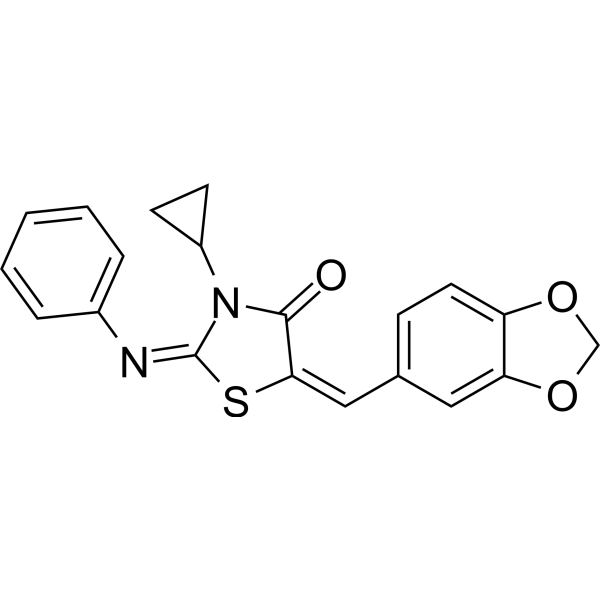 0 ImagesCat. No.: HY-157461CAS No.: 3023711-86-3Glycation-IN-1 (Compound 3) is an inhibitor of glycosylation reactions, which has a strong inhibitory effect on the synthesis of initial, intermediate, and final products of glycosylation reactions. Glycion-IN-1 can be used in the research of various chronic diseases, such as diabetes, immune inflammation, cardiovascular diseases and neurodegenerative diseases.
-
beta-1,3-Galactosyltransferase (CgtB)
 0 ImagesCat. No.: HY-E70050CAS No.: 37217-28-0beta-1,3-Galactosyltransferase (CgtB) (GM1-synthase) is an enzyme that required for sialylated lipooligosaccharide (LOSSIAL) production, is often used in biochemical studies. beta-1,3-Galactosyltransferase (CgtB) catalyzes the addition of a galactose molecule, which is required for GM1-like LOSSIAL structure production.
-
beta-1,3-Galactosyltransferase (WbgO)
 0 Imagesbeta-1,3-Galactosyltransferase (WbgO) (CgtB) acts on N-glycan substrates. beta-1,3-Galactosyltransferase (WbgO) catalyzes the formation of type 1 chains on oligosaccharide, glycopeptide, and glycoprotein substrates, including itself.
-
Bovine beta-1,4-Galactosyltransferase
 0 ImagesCat. No.: HY-E70046ASynonyms: Bovine B4GALT1Bovine beta-1,4-Galactosyltransferase (Bovine B4GALT1) is a one member of the glycosyltransferase family of enzymes. Bovine beta-1,4-Galactosyltransferase transfers galactose from UDP-galactose to N-acetylglucosamine (GlcNAc) to produce N-acetyllactosamine with a β-1,4-glycosidic linkage.


-
β-1,3-N-Acetylglucosaminyltransferase 4
 0 ImagesCat. No.: HY-E70141Synonyms: EC:2.4.1.149; B3GNT4β-1,3-N-Acetylglucosaminyltransferase 4 (EC:2.4.1.149, B3GNT4) is involved in the synthesis of poly-N-acetyllactosamine and has activity for type 2 oligosaccharides.
-
GYS1-IN-1
 0 ImagesCat. No.: HY-156155CAS No.: 2839916-15-1GYS1-IN-1 (compound 783) is a glycogen synthase 1(GYS1) inhibitor. GYS1-IN-1 can be used for the study of GYS1 -mediated disease, such as Gaucher and Fabry diseases.
-
ppGalNAc-T2-IN-1
 0 ImagesCat. No.: HY-175807CAS No.: 1112431-86-3ppGalNAc-T2-IN-1 is a polypeptide N-acetylgalactosaminyltransferase 2 (ppGalNAc-T2) inhibitor with an IC50 of 7.11 μM. ppGalNAc-T2-IN-1 is applicable for research on metabolic and neurodevelopmental disorders.




