



mAChR4 Agonist
- 1
- 2
-
Xanomeline-NH-Boc
 0 ImagesCat. No.: HY-186320CAS No.: 1018846-42-8
Xanomeline-NH-Boc is a derivative of Xanomeline (HY-105182), which serves as the orthosteric pharmacophore of M1/M4 muscarinic agonist 4 (HY-187957) for activating mAChR1/4.
-
Milameline
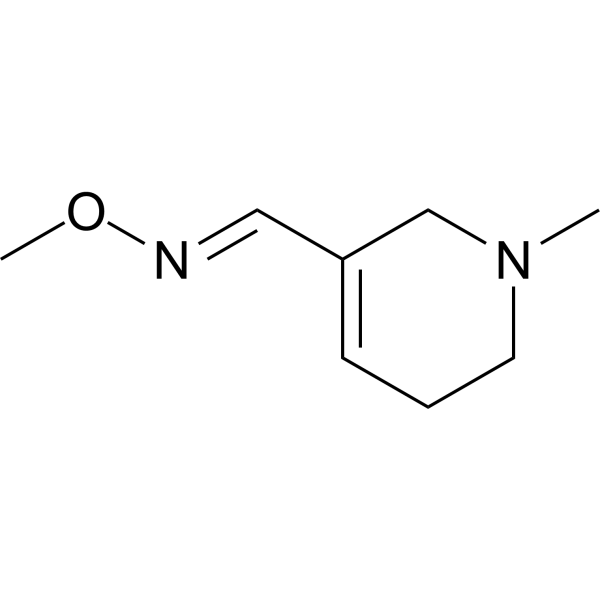 0 ImagesCat. No.: HY-135460CAS No.: 139886-32-1Synonyms: CI-979; RU35926
Milameline (CI-979; RU35926) is a nonselective, partical and orally active muscarinic receptor agonist that improves cognition. Milameline has equal affinity for different subtypes of human muscarinic receptors with IC50 of 1.3 µM for M1-, 1.1 µM for M2-, 1.5 µM for M3-, and 1.9 µM for M4-muscarinic receptors. Milameline has a higher affinity for sites [3H]CMD (IC50 = 20 nM), than [3H]QNB, (IC50 = 3059 nM). Milameline produces both central and peripheral cholinergic effects and reverses the cognitive deficits induced by Scopolamine (HY-N0296). Milameline can be used for the study of Alzheimer’s Disease.
-
Bethanechol-d6 chloride
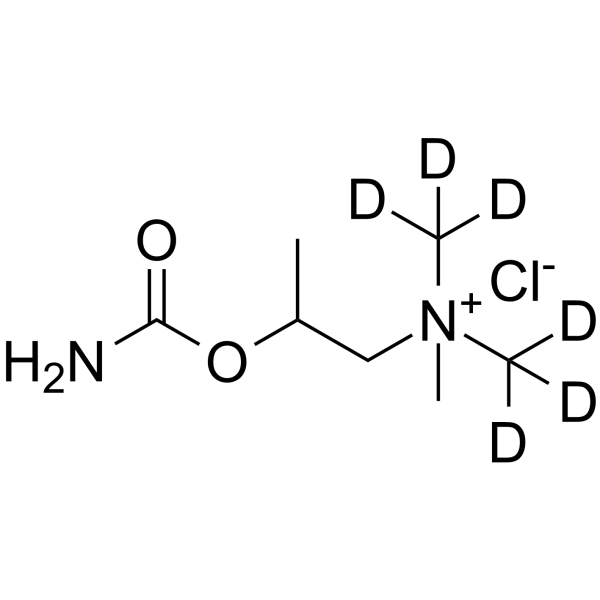 0 ImagesCat. No.: HY-B0406ASSynonyms: Carbamyl-β-methylcholine-d6 chloride
Bethanechol-d6 (chloride) is the deuterium labeled Bethanechol chloride. Bethanechol chloride (Carbamyl-β-methylcholine chloride), a parasympathomimetic agent, is a mAChR agonist that exerts its effects via directly stimulating the mAChR (M1, M2, M3, M4, and M5) of the parasympathetic nervous system.
-
Milameline hydroiodide
 0 ImagesCat. No.: HY-107650ASynonyms: CI 979 hydroiodide; RU 35926 hydroiodide
Milameline (CI 979; RU35926) hydroiodide is a nonselective, partical and orally active muscarinic receptor agonist that improves cognition. Milameline hydroiodide has equal affinity for different subtypes of human muscarinic receptors with IC50 of 1.3 µM for M1-, 1.1 µM for M2-, 1.5 µM for M3-, and 1.9 µM for M4-muscarinic receptors. Milameline hydroiodide has a higher affinity for sites [3H]CMD (IC50 = 20 nM), than [3H]QNB, (IC50 = 3059 nM). Milameline hydroiodide produces both central and peripheral cholinergic effects and reverses the cognitive deficits induced by Scopolamine (HY-N0296). Milameline hydroiodide can be used for the study of Alzheimer’s Disease.
-
M1/M4 muscarinic agonist 4
 0 ImagesCat. No.: HY-187957
M1/M4 muscarinic agonist 4 is a dual-site muscarinic acetylcholine receptor ligand with potent agonistic activity at M1/M4 muscarinic acetylcholine receptors. M1/M4 muscarinic agonist 4 activates M1R to induce phosphorylation of ERK1/2, and activates M4R to induce GαoB protein activation as well as ERK1/2 phosphorylation. M1/M4 muscarinic agonist 4 exhibits higher binding affinity for M4R than for other muscarinic receptors, while its binding affinity for the W435A mutant M4R is reduced. M1/M4 muscarinic agonist 4 can be used in the research of schizophrenia.
-
M1/M2/M4 muscarinic agonist 1
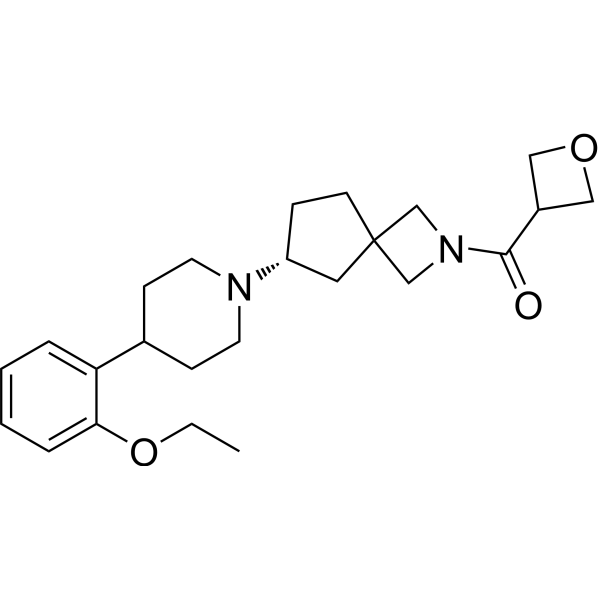 0 ImagesCat. No.: HY-149704CAS No.: 2640109-42-6
M1/M2/M4 muscarinic agonist 1 (Compound 42) is a muscarinic M4/M1/M2 agonist with EC50 values of 6.5, 26 and 210 nM for M4/M1/M2, respectively. M1/M2/M4 muscarinic agonist 1 can be used for research on mental diseases, such as schizophrenia, delusion, etc.
-
Arecaidine-propargyl ester
 0 ImagesCat. No.: HY-183853CAS No.: 35516-99-5
Arecaidine-propargyl ester is a selective M2 muscarinic receptor agonist with blood-brain barrier permeability, with a pKi of 5.91 for hm1, 7.06 for hm2, 6.07 for hm3, 6.01 for hm4, and 6.03 for hm5. Arecaidine-propargyl ester stimulates central and peripheral muscarinic receptors. Arecaidine-propargyl ester increases intracellular ROS, induces DNA damage and Apoptosis, and upregulates the expression of MnSOD and SIRT1. Arecaidine-propargyl ester reduces sympathetic nerve outflow, induces dose-dependent hypotension, and triggers negative chronotropic effects at high peripheral doses. Arecaidine-propargyl ester can be used in research related to Alzheimer's disease and glioblastoma.
- 1
- 2



