



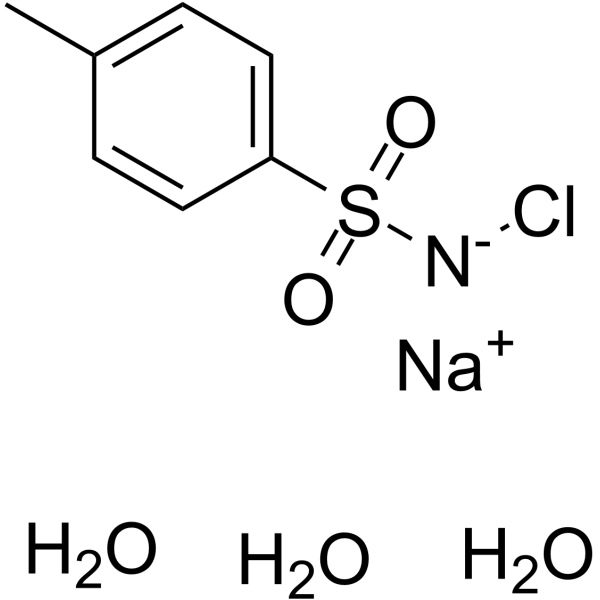
Tosylchloramide sodium trihydrate

Based on 1 Customer Validation
Tosylchloramide sodium trihydrate (Chloramine T sodium trihydrate) is a disinfectant agent widely used in laboratories, kitchens and hospitals. It is also used as a biocide in air fresheners and deodorants.
Nur für Forschungszwecke. Wir verkaufen nicht an Patienten.
- Reinheit : 98.0%
- CAS. Nr.: 7080-50-4
- Formel: C7H13ClNNaO5S
- Molecular Weight:281.69
-
Speicherung:Powder -20°C, 3 years , 4°C, 2 years ; In solvent -80°C, 6 months , -20°C, 1 month

To place orders, for customer services and technical support, please contact: MedChemExpress USA
Tel: 609-228-6898 E-mail: [email protected] [email protected]


-
 Biologische Aktivität
-
Chemical Information
-
Lösungsmittel & Löslichkeit
- Reinheit & Dokumentation
- Verweise
-
 Help & FAQs


-

HY-Y0283
Potassium iodide ,meet Ch.PBiochemical Reagent -

HY-Y0775
1-Bromo-2,5-pyrrolidinedioneBiochemical Assay Reagents -

HY-ER017
N-IodosuccinimidePlant Agglutinin -

HY-Y0532
N-Chlorosuccinimide生化试剂 -

HY-Y0775R
1-Bromo-2,5-pyrrolidinedione (Standard)Standard Of 1-Bromo-2,5-pyrrolidinedione -
HY-N0681
D-Pantothenic acid hemicalcium saltVitamin -

HY-21179
Trimethylsilyl trifluoromethylsulfonateMetal-free Catalyst -

HY-N0681R
D-Pantothenic acid hemicalcium salt (Standard)Vitamin -

HY-Y0532R
N-Chlorosuccinimide (Standard)Reference Standard


Biologische Aktivität
Beschreibung
In Vitro
Gram-positive growth is reduced by 95% to 100% after tosylchloramide treatment, regardless of dose, with or without serum. E coli (gram-negative; with/without serum) is reduced 94% to 100% at antiseptic concentrations of 300 and 400 ppm. At 200 ppm, E coli growth is fully inhibited without serum present and by 50% with serum. At 100 and 200 ppm, cell viability remains greater than 90% under all experimental conditions. A 300-ppm, 3-minute exposure to tosylchloramide results in cell viability of up to 70%, with longer exposures producing lower viabilities. Serum does not affect cell viability in any condition[1].
MedChemExpress (MCE) has not independently confirmed the accuracy of these methods. They are for reference only. .
In Vivo
MedChemExpress (MCE) has not independently confirmed the accuracy of these methods. They are for reference only.


Chemical Information
-
CAS. Nr. 7080-50-4
-
Appearance Solid
-
Molecular Weight 281.69
-
Formel C7H13ClNNaO5S
-
Color White to off-white
-
SMILES
O=S(C1=CC=C(C)C=C1)([N-]Cl)=O.[Na+].O.O.O
-
Versand
Room temperature in continental US; may vary elsewhere.
-
Speicherung
Powder -20°C 3 years 4°C 2 years In solvent -80°C 6 months -20°C 1 month


Lösungsmittel & Löslichkeit
In Vitro:
DMSO : 100 mg/mL (355.00 mM; Need ultrasonic; Hygroscopic DMSO has a significant impact on the solubility of product, please use newly opened DMSO)
Please refer to the solubility information to select the appropriate solvent. Once prepared, please aliquot and store the solution to prevent product inactivation from repeated freeze-thaw cycles.
Storage method and period of stock solution: -80°C, 6 months; -20°C, 1 month. When stored at -80°C, please use it within 6 months. When stored at -20°C, please use it within 1 month.
Please refer to the solubility information to select the appropriate solvent. Once prepared, please aliquot and store the solution to prevent product inactivation from repeated freeze-thaw cycles.
Storage method and period of stock solution: -80°C, 6 months; -20°C, 1 month. When stored at -80°C, please use it within 6 months. When stored at -20°C, please use it within 1 month.
Konzentration (Stammlösung) × Volumen (Stammlösung) = Konzentration (Ziellösung) × Volumen (Ziellösung)
In Vivo:
Select the appropriate dissolution method based on your experimental animal and administration route.
- For the following dissolution methods, please ensure to first prepare a clear stock solution using an In Vitro approach and then sequentially add co-solvents:
- To ensure reliable experimental results, the clarified stock solution can be appropriately stored based on storage conditions. As for the working solution for In Vivo experiments, it is recommended to prepare freshly and use it on the same day.
- The percentages shown for the solvents indicate their volumetric ratio in the final prepared solution. If precipitation or phase separation occurs during preparation, heat and/or sonication can be used to aid dissolution.
Add each solvent one by one: 10% DMSO 40% PEG300 5% Tween-80 45% Saline
Solubility: ≥ 2.5 mg/mL (8.88 mM); Clear solution
This protocol yields a clear solution of ≥ 2.5 mg/mL (saturation unknown).
Taking 1 mL working solution as an example, add 100 μL DMSO stock solution (25.0 mg/mL) to 400 μL PEG300, and mix evenly; then add 50 μL Tween-80 and mix evenly; then add 450 μL Saline to adjust the volume to 1 mL.
Preparation of Saline: Dissolve 0.9 g sodium chloride in ddH₂O and dilute to 100 mL to obtain a clear Saline solution.
Add each solvent one by one: 10% DMSO 90% (20% SBE-β-CD in Saline)
Solubility: ≥ 2.5 mg/mL (8.88 mM); Clear solution
This protocol yields a clear solution of ≥ 2.5 mg/mL (saturation unknown).
Taking 1 mL working solution as an example, add 100 μL DMSO stock solution (25.0 mg/mL) to 900 μL 20% SBE-β-CD in Saline, and mix evenly.
Preparation of 20% SBE-β-CD in Saline (4°C, storage for one week): 2 g SBE-β-CD powder is dissolved in 10 mL Saline, completely dissolve until clear.
In Vivo Dissolution Calculator
Please enter the basic information of animal experiments:
-
-
-
-
Recommended: Prepare an additional quantity of animals to account for potential losses during experiments.
Please enter your animal formula composition:
-
%DMSO +
Recommended: Keep the proportion of DMSO in working solution below 2% if your animal is weak.
-
%+
-
+%Tween-80 + +
-
%Saline +
The co-solvents required include: DMSO, . All of co-solvents are available by MedChemExpress (MCE). , Tween 80. All of co-solvents are available by MedChemExpress (MCE).
Working solution concentration: 0.22 mg/mL
Method for preparing stock solution: mg drug dissolved in μL DMSO. Stock solution concentration: mg/mL.
1. Take μL DMSO stock solution;
2. Add μL .
μL , mix evenly;
3. Then add μL Tween 80, mix evenly;
4. Then add μL
Please ensure that the stock solution in the first step is dissolved to a clear state, and add co-solvents in sequence. You can use ultrasonic heating (ultrasonic cleaner, recommended frequency 20-40 kHz), vortexing, etc. to assist dissolution.


Reinheit & Dokumentation
-
Data Sheet (281 KB)
-
SDS (779 KB)
- English - EN (779 KB)
- Français - FR (779 KB)
- Deutsch - DE (779 KB)
- Norwegian - NO (779 KB)
- Español - ES (779 KB)
- Swedish - SV (779 KB)
- Italian - IT (779 KB)
- Korean - KR (779 KB)
- Portuguese - PT (779 KB)
-
Handling Instructions (2659 KB)
Verweise
[1]. Kloth LC, et al. Bactericidal and cytotoxic effects of chloramine-T on wound pathogens and human fibroblasts in vitro. Adv Skin Wound Care. 2007 Jun;20(6):331-45. [Content Brief]
[2]. Shim I, et al. Inhalation exposure to chloramine T induces DNA damage and inflammation in lung of Sprague-Dawley rats. J Toxicol Sci. 2013;38(6):937-46. [Content Brief]
[3]. Kuklina I, et al. Investigation of chloramine-T impact on crayfish Astacus leptodactylus (Esch., 1823) cardiac activity. Environ Sci Pollut Res Int. 2014 Sep;21(17):10262-9. [Content Brief]
[4]. Martínez MA, et al. Induction of cytochrome P450-dependent mixed function oxidase activities and peroxisome proliferation by chloramine-T in male rat liver. Food Chem Toxicol. 2017 Aug;106(Pt A):86-91. [Content Brief]


Complete Stock Solution Preparation Table
Please refer to the solubility information to select the appropriate solvent. Once prepared, please aliquot and store the solution to prevent product inactivation from repeated freeze-thaw cycles.
Storage method and period of stock solution: -80°C, 6 months; -20°C, 1 month. When stored at -80°C, please use it within 6 months. When stored at -20°C, please use it within 1 month.
| Optional Solvent | Concentration Solvent Mass | 1 mg | 5 mg | 10 mg | 25 mg |
|---|---|---|---|---|---|
| DMSO | 1 mM | 3.5500 mL | 17.7500 mL | 35.5000 mL | 88.7500 mL |
| 5 mM | 0.7100 mL | 3.5500 mL | 7.1000 mL | 17.7500 mL | |
| 10 mM | 0.3550 mL | 1.7750 mL | 3.5500 mL | 8.8750 mL | |
| 15 mM | 0.2367 mL | 1.1833 mL | 2.3667 mL | 5.9167 mL | |
| 20 mM | 0.1775 mL | 0.8875 mL | 1.7750 mL | 4.4375 mL | |
| 25 mM | 0.1420 mL | 0.7100 mL | 1.4200 mL | 3.5500 mL | |
| 30 mM | 0.1183 mL | 0.5917 mL | 1.1833 mL | 2.9583 mL | |
| 40 mM | 0.0888 mL | 0.4438 mL | 0.8875 mL | 2.2188 mL | |
| 50 mM | 0.0710 mL | 0.3550 mL | 0.7100 mL | 1.7750 mL | |
| 60 mM | 0.0592 mL | 0.2958 mL | 0.5917 mL | 1.4792 mL | |
| 80 mM | 0.0444 mL | 0.2219 mL | 0.4438 mL | 1.1094 mL | |
| 100 mM | 0.0355 mL | 0.1775 mL | 0.3550 mL | 0.8875 mL |


Tosylchloramide sodium trihydrate Related Classifications
HY-U00087 Related Classifications
 Powered by Bioz