



AChE/BuChE-IN-1
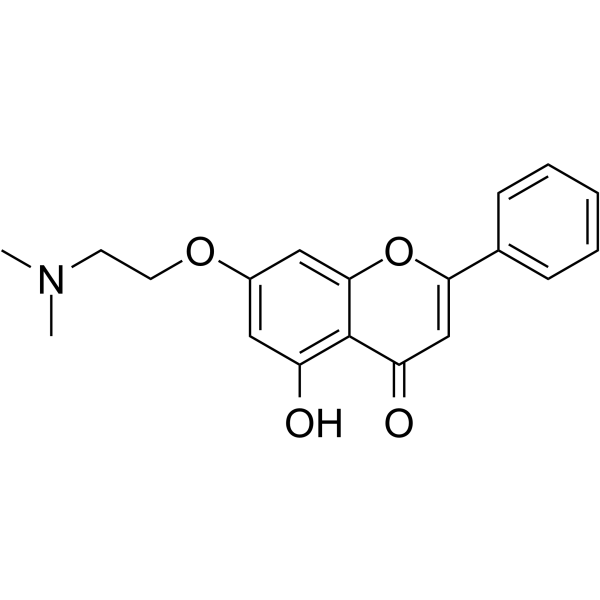
AChE/BuChE-IN-1 (Compound 1), a chrysin derivative, is a selective butyrylcholinesterase (BuChE) inhibitor with an IC50 of 0.48 μM. AChE/BuChE-IN-1 inhibits acetylcholinesterase (AChE) with an IC50 of 7.16 μM. AChE/BuChE-IN-1 shows strong scavenging ·OH activities with a IC50 of 0.1674 μM. AChE/BuChE-IN-1 inhibits reactive oxygen species (ROS), Aβ1-42 aggregation (self-, Cu2+-induced, AChE-induced). AChE/BuChE-IN-1 has high BBB permeability and bioavailability and low cell toxicity. AChE/BuChE-IN-1 has the potential for Alzheimer' disease (AD) research.
For research use only. We do not sell to patients.
- CAS No.: 84212-49-7
- Formula: C19H19NO4
- Molecular Weight:325.36
-
Storage:
Please store the product under the recommended conditions in the Certificate of Analysis.

To place orders, for customer services and technical support, please contact: MedChemExpress USA
Tel: 609-228-6898 E-mail: [email protected] [email protected]


-
 Biological Activity
-
Chemical Information
- Protocols
- Purity & Documentation
- References
-
 Help & FAQs




Biological Activity
Description
IC50 & Target
|
AChE |
Cellular Effect
|
Cell Line

|
Type | Value | Description | References |
|---|---|---|---|---|
| DU-145 | IC50 |
17.7 μM
Compound: 8f
|
Cytotoxicity against Homo sapiens (human) DU145 cells by MTT assay
Cytotoxicity against Homo sapiens (human) DU145 cells by MTT assay
|
10.1007/s00044-010-9395-1 |
| HCT-116 | IC50 |
6.2 μM
Compound: 8f
|
Cytotoxicity against Homo sapiens (human) HCT116 cells by MTT assay
Cytotoxicity against Homo sapiens (human) HCT116 cells by MTT assay
|
10.1007/s00044-010-9395-1 |
| HeLa | IC50 |
17.7 μM
Compound: 8f
|
Cytotoxicity against Homo sapiens (human) HeLa cells by MTT assay
Cytotoxicity against Homo sapiens (human) HeLa cells by MTT assay
|
10.1007/s00044-010-9395-1 |
| K562 | IC50 |
17.9 μM
Compound: 8f
|
Cytotoxicity against Homo sapiens (human) K562 cells by MTT assay
Cytotoxicity against Homo sapiens (human) K562 cells by MTT assay
|
10.1007/s00044-010-9395-1 |
| SGC-7901 | IC50 |
10.99 μM
Compound: 8f
|
Cytotoxicity against Homo sapiens (human) SGC7901 cells by MTT assay
Cytotoxicity against Homo sapiens (human) SGC7901 cells by MTT assay
|
10.1007/s00044-010-9395-1 |
In Vitro
AChE/BuChE-IN-1 (Compound 1) is mixed-type inhibitor of competitive inhibition and non-competitive inhibition that can simultaneously bind to CAS and PAS of the AChE and BuChE enzyme. AChE/BuChE-IN-1 has no significant inhibitory effect in the ·DPPH scavenging assay (IC50>500 μM)[1].
AChE/BuChE-IN-1 selectively chelates Cu2+, Fe2+, Zn2+ and Al3+ ions, while had no chelating ability to other biometals[1].
MedChemExpress (MCE) has not independently confirmed the accuracy of these methods. They are for reference only. Further protocols information, click here.


Chemical Information
-
CAS No. 84212-49-7
-
Molecular Weight 325.36
-
Formula C19H19NO4
-
SMILES
O=C1C=C(C2=CC=CC=C2)OC3=CC(OCCN(C)C)=CC(O)=C13
-
Shipping
Room temperature in continental US; may vary elsewhere.
-
Storage
Please store the product under the recommended conditions in the Certificate of Analysis.

Protocols
-
Cell Cytotoxicity Assay
Cytotoxicity assays are usually based on the assessment of cell membrane damage, which can also be indirectly detected by measuring cell viability. Detection methods include MTT assay, CKK-8 assay, LDH assay and ATP assay, etc.
-
ROS/oxidative-stress fluorescent staining
ROS/oxidative-stress fluorescent staining uses cell-permeant fluorogenic probes that become fluorescent after oxidation inside cells or tissues; commonly used examples include DCFH-DA/DCFDA for broad cellular oxidant detection, DHE for superoxide-related signal detection, MitoSOX for mitochondrial superoxide-related signal detection, and CellROX probes for oxidative-stress-associated fluorescence readouts. The assay detects probe oxidation rather than a single ROS species unless the probe and analysis method have been chemically validated for that species. DCFH-DA enters cells, is deacetylated by intracellular esterases to DCFH, and produces fluorescent DCF after oxidation, so the readout is used as an operational measure of total cellular oxidative stress rather than a species-specific ROS measurement. DHE and MitoSOX can report superoxide-related oxidation, but red fluorescence alone can include non-specific ethidium-like oxidation products; HPLC or optimized spectral approaches are
-
Protocol for Pharmacokinetic Study
Pharmacokinetic studies quantify how an organism handles a drug over time through absorption, distribution, metabolism, and excretion, and the core experimental readout is the concentration-time profile of parent drug and, when relevant, metabolites in biological matrices such as plasma, whole blood, urine, bile, or tissue. Pharmacokinetic analysis links dose, route, exposure, clearance, half-life, distribution, bioavailability, and systemic exposure to drug efficacy and toxicity hypotheses rather than measuring a signaling pathway directly. The literature links pharmacokinetics to drug-development phenotypes by showing that drug metabolism and pharmacokinetics influence compound progression, exposure-response interpretation, safety margins, dosing strategy, and failure risk during discovery and development. DMPK science contributes to compound optimization by integrating physicochemical properties, in vitro metabolism, transporter behavior, in vivo exposure, and pharmacodynamic contex
-
Transepithelial/transendothelial electrical resistance assay
TEER measures electrical resistance across epithelial or endothelial monolayers cultured on permeable supports, and the readout reflects ionic conductance through the cell barrier, especially the paracellular pathway regulated by junctional integrity. TEER can be measured without destroying the monolayer and is commonly used before or during transport, permeability, barrier-disruption, and barrier-maturation experiments. TEER values are influenced by biological maturation and technical conditions; reported factors include temperature, medium formulation, passage number, electrode geometry, membrane properties, and junctional length during early monolayer maturation. Therefore, TEER should be interpreted with blank-insert subtraction, area normalization, repeated readings, and, when possible, orthogonal barrier readouts such as FITC-dextran flux or tight-junction staining.


Purity & Documentation
References

Calculators
Concentration (start) × Volume (start) = Concentration (final) × Volume (final)


AChE/BuChE-IN-1 Related Classifications
HY-144392 Related Classifications
 Powered by Bioz