



Alcian Blue 8GX
Based on 4 publication(s) in Google Scholar
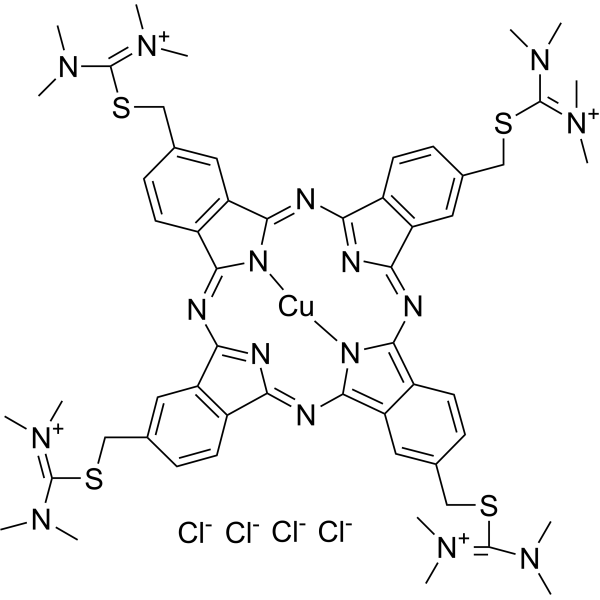
Alcian Blue 8GX is a commonly used phthalocyanine dye that binds to glycoproteins and glycosaminoglycans. Alcian Blue 8GX has a wide range of applications in biological staining, including proteins in brain tumors and DNA in cells and tissues.
For research use only. We do not sell to patients.
- CAS No.: 33864-99-2
- Formula: C56H68Cl4CuN16S4
- Molecular Weight:1298.86
-
Storage:
4°C, sealed storage, away from moisture and light
* In solvent : -80°C, 6 months; -20°C, 1 month (sealed storage, away from moisture and light)

To place orders, for customer services and technical support, please contact: MedChemExpress USA
Tel: 609-228-6898 E-mail: [email protected] [email protected]


-
 Biological Activity
-
Chemical Information
-
Solvent & Solubility
- Protocols
- Purity & Documentation
- References
-
 Help & FAQs


-

HY-N1389
CarmineNatural Dye -

HY-120601A
Alizarin Red SCalcium Deposits Dye -
HY-13259
MG-132Proteasome Inhibitor -
HY-10219
RapamycinmTOR Inhibitor -
HY-D0914
Fast Green FCFSea Green Triarylmethane Food Dye -
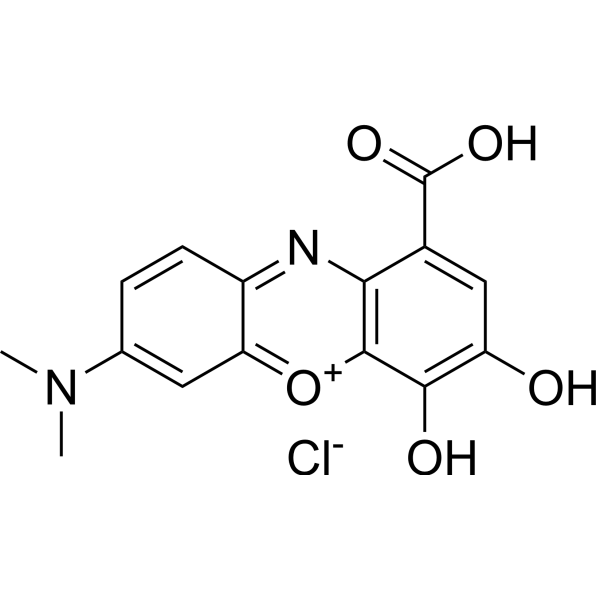
HY-D0961
Gallocyanine chlorideDKK1 Inhibitor -
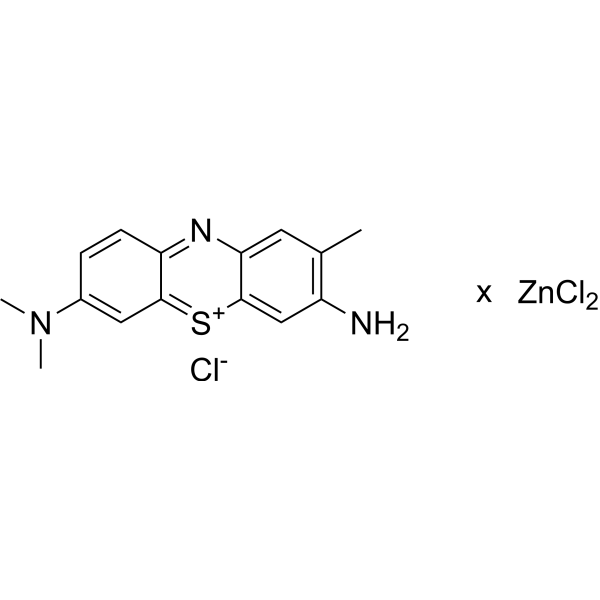
HY-W250143
Toluidine blue (ZnCl2)Biochemical Assay Reagent -
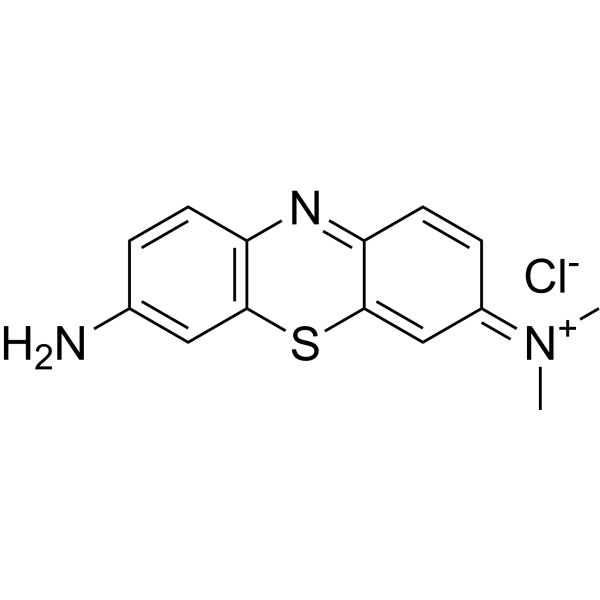
HY-D0944
Giemsa stainComposite Dye -
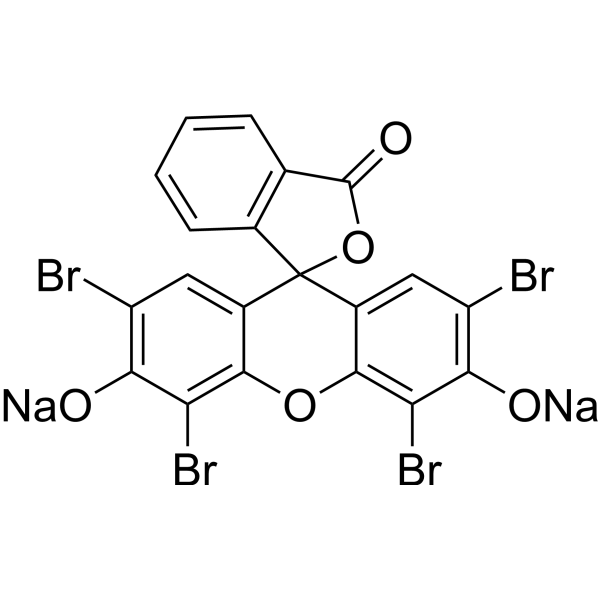
HY-D0505A
Eosin Y disodiumDye Molecule -
HY-D0958
Methylene blue hydratesGC Inhibitor -
HY-D0932
Sudan IVDisazo Dye -
HY-D0931
Sudan IIIDisazo Dye
Publications Citing Use of MedChemExpress (MCE) Alcian Blue 8GX
More Customer Validation & Images

-
Cell Imaging/Staining


Biological Activity
Description
In Vitro
Guide (The following is our recommended protocol. This protocol is only a guide and should be modified according to your specific needs).
1. Alcian Blue 8GX staining of cell micromass cultures[1]
1.1 Prepare preprocessing solution A: add 0.5 mL of ammonium hydroxide solution to 500 mL of 70% ethanol.
1.2 Prepare preprocessing solution B: add 25 mL of glacial acetic acid to 70% ethanol to a final volume of 500 mL.
1.3 Discard the culture medium from the micromass culture and fix with 1 mL of Bouin's fixative at room temperature for 15 minutes.
1.4 Wash with preprocessing solution A and B.
1.5 Stain with 2 mL of 1 mg/mL Alcian Blue 8GX at room temperature for 1 hour.
1.6 Wash off the dye with deionized water, repeat four times. and soak in 2 mL of deionized water.
1.7 Take a photograph.
1.8 Wash off the dye again with deionized water.
1.9 Extract the dye by incubating the culture with 1 mL of 6 M guanidine hydrochloride at room temperature overnight.
1.10 Measure the optical density at OD595 using a spectrophotometer.
2. Cell Culture Precautions[1]
2.1 Avoiding Cell Death: To prevent cell death, embryos/cells should always be kept on ice before plating.
2.2 Handling When Cell Viability is Below 70-80%: If cell viability drops below 70-80%, consider using a dead cell removal kit (e.g., Miltenyi Dead Cell Removal Kit, Miltenyi Biotech, Cat. No: 130-090-101) to eliminate dead cells.
2.3 Cell Plating in 35 mm Culture Dishes: When plating cells in 35 mm culture dishes, maintain a high-density cell area. After 1.5 hours of culture, the cells should adhere. Carefully add high DMEM culture medium containing fibronectin.
2.4 Use and Passaging of Isolated Cells: Isolated cells can be used for micro-clump culture on the same day they are isolated. However, these cells can only be passaged a maximum of three times, and the total culture time from isolation should not exceed 10 days.
3. Alcian Blue 8GX staining of glycosaminoglycans[2]
3.1 Mast cells are fixed with methanol-40% formaldehyde-acetic acid (85:10:5 volume ratio) for 30 min, and the cells are stained after washing.
3.2 Stain with 0.5% (w/v) Alcian Blue 8GX dissolved in 3% (v/v) acetic acid, pH 2.4, for 0.5 or 2 hours.
3.3 The same solution saturated with urea as in 3.1 is returned to pH 2.4 with HCl and stained for 0.5 h.
3.4 After staining with the same solution as in 3.1 for 0.5 h, the slides are stained with 0.3% (w/v) hematoxylin O (pH 0.9) in 0.125 N HCl for 5 min.
3.5 After staining, rinse with distilled water, let it air dry, and then mount with Entellan.
3.6 To detect the presence of histamine, air dry the unfixed or fixed smears of rat peritoneal mast cells, and stain them with 1% (w/v) ortho-phthalaldehyde (OPT) dissolved in xylene (staining time 2 minutes). The staining process is carried out in a closed chamber at room temperature with 100% relative humidity. After staining, the slides are drained and immediately mounted with tetrahydrofuran.
3.7 The yellow fluorescence intensity of the histamine-OPT complex in mast cell granules is examined using a Leitz Orthoplan microscope equipped with a Leitz Ploemopak 2 (for incident fluorescence) and a 75 W high-pressure xenon lamp. The filter system used consisted of a TK 510/K 515 dichroic, a K 510 blocking filter and a 2 x KP 490 (= KP 500) excitation filter.
4. Alcian Blue 8GX staining of fetal cartilage[3]
4.1 Rat fetuses are obtained from mated female Spraque-Dawley rats. On gestational day 21 (sperm/sperm day 5, gestational day 0), rats are euthanized by carbon dioxide asphyxiation. Fetuses are obtained by standard cesarean section and subsequently euthanized by oral administration of sodium pentobarbital. New Zealand white and Dutch rabbits are 5-6 months old at the time of mating, and pregnant rabbits are sacrificed on gestational day 28 and fetuses are obtained by intravenous injection of sodium pentobarbital. Each fetus is euthanized by oral administration of sodium pentobarbital.
4.2 Fetuses are eviscerated, skinned, and fixed in 70% ethanol for 3-7 days.
4.3 Alcian Blue 8GX is added to a mixture of 8 parts 95% ethanol and 2 parts glacial acetic acid to prepare solutions of 75 and 100 mg/L.
4.4 Rat fetuses are stained in Alcian Blue 8GX (100 mg/L) for 24 h and rabbit fetuses are stained in Alcian Blue 8GX (75 mg/L) for 24 h, followed by rinsing in 95% ethanol for 6 h.
4.5 Rat and rabbit fetuses are immersed in 1% and 1.25% potassium hydroxide, respectively. Rat fetuses are stained with 12 mg/L Alizarin Red S (HY-120601) for 48 h and rabbit fetuses are stained with 6 mg/L Alizarin Red S (HY-120601) for 24 h.
4.6 Transferred to a solution of 70% ethanol and glycerol (1:1) for clearing, hardening, and examination.
5. Alcian Blue 8GX for protein determination[4]
5.1 Dissolve the target protein in water or 0.1 M NaCl solution to a working concentration of 25 μg/ml.
5.2 Use Britton-Robinson buffer (pH 7.24, containing 0.04 M H3PO4, 0.04 M HAc and 0.04 M H3BO3) to control the acidity and use 0.5 M NaCl solution to adjust the ionic strength of the aqueous solution.
5.3 Add the appropriate protein working solution, 1.0 mL of Britton-Robinson buffer. Except for IgG, which was diluted with 0.1 M NaCl, all other mixtures were diluted to 10 mL with double distilled water.
5.4 The mixture is used for absorption or RLS measurement. The RLS spectrum is scanned by adjusting the excitation and emission monochromators (?λ = 0 nm) of the RF-540 fluorescence spectrometer. The RLS intensity is measured at 398.0 nm, proteins,
including bovine serum albumin (BSA), human serum albumin (HAS), pepsin (Pep) and cellulase (Cel), can be
determined with the limit of detection below 30 ng/mL.
5.5 RLS spectra of the interaction between ABGX and BSA. Concentration 1.0 × 10⁻⁵ M.
MedChemExpress (MCE) has not independently confirmed the accuracy of these methods. They are for reference only. Further protocols information, click here.


Chemical Information
-
CAS No. 33864-99-2
-
Appearance Solid
-
Molecular Weight 1298.86
-
Formula C56H68Cl4CuN16S4
-
Color Dark purple to black
-
SMILES
CN(C)/C(SCC(C=C1)=CC2=C1/C3=N/C(C4=C/5C=CC(CS/C(N(C)C)=[N+](C)\C)=C4)=NC5=N/C6=C(C=C(CS/C(N(C)C)=[N+](C)\C)C=C7)C7=C8N6[Cu]N3/C2=N\C9=N/C(C%10=C9C=CC(CS/C(N(C)C)=[N+](C)/C)=C%10)=N\8)=[N+](C)\C.[Cl-].[Cl-].[Cl-].[Cl-]
-
Shipping
Room temperature in continental US; may vary elsewhere.
-
Storage
4°C, sealed storage, away from moisture and light
* In solvent : -80°C, 6 months; -20°C, 1 month (sealed storage, away from moisture and light)


Publications (4)
-
Journal Impact Factor
-
Most Recent
-
Commun Biol
The secretory protein COA1 enables Metarhizium robertsii to evade insect immune recognition during cuticle penetration. [Abstract]2024 Sep 30;7(1):1220. PMID: 39349686 -
J Orthop Surg Res
2023 Jul 29;18(1):546. PMID: 37516879 -
J Biochem Mol Toxicol
miRNA-211-5p inhibition enhances the protective effect of hucMSC-derived exosome in Aβ1-40 -induced SH-SY5Y cells by increasing NEP expression. [Abstract]2024 Jan;38(1):e23624. PMID: 38229323
Alcian Blue 8GX purchased from MedChemExpress. Usage Cited in: J Biochem Mol Toxicol. 2024 Jan;38(1):e23624. [Abstract]
Alizarin red, alcian blue, and oil red o staining results indicating the osteogenesis, adipogenesis, and chondrogenesis of hucMSCs.
-
Biol Reprod
2024 Aug 15;111(2):414-426. PMID: 38647664


Solvent & Solubility
In Vitro:
DMSO : 100 mg/mL (76.99 mM; ultrasonic and warming and heat to 60°C; Hygroscopic DMSO has a significant impact on the solubility of product, please use newly opened DMSO)
Please refer to the solubility information to select the appropriate solvent. Once prepared, please aliquot and store the solution to prevent product inactivation from repeated freeze-thaw cycles.
Storage method and period of stock solution: -80°C, 6 months; -20°C, 1 month (sealed storage, away from moisture and light). When stored at -80°C, please use it within 6 months. When stored at -20°C, please use it within 1 month.
Please refer to the solubility information to select the appropriate solvent. Once prepared, please aliquot and store the solution to prevent product inactivation from repeated freeze-thaw cycles.
Storage method and period of stock solution: -80°C, 6 months; -20°C, 1 month (sealed storage, away from moisture and light). When stored at -80°C, please use it within 6 months. When stored at -20°C, please use it within 1 month.
Concentration (start) × Volume (start) = Concentration (final) × Volume (final)

Protocols
-
Carbohydrates and Mucins: Alcian Blue/Alcian Blue-PAS Staining
Alcian Blue (AB) staining is a cationic copper phthalocyanine dye-based histochemical method that binds electrostatically to negatively charged acidic mucopolysaccharides (glycosaminoglycans and sialomucins), enabling visualization of acidic carbohydrate-rich structures such as epithelial mucins, cartilage matrix, and mast cell granules. Periodic Acid-Schiff (PAS) reaction detects neutral mucopolysaccharides and glycoconjugates by oxidizing vicinal diols to aldehydes, which subsequently react with Schiff reagent to produce a magenta signal. The combined Alcian Blue-PAS (AB-PAS) method allows simultaneous differentiation of acidic (blue) and neutral (magenta) mucins in the same tissue section, enabling mucin subtype discrimination in epithelial tissues and pathological lesions.


Purity & Documentation
-
Data Sheet (293 KB)
-
SDS (394 KB)
- English - EN (394 KB)
- Français - FR (394 KB)
- Deutsch - DE (394 KB)
- Norwegian - NO (394 KB)
- Español - ES (394 KB)
- Swedish - SV (394 KB)
- Italian - IT (394 KB)
- Korean - KR (394 KB)
- Portuguese - PT (394 KB)
-
Handling Instructions (2659 KB)
References
[1]. Hiroki Ueharu, et al. Isolation and Culture of Cranial Neural Crest Cells from the First Branchial Arch of Mice. Bio Protoc. 2022 Apr 5;12(7):e4371. [Content Brief]
[2]. J Tas, et al. The Alcian blue and combined Alcian blue--Safranin O staining of glycosaminoglycans studied in a model system and in mast cells. Histochem J. 1977 Mar;9(2):205-30. [Content Brief]
[3]. Brian G Redfern, et al. An alternative Alcian Blue dye variant for the evaluation of fetal cartilage. Birth Defects Res B Dev Reprod Toxicol. 2007 Jun;80(3):171-6. [Content Brief]


Complete Stock Solution Preparation Table
Please refer to the solubility information to select the appropriate solvent. Once prepared, please aliquot and store the solution to prevent product inactivation from repeated freeze-thaw cycles.
Storage method and period of stock solution: -80°C, 6 months; -20°C, 1 month (sealed storage, away from moisture and light). When stored at -80°C, please use it within 6 months. When stored at -20°C, please use it within 1 month.
| Optional Solvent | Concentration Solvent Mass | 1 mg | 5 mg | 10 mg | 25 mg |
|---|---|---|---|---|---|
| DMSO | 1 mM | 0.7699 mL | 3.8495 mL | 7.6991 mL | 19.2476 mL |
| 5 mM | 0.1540 mL | 0.7699 mL | 1.5398 mL | 3.8495 mL | |
| 10 mM | 0.0770 mL | 0.3850 mL | 0.7699 mL | 1.9248 mL | |
| 15 mM | 0.0513 mL | 0.2566 mL | 0.5133 mL | 1.2832 mL | |
| 20 mM | 0.0385 mL | 0.1925 mL | 0.3850 mL | 0.9624 mL | |
| 25 mM | 0.0308 mL | 0.1540 mL | 0.3080 mL | 0.7699 mL | |
| 30 mM | 0.0257 mL | 0.1283 mL | 0.2566 mL | 0.6416 mL | |
| 40 mM | 0.0192 mL | 0.0962 mL | 0.1925 mL | 0.4812 mL | |
| 50 mM | 0.0154 mL | 0.0770 mL | 0.1540 mL | 0.3850 mL | |
| 60 mM | 0.0128 mL | 0.0642 mL | 0.1283 mL | 0.3208 mL |


Alcian Blue 8GX Related Classifications
HY-D0001 Related Classifications
 Powered by Bioz