



Axl Antibody (YA5818)
(Synonyms: AXL; UFO; Tyrosine-protein kinase receptor UFO; AXL oncogene)Based on 1 Customer Validation
Axl Antibody (YA5818) is a Rabbit-derived and non-conjugated IgG monoclonal antibody, targeting to Axl.
-
Host:
Rabbit
-
Isotype:
IgG
-
Application:
WB, IHC-P, ICC/IF, ELISA
-
Reactivity :
Human, Mouse, Rat
-
Formulation:
Supplied in PBS, 50% glycerol, 0.05% Proclin 300, 0.05%BSA
-
Conjugation:
Non-conjugated


To place orders, for customer services and technical support, please contact: MedChemExpress USA
Tel: 609-228-6898 E-mail: [email protected] [email protected]





Applications
| Application |
IHC-P

IHC-P: Immunohistochemistry-Paraffin
|
WB
WB: Western Blot
|
ICC/IF
ICC/IF: Immunocytochemistry/
Immunofluorescence |
ELISA
ELISA: Enzyme Linked Immunosorbent Assay
|
|---|---|---|---|---|
| Dilution Ratio | 1:200-1:1000 | 1:2000-1:10000 | 1:200-1:1000 | 1:5000-1:20000 |


Product Details
Axl Antibody (YA5818) is a Rabbit-derived and non-conjugated IgG monoclonal antibody, targeting to Axl.
-
Host Rabbit

-
Clonality Monoclonal

-
Species ReactivityHuman, Mouse, Rat
-
Observed Molecular WeightObserved band size: 138 kDa
Note: Due to possible protein modifications or aggregation, the molecular weight should be confirmed by actual measurement, and the predicted value is for reference only.

-
Calculated Molecular Weight Predicted band size: 98 kDa

Protein A
Non-conjugated
Unmodified
IgG


Product Properties
-
Appearance
Solution
-
Formulation
Supplied in PBS, 50% glycerol, 0.05% Proclin 300, 0.05%BSA
-
Concentration
Batch-dependent, Please check the COA for the concentration of each lot. Check Lot Concentration
-
Storage & Stability
Stored at -20°C for 1 year. Avoid repeated freeze / thaw cycles.
-
Shipping
Shipping with blue ice.


Verification Images
-
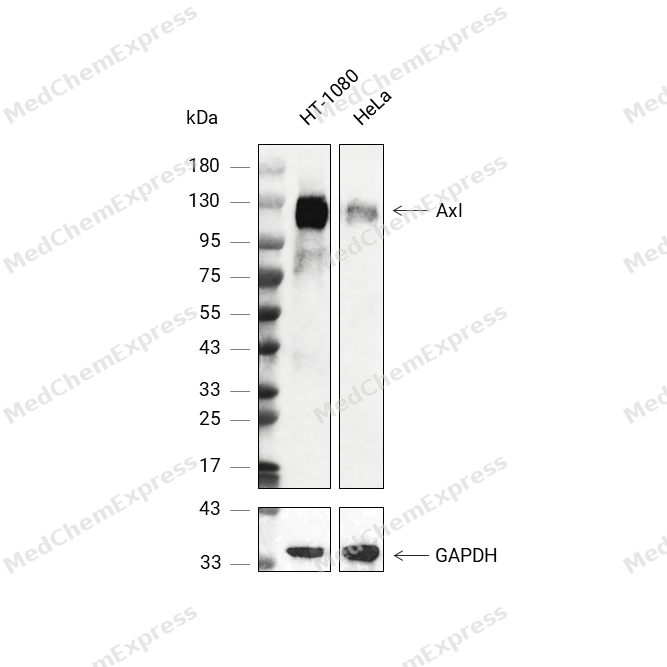 Western blot analysis was performed on protein extracts (30 μg) from HT-1080 (lane 2), and HeLa (lane 3) using Axl antibody. Proteins were transferred onto a 0.45 μm PVDF membrane using the Trans-Blot® Turbo™ system for 13 min. The membrane was then blocked with 5% nonfat milk in TBST (HY-K1025) for 1 h at room temperature. Thhe primary antibody (1:1000) and loading control antibody GAPDH Antibody (HRP) (HY-P80954A) (1:2500) were diluted in 5% nonfat milk in TBST and incubated with the membrane overnight at 4°C. After washing, the membrane of primary antibody was incubated with HRP-conjugated goat anti-rabbit IgG (H&L) secondary antibody (HY-P8001) (1:5000) diluted in 5% nonfat milk in TBST for 1 h at room temperature. Protein bands were visualized using an Ultra High Sensitivity ECL detection kit (HY-K1005).
 -
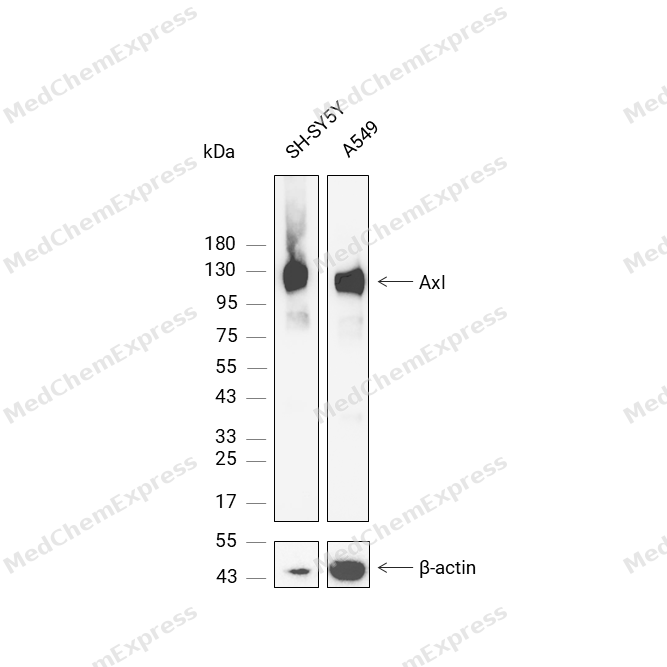 Western blot analysis was performed on protein extracts (30 μg) from SH-SY5Y (lane 1) and A549 (lane 2) using Axl antibody. Proteins were transferred onto a 0.45 μm PVDF membrane using the Trans-Blot® Turbo™ system for 13 min. The membrane was then blocked with 5% nonfat milk in TBST (HY-K1025) for 1 h at room temperature. Thhe primary antibody (1:1000) and loading control antibody GAPDH Antibody (HRP) (HY-P80954A) (1:2500) were diluted in 5% nonfat milk in TBST and incubated with the membrane overnight at 4°C. After washing, the membrane of primary antibody was incubated with HRP-conjugated goat anti-rabbit IgG (H&L) secondary antibody (HY-P8001) (1:5000) diluted in 5% nonfat milk in TBST for 1 h at room temperature. Protein bands were visualized using an Ultra High Sensitivity ECL detection kit (HY-K1005).


Background
-
Function
Axl is a TAM receptor tyrosine kinase activated by GAS6, and TAM receptors support apoptotic-cell recognition, efferocytosis, immune regulation, tissue homeostasis, and cancer-related signaling[1][2]. Mechanistically, Axl participates in ligand-induced TAM activation with TYRO3 and MERTK, but each receptor shows distinct activation patterns with GAS6, PROS1, apoptotic cells, phosphatidylserine vesicles, and enveloped virus[3]. In cancer models, Axl activation stimulates MAPK, AKT, and FAK pathways, while Axl inhibition or knockdown reduces tumor growth, migration, colony formation, and chemoresistance in NSCLC and neuroblastoma[2][4]. In inflammatory disease models, AXL/MERTK inhibition protected against pancreatic necrosis by limiting CXCL2-related neutrophil infiltration, whereas soluble Axl increased in lupus nephritis and multiple sclerosis lesions, indicating disease-linked dysregulation of GAS6-TAM signaling[5][6][7]. Compared with MERTK, Axl showed stronger effects on chemosensitivity in NSCLC, distinct ligand-response behavior among TAM isoforms, and critical roles with TYRO3 in GPVI-mediated platelet activation[3][2][8]. For experimental applications, Axl inhibitors, soluble TAM domains, and antagonist or agonist antibodies provide tools to test TAM signaling, immune regulation, apoptosis, and therapeutic sensitization[3][5][9].
-
Subcellular Localization
Cell membrane; Single-pass type I membrane protein
-
Expression
Tissue_specificity:Highly expressed in metastatic colon tumors. Expressed in primary colon tumors. Weakly expressed in normal colon tissue.
Induction: (Microbial infection) Up-regulated by Aedes aegypti lymphotoxin beta receptor inhibitor during Zika virus infection -
Isoforms & Post-Translational Modification
P30530 has 2 isomers: P30530-1: 98337 Da (predicted); P30530-2: 97378 Da (predicted).
Monoubiquitinated upon GAS6-binding. A very small proportion of the receptor could be subjected to polyubiquitination in a very transient fashion;Phosphorylated at tyrosine residues by autocatalysis, which activates kinase activity -
Subunit
Heterodimer and heterotetramer with ligand GAS6. Interacts with CBL, GRB2, LCK, NCK2, PIK3R1, PIK3R2, PIK3R3, PLCG1, SOCS1 and TNS2. Part of a complex including AXL, TNK2 and GRB2, in which GRB2 promotes AXL recruitment by TNK2
-
SwissProt ID
-
Synonyms
AXL; UFO; Tyrosine-protein kinase receptor UFO; AXL oncogene


Documentation
-
Data Sheet (263 KB)
-
SDS (251 KB)
- English - EN (251 KB)
- Français - FR (251 KB)
- Deutsch - DE (251 KB)
- Norwegian - NO (251 KB)
- Español - ES (251 KB)
- Swedish - SV (251 KB)
- Italian - IT (251 KB)
- Korean - KR (251 KB)
- Portuguese - PT (251 KB)
-
User Guide for Antibodies (1077 KB)
References
[1]. Zhou L, et al. Tyro3, Axl, Mertk receptor-mediated efferocytosis and immune regulation in the tumor environment. Int Rev Cell Mol Biol. 2021;361:165-210. [Content Brief]
[2]. Linger RM, et al. Mer or Axl receptor tyrosine kinase inhibition promotes apoptosis, blocks growth and enhances chemosensitivity of human non-small cell lung cancer. Oncogene. 2013 Jul 18;32(29):3420-31. [Content Brief]
[3]. Tsou WI, et al. Receptor tyrosine kinases, TYRO3, AXL, and MER, demonstrate distinct patterns and complex regulation of ligand-induced activation. J Biol Chem. 2014 Sep 12;289(37):25750-63. [Content Brief]
[4]. Li Y, et al. Inhibition of Mer and Axl receptor tyrosine kinases leads to increased apoptosis and improved chemosensitivity in human neuroblastoma. Biochem Biophys Res Commun. 2015 Feb 13;457(3):461-6. [Content Brief]
[5]. Bao J, et al. AXL and MERTK receptor tyrosine kinases inhibition protects against pancreatic necrosis via selectively limiting CXCL2-related neutrophil infiltration. Biochim Biophys Acta Mol Basis Dis. 2022 Dec 1;1868(12):166490. [Content Brief]
[6]. Bellan M, et al. Increased plasma levels of Gas6 and its soluble tyrosine kinase receptors Mer and Axl are associated with immunological activity and severity of lupus nephritis. Clin Exp Rheumatol. 2021 Jan-Feb;39(1):132-138. [Content Brief]
[7]. Weinger JG, et al. Up-regulation of soluble Axl and Mer receptor tyrosine kinases negatively correlates with Gas6 in established multiple sclerosis lesions. Am J Pathol. 2009 Jul;175(1):283-93. [Content Brief]
[9]. Ali SR, et al. Nerve Density and Neuronal Biomarkers in Cancer. Cancers (Basel). 2022 Oct 1;14(19):4817. [Content Brief]

 Powered by Bioz
