



CASP4 Antibody
(Synonyms: Caspase-4 subunit 2; Caspase-4 subunit p10; Caspase-11; CASP-11; Protease ICH-3; Apoptosis related cysteine peptidase; Apoptotic cysteine protease Mih1/TX; CASP 4; CASP 4; CASP-4; CASP4; CASP4_HUMAN; CASP4_MOUSE; Caspase 4 apoptosis related cysteine peptidase; Caspase-4 subunit 2; Caspase4; ICE(rel) II; ICE(rel)-II; ICE(rel)II; ICEREL II; ICERELII; ICH 2; ICH 2 protease; ICH2; Mih1/TX; Mih1/TX; Protease ICH-2; Protease TX; TX; TX protease; EC:3.4.22.64.)
Based on 1 Customer Validation
CASP4 Antibody is a Rabbit-derived and non-conjugated IgG polyclonal antibody, targeting to CASP4.
-
Host:
Rabbit
-
Isotype:
IgG
-
Application:
WB, ELISA
-
Reactivity :
Human, Rat
-
Formulation:
Supplied in 0.02% Proclin300, Constituents: 1% BSA, 0.01M PBS, pH7.4.
-
Conjugation:
Non-conjugated


To place orders, for customer services and technical support, please contact: MedChemExpress USA
Tel: 609-228-6898 E-mail: [email protected] [email protected]





Applications
| Application |
WB

WB: Western Blot
|
ELISA
ELISA: Enzyme Linked Immunosorbent Assay
|
|---|---|---|
| Dilution Ratio | 1:500-2000 | 1:5000-10000 |


Product Details
CASP4 Antibody is a Rabbit-derived and non-conjugated IgG polyclonal antibody, targeting to CASP4.
-
Host Rabbit

-
Clonality Polyclonal

-
Species ReactivityHuman, Rat Predicted Reactivity: Mouse
Note: The predicted reactivity is for reference only and should not be considered a guarantee of product performance.
-
Observed Molecular WeightObserved band size: 54 kDa
Note: Due to possible protein modifications or aggregation, the molecular weight should be confirmed by actual measurement, and the predicted value is for reference only.

-
Calculated Molecular Weight Predicted band size: 43 kDa

KLH conjugated synthetic peptide derived from mouse Caspase-4 subunit p10: 251-350/373
Endogenous
Affinity Purified
Non-conjugated
Unmodified
IgG


Product Properties
-
Appearance
Liquid
-
Formulation
Supplied in 0.02% Proclin300, Constituents: 1% BSA, 0.01M PBS, pH7.4.
-
Concentration
Batch-dependent, Please check the COA for the concentration of each lot. Check Lot Concentration
-
Storage & Stability
Stored at -20°C for 1 year. Avoid repeated freeze / thaw cycles.
-
Shipping
Shipping with blue ice.


Verification Images
-
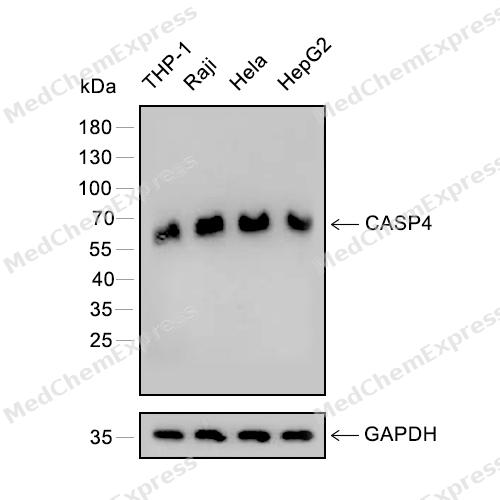 Western blot analysis of extracts from THP-1 (lane 1) and Raji (lane 2) and Hela (lane 3) and HepG2 (lane 4) using CASP4 antibody. Proteins were transferred to a PVDF membrane and blocked with 5% nonfat powdered milk in PBST for 2 hour at room temperature. The primary antibody (1/1000) and Loading control antibody (GAPDH, 1/3000) was diluted with 5% nonfat powdered milk in PBST at 4°C overnight. Goat Anti-Rabbit IgG-HRP Secondary Antibody (1/8,000) was incubated for 45min at room temperature.


Background
-
Function
CASP4 is an Inflammatory caspase that acts as the effector of the non-canonical inflammasome by mediating lipopolysaccharide (LPS)-induced pyroptosis. Also indirectly activates the NLRP3 and NLRP6 inflammasomes. Acts as a thiol protease that cleaves a tetrapeptide after an Asp residue at position P1: catalyzes cleavage of CGAS, GSDMD and IL18. Effector of the non-canonical inflammasome independently of NLRP3 inflammasome and CASP1: the non-canonical inflammasome promotes pyroptosis through GSDMD cleavage without involving secretion of cytokine IL1B. In the non-canonical inflammasome, CASP4 is activated by direct binding to the lipid A moiety of LPS without the need of an upstream sensor. LPS-binding promotes CASP4 activation and CASP4-mediated cleavage of GSDMD and IL18, followed by IL18 secretion through the GSDMD pore, pyroptosis of infected cells and their extrusion into the gut lumen. Also indirectly promotes secretion of mature cytokines (IL1A and HMGB1) downstream of GSDMD-mediated pyroptosis via activation of the NLRP3 and NLRP6 inflammasomes. Involved in NLRP3-dependent CASP1 activation and IL1B secretion in response to non-canonical activators, such as UVB radiation or cholera enterotoxin. Involved in NLRP6 inflammasome-dependent activation in response to lipoteichoic acid (LTA), a cell-wall component of Gram-positive bacteria, which leads to CASP1 activation and IL1B secretion. Involved in LPS-induced IL6 secretion; this activity may not require caspase enzymatic activity. The non-canonical inflammasome is required for innate immunity to cytosolic, but not vacuolar, bacteria. Plays a crucial role in the restriction of S.typhimurium replication in colonic epithelial cells during infection. Activation of the non-canonical inflammasome in brain endothelial cells can lead to excessive pyroptosis, leading to blood-brain barrier breakdown. Pyroptosis limits bacterial replication, while cytokine secretion promotes the recruitment and activation of immune cells and triggers mucosal inflammation. May also act as an activator of adaptive immunity in dendritic cells, following activation by oxidized phospholipid 1-palmitoyl-2-arachidonoyl- sn-glycero-3-phosphorylcholine, an oxidized phospholipid (oxPAPC). Involved in cell death induced by endoplasmic reticulum stress and by treatment with cytotoxic APP peptides found in Alzheimer's brains. Cleavage of GSDMD is not strictly dependent on the consensus cleavage site but depends on an exosite interface on CASP4 that recognizes and binds the Gasdermin-D, C-terminal (GSDMD-CT) part. Catalyzes cleavage and maturation of IL18; IL18 processing also depends of the exosite interface on CASP4. In contrast, it does not directly process IL1B. During non-canonical inflammasome activation, cuts CGAS and may play a role in the regulation of antiviral innate immune activation; (Microbial infection) In response to the Td92 surface protein of the periodontal pathogen T.denticola, activated by cathepsin CTSG which leads to production and secretion of IL1A and pyroptosis of gingival fibroblasts[1][2][3][4][5][6][7][8][9][10][11][12][13][14][15][16][17][18][19][20][21][22][23][24][25][26][27].
-
Subcellular Localization
Cytoplasm, cytosol; Endoplasmic reticulum membrane; Peripheral membrane protein; Cytoplasmic side; Mitochondrion; Inflammasome; Secreted
-
Expression
Tissue_specificity:Widely expressed, including in keratinocytes and colonic and small intestinal epithelial cells (at protein level) . Not detected in brain
Induction:In peripheral blood mononuclear cells and purified monocytes, up-regulated by bacterial lipopolysaccharides (LPS) and interferon-beta/IFNB1 at the mRNA level (PubMed:16893518, PubMed:24879791) . However, this increase is not observed at the protein level, which remains constant in monocytes and other cell types following LPS treatment (PubMed:25121752, PubMed:26508369) . In monocyte-derived macrophages, some up-regulation at the protein level is observed following treatment with LPS and IFNB1 (PubMed:25964352) . In SH-EP1 neuroblastoma cell line, up-regulated by NF-kappa-B RELA/p65 at both mRNA and protein levels -
Isoforms & Post-Translational Modification
P49662 has 5 isomers: P49662-1: 43262 Da (predicted); P49662-2: 36705 Da (predicted); P49662-3: 13264 Da (predicted); P49662-4: 30000 Da (predicted); P49662-5: 18111 Da (predicted).
In response to activation signals, undergoes autoproteolytic cleavage and activation;(Microbial infection) ADP-riboxanation by S.flexneri OspC3 blocks CASP4 autoprocessing, preventing CASP4 activation and ability to recognize and cleave GSDMD, thereby thwarting the inflammasome/pyroptosis-mediated defense -
Subunit
Heterotetramer that consists of two anti-parallel arranged heterodimers, each one formed by a 20 kDa (Caspase-4 subunit p20) and a 10 kDa (Caspase-4 subunit p10) subunit (PubMed:32109412). Upon direct LPS-binding, forms large homooligomers, resulting in its activation (By similarity). These oligomers are often referred to as 'non-canonical inflammasomes' (PubMed:25119034). In its precursor form, interacts with TMEM214; this interaction is required for association with the endoplasmic reticulum membrane (PubMed:23661706). Interacts with CASP1 (PubMed:22246630). Interacts with NOD2 (PubMed:18511561). Interacts with SERPINB1; this interaction regulates CASP4 activity (PubMed:30692621)
-
SwissProt ID
-
Synonyms
Caspase-4 subunit 2; Caspase-4 subunit p10; Caspase-11; CASP-11; Protease ICH-3; Apoptosis related cysteine peptidase; Apoptotic cysteine protease Mih1/TX; CASP 4; CASP 4; CASP-4; CASP4; CASP4_HUMAN; CASP4_MOUSE; Caspase 4 apoptosis related cysteine peptidase; Caspase-4 subunit 2; Caspase4; ICE(rel) II; ICE(rel)-II; ICE(rel)II; ICEREL II; ICERELII; ICH 2; ICH 2 protease; ICH2; Mih1/TX; Mih1/TX; Protease ICH-2; Protease TX; TX; TX protease; EC:3.4.22.64.


Documentation
-
Data Sheet (235 KB)
-
SDS (254 KB)
- English - EN (254 KB)
- Français - FR (254 KB)
- Deutsch - DE (254 KB)
- Norwegian - NO (254 KB)
- Español - ES (254 KB)
- Swedish - SV (254 KB)
- Italian - IT (254 KB)
- Korean - KR (254 KB)
- Portuguese - PT (254 KB)
-
User Guide for Antibodies (1077 KB)

 Powered by Bioz
