



CDT2 Antibody (YA2474)
(Synonyms: CDW1; DCAF2; Dtl; L2DTL; RAMP)Based on 1 publication(s) in Google Scholar
CDT2 Antibody (YA2474) is a Rabbit-derived and non-conjugated IgG monoclonal antibody, targeting to CDT2.
-
Host:
Rabbit
-
Isotype:
IgG
-
Application:
WB, IHC-P
-
Reactivity :
Human
-
Formulation:
Supplied in 50mM Tris-Glycine(pH 7.4), 0.15M NaCl, 40% Glycerol, 0.01% Sodium azide and 0.05% BSA
-
Conjugation:
Non-conjugated


To place orders, for customer services and technical support, please contact: MedChemExpress USA
Tel: 609-228-6898 E-mail: [email protected] [email protected]



Publications Citing Use of MedChemExpress (MCE) CDT2 Antibody (YA2474)
More

Applications
| Application |
WB

WB: Western Blot
|
IHC-P
IHC-P: Immunohistochemistry-Paraffin
|
|---|---|---|
| Dilution Ratio | 1:500-1:1000 | 1:50-1:100 |


Product Details
CDT2 Antibody (YA2474) is a Rabbit-derived and non-conjugated IgG monoclonal antibody, targeting to CDT2.
-
Host Rabbit

-
Clonality Recombinant, Monoclonal

-
Species ReactivityHuman
-
Observed Molecular WeightObserved band size: 79 kDa
Note: Due to possible protein modifications or aggregation, the molecular weight should be confirmed by actual measurement, and the predicted value is for reference only.

-
Calculated Molecular Weight Predicted band size: 79 kDa

Recombinant protein of human CDT2
Endogenous
Affinity Purified
Non-conjugated
Unmodified
IgG


Product Properties
-
Appearance
Liquid
-
Formulation
Supplied in 50mM Tris-Glycine(pH 7.4), 0.15M NaCl, 40% Glycerol, 0.01% Sodium azide and 0.05% BSA
-
Concentration
Batch-dependent, Please check the COA for the concentration of each lot. Check Lot Concentration
-
Storage & Stability
Stored at -20°C for 1 year. Avoid repeated freeze / thaw cycles.
-
Shipping
Shipping with blue ice.


Publications (1)
-
Journal Impact Factor
-
Most Recent
-
J Clin Invest
Poly(ADP-ribose) glycohydrolase enforces p21 degradation via dePARylation to promote gastric cancer progression. [Abstract]2026 Jan 15;136(5):e195538. PMID: 41538291


Verification Images
-
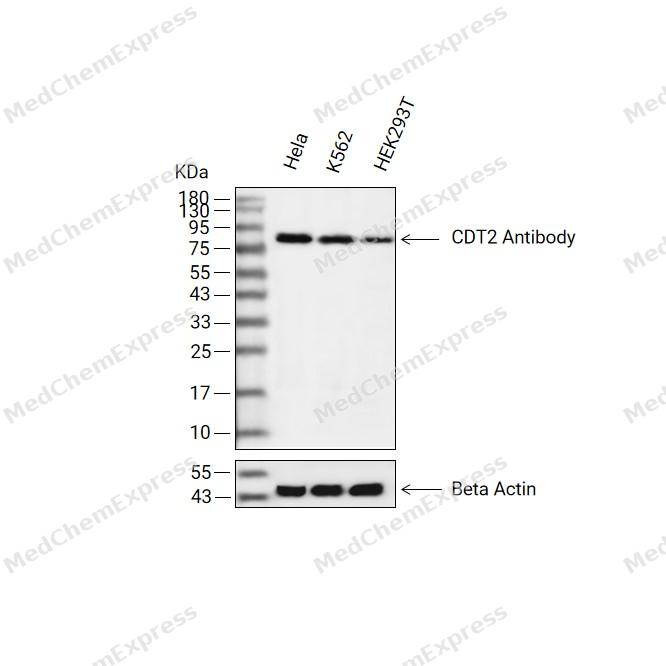 Western blot analysis of extracts from Hela(lane 2(20ug),K562(lane 3(20ug) and HEK293T(lane 4(20ug) using CDT2 Antibody (HY-P82729) Rabbit mAb. Proteins were transferred to a PVDF membrane and blocked with 5% non-fat milk in TBST for 2 hour at room temperature. The primary antibody (1/1000) and Loading control antibody (Beta Actin, HY-P83730, 1/10000) was used in 5% non-fat milk in TBST at 4°C overnight. Goat Anti-Mouse/Rabbit IgG-HRP Secondary Antibody (1/10000) was used for 1 hour at room temperature.


Background
-
Function
CDT2 is a Substrate-specific adapter of a DCX (DDB1-CUL4-X-box) E3 ubiquitin-protein ligase complex required for cell cycle control, DNA damage response and translesion DNA synthesis. The DCX(DTL) complex, also named CRL4(CDT2) complex, mediates the polyubiquitination and subsequent degradation of CDT1, CDKN1A/p21(CIP1), FBH1, KMT5A and SDE2. CDT1 degradation in response to DNA damage is necessary to ensure proper cell cycle regulation of DNA replication. CDKN1A/p21(CIP1) degradation during S phase or following UV irradiation is essential to control replication licensing. KMT5A degradation is also important for a proper regulation of mechanisms such as TGF-beta signaling, cell cycle progression, DNA repair and cell migration. Most substrates require their interaction with PCNA for their polyubiquitination: substrates interact with PCNA via their PIP-box, and those containing the 'K+4' motif in the PIP box, recruit the DCX(DTL) complex, leading to their degradation. In undamaged proliferating cells, the DCX(DTL) complex also promotes the 'Lys-164' monoubiquitination of PCNA, thereby being involved in PCNA-dependent translesion DNA synthesis. The DDB1-CUL4A-DTL E3 ligase complex regulates the circadian clock function by mediating the ubiquitination and degradation of CRY1[1][2][3][4][5][6][7][8][9][10][11][12][13][14].
-
Subcellular Localization
Nucleus; Nucleus membrane; Peripheral membrane protein; Nucleoplasmic side; Cytoplasm, cytoskeleton, microtubule organizing center, centrosome; Chromosome
-
Expression
Tissue_specificity:Expressed in placenta and testis, very low expression seen in skeletal muscle. Detected in all hematopoietic tissues examined, with highest expression in thymus and bone marrow. A low level detected in the spleen and lymph node, and barely detectable level in the peripheral leukocytes. RA treatment down-regulated the expression in NT2 cell
Induction:Induced by TGF-beta, the up-regulation is immediate and transient -
Isoforms & Post-Translational Modification
Q9NZJ0 has 2 isomers: Q9NZJ0-1: 79468 Da (predicted); Q9NZJ0-2: 23682 Da (predicted).
Ubiquitinated by the anaphase promoting complex/cyclosome (APC/C). Autoubiquitinated through 'Lys-48'-polyubiquitin chains in a PCNA-independent reaction, allowing proteasomal turnover. Polyubiquitinated by SCF(FBXO11) when not phosphorylated, leading to its degradation. A tight regulation of the polyubiquitination by SCF(FBXO11) is involved in the control of different processes such as TGF-beta signaling, cell cycle progression and exit;Phosphorylated at Thr-464 by CDK1/Cyclin-B and CDK2/Cyclin-A but not by CDK2/Cyclin-E, MAPK1 or PLK1. Phosphorylation at Thr-464 inhibits the interaction with FBXO11 and decreases upon cell cycle exit induced by TGF-beta or serum starvation -
Subunit
Component of the DCX(DTL) E3 ubiquitin ligase complex (also called CRL4(CDT2)), at least composed of CUL4 (CUL4A or CUL4B), DDB1, DTL/CDT2 and RBX1 (PubMed:16861906, PubMed:16949367, PubMed:17041588, PubMed:17085480, PubMed:18794347, PubMed:18794348, PubMed:23478441). Interacts with CDKN1A (PubMed:23213251). Interacts with DDB1 (PubMed:16949367, PubMed:23478445). Interacts with FBXO11; SCF(FBXWO11) controls DTL stability but DCX(DTL) does not control FBXO11 stability (PubMed:23478441, PubMed:23478445). Interacts with CRY1 (PubMed:26431207)
-
SwissProt ID
-
Synonyms
CDW1; DCAF2; Dtl; L2DTL; RAMP
-
Research Field
Cell Biology
Documentation
-
Data Sheet (235 KB)
-
SDS (251 KB)
- English - EN (251 KB)
- Français - FR (251 KB)
- Deutsch - DE (251 KB)
- Norwegian - NO (251 KB)
- Español - ES (251 KB)
- Swedish - SV (251 KB)
- Italian - IT (251 KB)
- Korean - KR (251 KB)
- Portuguese - PT (251 KB)
-
User Guide for Antibodies (1077 KB)

 Powered by Bioz
