



DBF4 Antibody (YA2652)
(Synonyms: DBF4; ASK; DBF4A; ZDBF1; Protein DBF4 homolog A; Activator of S phase kinase; Chiffon homolog A; DBF4-type zinc finger-containing protein 1)
Based on 1 Customer Validation
DBF4 Antibody (YA2652) is a Rabbit-derived and non-conjugated IgG monoclonal antibody, targeting to DBF4.
-
Host:
Rabbit
-
Isotype:
IgG
-
Application:
WB
-
Reactivity :
Human
-
Formulation:
Supplied in 50mM Tris-Glycine(pH 7.4), 0.15M NaCl, 40% Glycerol, 0.01% Sodium azide and 0.05% BSA
-
Conjugation:
Non-conjugated


To place orders, for customer services and technical support, please contact: MedChemExpress USA
Tel: 609-228-6898 E-mail: [email protected] [email protected]





Applications
| Application |
WB

WB: Western Blot
|
|---|---|
| Dilution Ratio | 1:2000-1:5000 |


Product Details
DBF4 Antibody (YA2652) is a Rabbit-derived and non-conjugated IgG monoclonal antibody, targeting to DBF4.
-
Host Rabbit

-
Clonality Recombinant,Monoclonal

-
Species ReactivityHuman
-
Observed Molecular WeightObserved band size: 77 kDa
Note: Due to possible protein modifications or aggregation, the molecular weight should be confirmed by actual measurement, and the predicted value is for reference only.

-
Calculated Molecular Weight Predicted band size: 77 kDa

A synthetic peptide of human DBF4
Endogenous
Affinity Purified
Non-conjugated
Unmodified
IgG


Product Properties
-
Appearance
Liquid
-
Formulation
Supplied in 50mM Tris-Glycine(pH 7.4), 0.15M NaCl, 40% Glycerol, 0.01% Sodium azide and 0.05% BSA
-
Concentration
Batch-dependent, Please check the COA for the concentration of each lot. Check Lot Concentration
-
Storage & Stability
Stored at -20°C for 1 year. Avoid repeated freeze / thaw cycles.
-
Shipping
Shipping with blue ice.


Verification Images
-
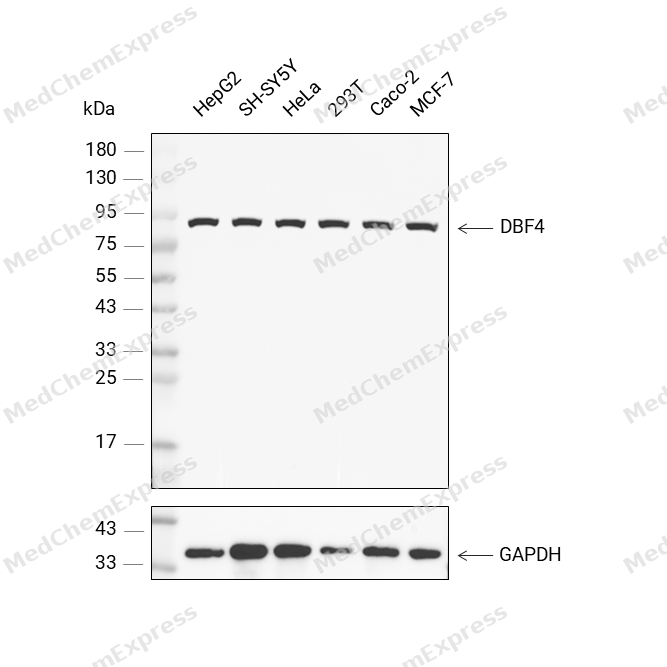 Western blot analysis was performed on protein extracts (25 μg) from HepG2 (lane 2), SH-SY5Y (lane 3), HeLa (lane 4), 293T (lane 5), Caco-2 (lane 6), and MCF-7 (lane 7) using DBF4 antibody. Proteins were transferred onto a 0.45 μm PVDF membrane using the Trans-Blot® Turbo™ system for 13 min. The membrane was then blocked with 5% nonfat milk in TBST (HY-K1025) for 1 h at room temperature. Thhe primary antibody (1:1000) and loading control antibody GAPDH Antibody (HRP) (HY-P80954A) (1:2500) were diluted in 5% nonfat milk in TBST and incubated with the membrane overnight at 4°C. After washing, the membrane of primary antibody was incubated with HRP-conjugated goat anti-rabbit/mouse IgG secondary antibody (HY-P8001/HY-P8004) (1:5000) diluted in 5% nonfat milk in TBST for 1 h at room temperature. Protein bands were visualized using an Ultra High Sensitivity ECL detection kit (HY-K1005).


Background
-
Function
DBF4 is a Regulatory subunit for CDC7 which activates its kinase activity thereby playing a central role in DNA replication and cell proliferation. Required for progression of S phase. The complex CDC7-DBF4A selectively phosphorylates MCM2 subunit at 'Ser-40' and 'Ser-53' and then is involved in regulating the initiation of DNA replication during cell cycle
-
Subcellular Localization
Nucleus
-
Expression
Tissue_specificity:Highly expressed in testis and thymus. Expressed also in most cancer cells lines
Induction:Induced in G1 phase at low level, increased during G1-S phase and remain high during S and G2-M phase -
Isoforms & Post-Translational Modification
Q9UBU7 has 2 isomers: Q9UBU7-1: 76858 Da (predicted); Q9UBU7-2: 26124 Da (predicted).
Phosphorylation increases its interaction with PSIP1 -
Subunit
Forms a complex with CDC7. Note that CDC7 forms distinct complex either with DBF4A or DBF4B. Such complexes are stable upon replication stress. Interacts with MEN1, MCM2, ORC2, ORC4 and ORC6. Interacts (via IBM motifs) with PSIP1 (via IBD domain); phosphorylation increases its affinity for PSIP1 (PubMed:29997176)
-
SwissProt ID
-
Synonyms
DBF4; ASK; DBF4A; ZDBF1; Protein DBF4 homolog A; Activator of S phase kinase; Chiffon homolog A; DBF4-type zinc finger-containing protein 1
-
Research Field
Cell Biology


Documentation
-
Data Sheet (232 KB)
-
SDS (252 KB)
- English - EN (252 KB)
- Français - FR (252 KB)
- Deutsch - DE (252 KB)
- Norwegian - NO (252 KB)
- Español - ES (252 KB)
- Swedish - SV (252 KB)
- Italian - IT (252 KB)
- Korean - KR (252 KB)
- Portuguese - PT (252 KB)
-
User Guide for Antibodies (1077 KB)

 Powered by Bioz
