



DRP1 Antibody (YA3491)
(Synonyms: DLP1; DRP1; DVLP; EMPF; VPS1; DYMPLE; HDYNIV; DYNIV-11)Based on 1 Customer Validation
DRP1 Antibody (YA3491) is a Mouse-derived and non-conjugated IgG1 monoclonal antibody, targeting to DRP1.
-
Host:
Mouse
-
Isotype:
IgG1
-
Application:
WB, ICC/IF, FC, ELISA
-
Reactivity :
Human, Mouse, Rat
-
Formulation:
Supplied in PBS with 0.05% sodium azide.
-
Conjugation:
Non-conjugated


To place orders, for customer services and technical support, please contact: MedChemExpress USA
Tel: 609-228-6898 E-mail: [email protected] [email protected]





Applications
| Application |
WB

WB: Western Blot
|
ICC/IF
ICC/IF: Immunocytochemistry/
Immunofluorescence |
FC
FC: Flow Cytometry
|
ELISA
ELISA: Enzyme Linked Immunosorbent Assay
|
|---|---|---|---|---|
| Dilution Ratio | 1:500-1:2000 | 1:200-1:1000 | 1:200-1:400 | 1:10000 |


Product Details
DRP1 Antibody (YA3491) is a Mouse-derived and non-conjugated IgG1 monoclonal antibody, targeting to DRP1.
-
Host Mouse

-
Clonality Monoclonal

-
Species ReactivityHuman, Mouse, Rat
-
Observed Molecular WeightObserved band size: 82 kDa
Note: Due to possible protein modifications or aggregation, the molecular weight should be confirmed by actual measurement, and the predicted value is for reference only.

-
Calculated Molecular Weight Predicted band size: 82 kDa

Purified recombinant fragment of human DNM1L (AA: 69-213) expressed in E. Coli.
affinity purified.
Non-conjugated
Unmodified
IgG1


Product Properties
-
Appearance
Solution
-
Formulation
Supplied in PBS with 0.05% sodium azide.
-
Concentration
Batch-dependent, Please check the COA for the concentration of each lot. Check Lot Concentration
-
Storage & Stability
Stored at -20°C for 1 year. Avoid repeated freeze / thaw cycles.
-
Shipping
Shipping with blue ice.


Verification Images
-
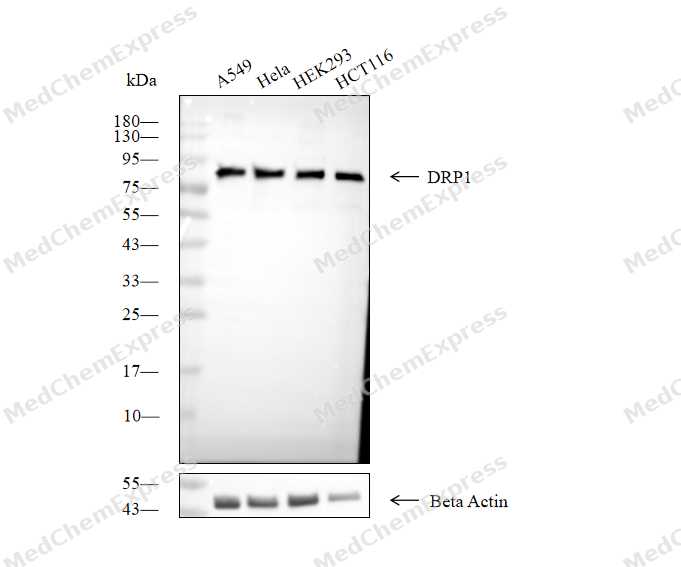 Western blot analysis of extracts from A549(lane 2(20μg), Hela (lane 3(20μg), HEK293(lane 4(20μg) and HCT116 (lane 5(20μg) using DRP1 Antibody (HY-P83794). Proteins were transferred to a PVDF membrane and blocked with 5% non-fat milk in TBST for 2 hour at room temperature. The primary antibody (1/1000)and Loading control antibody (Beta Actin, HY-P80993, 1/10000) was used in 5% non-fat milk in TBST at 4°C overnight. Goat Anti-Mouse IgG-HRP Secondary Antibody (1/10000) was used for 1 hour at room temperature.
 -
 Immunocytochemistry analysis of Hela cells labeling DRP1 with DRP1 Antibody (HY-P83794) at 1/300 dilution. Cells were fixed in 4% paraformaldehyde for 15 minutes at room temperature, permeabilized with 0.1% Triton X-100 in PBS for 15 minutes at room temperature, then blocked with quick block buffer for 10 minutes at room temperature. Cells were then incubated with DRP1 Antibody (HY-P83794) at 1/300 dilution in quick block buffer overnight at 4 ℃.AF488-conjugated Goat Anti-Mouse IgG H&L (HY-P8005, Green) was used as the secondary antibody at 1/1,000 dilution. PBS instead of the primary antibody was used as the secondary antibody only control. The Nuclear counterstain was DAPI (Blue).
 -
 Immunocytochemistry analysis of Hela cells labeling DRP1 with DRP1 Antibody (HY-P83794) at 1/600 dilution. Cells were fixed in 4% paraformaldehyde for 15 minutes at room temperature, permeabilized with 0.1% Triton X-100 in PBS for 15 minutes at room temperature, then blocked with quick block buffer for 10 minutes at room temperature. Cells were then incubated with DRP1 Antibody (HY-P83794) at 1/600 dilution in quick block buffer overnight at 4 ℃.AF488-conjugated Goat Anti-Mouse IgG H&L (HY-P8005, Green) was used as the secondary antibody at 1/1,000 dilution. PBS instead of the primary antibody was used as the secondary antibody only control. The Nuclear counterstain was DAPI (Blue).
 -
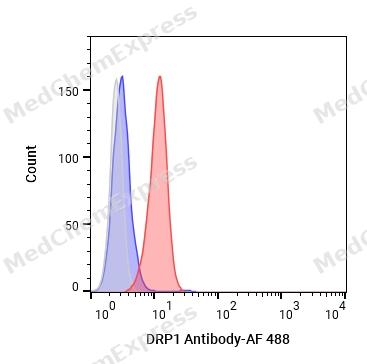 Flow cytometric analysis of 1X10⁶ HeLa cells labeling DRP1 Antibody (HY-P83794, red). Cells were fixed with 4% paraformaldehyde. Then stained with the primary antibody at 1/50 dilution for an hour at 4℃. AF 488-conjugated AffiniPure Goat Anti- Mouse IgG H&L (HY-P8005) was used as the secondary antibody at 1/1,000 dilution for 30 minutes at 4℃. Mouse IgG Isotype Control (HY-P80757, blue) was used as the isotype control, cells without incubation with primary antibody were used as the unlabeled control (black).


Background
-
Function
DRP1 functions in mitochondrial and peroxisomal division. Mediates membrane fission through oligomerization into membrane-associated tubular structures that wrap around the scission site to constrict and sever the mitochondrial membrane through a GTP hydrolysis-dependent mechanism. The specific recruitment at scission sites is mediated by membrane receptors like MFF, MIEF1 and MIEF2 for mitochondrial membranes. While the recruitment by the membrane receptors is GTP-dependent, the following hydrolysis of GTP induces the dissociation from the receptors and allows DNM1L filaments to curl into closed rings that are probably sufficient to sever a double membrane. Acts downstream of PINK1 to promote mitochondrial fission in a PRKN-dependent manner. Plays an important role in mitochondrial fission during mitosis. Through its function in mitochondrial division, ensures the survival of at least some types of postmitotic neurons, including Purkinje cells, by suppressing oxidative damage. Required for normal brain development, including that of cerebellum. Facilitates developmentally regulated apoptosis during neural tube formation. Required for a normal rate of cytochrome c release and caspase activation during apoptosis; this requirement may depend upon the cell type and the physiological apoptotic cues. Required for formation of endocytic vesicles. Proposed to regulate synaptic vesicle membrane dynamics through association with BCL2L1 isoform Bcl-X(L) which stimulates its GTPase activity in synaptic vesicles; the function may require its recruitment by MFF to clathrin-containing vesicles. Required for programmed necrosis execution. Rhythmic control of its activity following phosphorylation at Ser-637 is essential for the circadian control of mitochondrial ATP production; Inhibits peroxisomal division when overexpressed; Inhibits peroxisomal division when overexpressed[1][2][3][4][5][6][7][8][9][10][11][12][13][14][15][16][17][18][19][20][21][22][23][24][25][26][27][28][29][30].
-
Subcellular Localization
Cytoplasm, cytosol; Golgi apparatus; Endomembrane system; Peripheral membrane protein; Mitochondrion outer membrane; Peripheral membrane protein; Peroxisome; Membrane, clathrin-coated pit; Cytoplasmic vesicle, secretory vesicle, synaptic vesicle membrane
-
Expression
Tissue_specificity:This gene is widely expressed in various tissues, with the highest expression levels in skeletal muscle, heart, kidneys, and brain. Isomer 1 is brain-specific. Isomers 2 and 3 are primarily expressed in the testes and skeletal muscle, respectively. Isomer 4 is weakly expressed in the brain, heart, and kidneys. Isomer 5 is primarily expressed in the liver, heart, and kidneys. Isomer 6 is expressed in neurons. -
Isoforms & Post-Translational Modification
O00429 has 9 isomers: O00429-1: 81877 Da (predicted); O00429-2: 80536 Da (predicted); O00429-3: 79442 Da (predicted); O00429-4: 78100 Da (predicted); O00429-5: 79109 Da (predicted); O00429-6: 83399 Da (predicted); O00429-7: 60009 Da (predicted); O00429-8: 82057 Da (predicted); O00429-9: 79622 Da (predicted).
Phosphorylation/dephosphorylation events on two sites near the GED domain regulate mitochondrial fission (PubMed:17301055, PubMed:17553808, PubMed:18695047, PubMed:18838687, PubMed:23283981, PubMed:29478834, PubMed:33850055). Phosphorylation on Ser-637 by CAMK1 and PKA inhibits the GTPase activity, leading to a defect in mitochondrial fission promoting mitochondrial elongation (PubMed:17553808, PubMed:18695047, PubMed:23283981, PubMed:29478834). Dephosphorylated on this site by PPP3CA which promotes mitochondrial fission (PubMed:18838687). Phosphorylation on Ser-616 by CDK1 and PINK1 activates the GTPase activity and promotes mitochondrial fission (PubMed:18838687, PubMed:21822277, PubMed:32484300). Phosphorylated in a circadian manner at Ser-637 (PubMed:29478834). Dephosphorylated by PGAM5 (PubMed:32439975);Sumoylated on various lysine residues within the B domain, probably by MUL1. Sumoylation positively regulates mitochondrial fission. Desumoylated by SENP5 during G2/M transition of mitosis. Appears to be linked to its catalytic activity;S-nitrosylation increases DNM1L dimerization, mitochondrial fission and causes neuronal damage;Ubiquitination by MARCHF5 affects mitochondrial morphology;O-GlcNAcylation augments the level of the GTP-bound active form of DNM1L and induces translocation from the cytoplasm to mitochondria in cardiomyocytes. It also decreases phosphorylation at Ser-637 (By similarity) -
Subunit
Homotetramer; dimerizes through the N-terminal GTP-middle region of one molecule binding to the GED domain of another DNM1L molecule (PubMed:17553808, PubMed:23530241, PubMed:23584531, PubMed:23977156). Oligomerizes in a GTP-dependent manner to form membrane-associated tubules with a spiral pattern (PubMed:23584531). Interacts with GSK3B and MARCHF5 (PubMed:10749171, PubMed:16874301, PubMed:16936636, PubMed:9731200). Interacts (via the GTPase and B domains) with UBE2I; the interaction promotes sumoylation of DNM1L, mainly in its B domain (PubMed:19638400). Interacts with PPP3CA; the interaction dephosphorylates DNM1L and regulates its transition to mitochondria (PubMed:18838687). Interacts with BCL2L1 isoform BCL-X(L) and CLTA; DNM1L and BCL2L1 isoform BCL-X(L) may form a complex in synaptic vesicles that also contains clathrin and MFF (PubMed:23792689). Interacts with MFF; the interaction is inhibited by C11orf65/MFI (By similarity). Interacts with FIS1; may form part of a larger protein complex at the endoplasmic reticulum-mitochondrial interface during mitochondrial fission (PubMed:18695047, PubMed:24196833). Interacts with CANX (PubMed:24196833). Interacts with BCAP31 (PubMed:24196833). Interacts with MIEF2 and MIEF1; GTP-dependent, regulates GTP hydrolysis and DNM1L oligomerization (PubMed:21508961). Interacts with PGAM5; this interaction leads to dephosphorylation at Ser-656 and activation of GTPase activity and eventually to mitochondria fragmentation (PubMed:22265414). Interacts with RALBP1; during mitosis, recruits DNM1L to the mitochondrion and mediates its activation by the mitotic kinase cyclin B-CDK1 (PubMed:21822277). Interacts with FUNDC1; this interaction recruits DNM1L/DRP1 at ER-mitochondria contact sites (PubMed:27145933)
-
SwissProt ID
-
Synonyms
DLP1; DRP1; DVLP; EMPF; VPS1; DYMPLE; HDYNIV; DYNIV-11


Documentation
-
Data Sheet (235 KB)
-
SDS (252 KB)
- English - EN (252 KB)
- Français - FR (252 KB)
- Deutsch - DE (252 KB)
- Norwegian - NO (252 KB)
- Español - ES (252 KB)
- Swedish - SV (252 KB)
- Italian - IT (252 KB)
- Korean - KR (252 KB)
- Portuguese - PT (252 KB)
-
User Guide for Antibodies (1077 KB)

 Powered by Bioz
