



eNOS Antibody
(Synonyms: NOS3; Nitric oxide synthase; endothelial; Constitutive NOS; cNOS; EC-NOS; Endothelial NOS; eNOS; NOS type III; NOSIII)Based on 1 publication(s) in Google Scholar
eNOS Antibody is a Rabbit-derived and non-conjugated IgG polyclonal antibody, targeting to eNOS.
-
Host:
Rabbit
-
Isotype:
IgG
-
Application:
WB, IHC-P, ICC/IF, ELISA
-
Reactivity :
Human, Mouse, Rat
-
Formulation:
Supplied in 1*PBS (pH 7.3), 50% glycerol and 0.5% BSA. Preservative: 0.02% sodium azide.
-
Conjugation:
Non-conjugated


To place orders, for customer services and technical support, please contact: MedChemExpress USA
Tel: 609-228-6898 E-mail: [email protected] [email protected]



Publications Citing Use of MedChemExpress (MCE) eNOS Antibody
More

Applications
| Application |
WB

WB: Western Blot
|
IHC-P
IHC-P: Immunohistochemistry-Paraffin
|
ICC/IF
ICC/IF: Immunocytochemistry/
Immunofluorescence |
ELISA
ELISA: Enzyme Linked Immunosorbent Assay
|
|---|---|---|---|---|
| Dilution Ratio | 1:500-1:1000 | 1:50-1:100 | 1:50-1:200 | 1:10000 |


Product Details
eNOS Antibody is a Rabbit-derived and non-conjugated IgG polyclonal antibody, targeting to eNOS.
-
Host Rabbit

-
Clonality Polyclonal

-
Species ReactivityHuman, Mouse, Rat
-
Observed Molecular WeightObserved band size: 140 kDa
Note: Due to possible protein modifications or aggregation, the molecular weight should be confirmed by actual measurement, and the predicted value is for reference only.

-
Calculated Molecular Weight Predicted band size: 133 kDa

Entrez Gene: 4846 Human ; 18127 Mouse ; 24600 Rat
SwissProt: P29474 Human ; P70313 Mouse ; Q62600 Rat
OMIM: 163729 Human
Synthetic peptide corresponding to Human eNOS.AA range:1144-1193
Endogenous
affinity purified
Non-conjugated
Unmodified
IgG


Product Properties
-
Appearance
Solution
-
Formulation
Supplied in 1*PBS (pH 7.3), 50% glycerol and 0.5% BSA. Preservative: 0.02% sodium azide.
-
Concentration
Batch-dependent, Please check the COA for the concentration of each lot. Check Lot Concentration
-
Storage & Stability
Stored at -20°C for 1 year. Avoid repeated freeze / thaw cycles.
-
Shipping
Shipping with blue ice.


Publications (1)
-
Journal Impact Factor
-
Most Recent
-
FASEB J
2025 Sep 30;39(18):e71065. PMID: 40990660


Verification Images
-
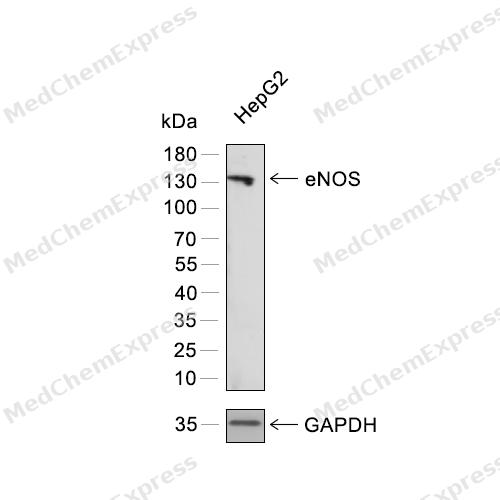 Western blot analysis of extracts from HepG2 using eNOS antibody. Proteins were transferred to a PVDF membrane and blocked with 5% nonfat powdered milk in PBST for 2 hour at room temperature. The primary antibody (1/1000) and Loading control antibody (GAPDH, 1/3000) was diluted with 5% nonfat powdered milk in PBST at 4°C overnight. Goat Anti-Rabbit IgG-HRP Secondary Antibody (1/8,000) was incubated for 45min at room temperature.
 -
 Immunocytochemistry analysis of A549 cells labeling eNOS with eNOS Antibody (HY-P80656) at 1/100 dilution. Cells were fixed in 4% paraformaldehyde for 15 minutes at room temperature, permeabilized with 0.1% Triton X-100 in PBS for 15 minutes at room temperature, then blocked with quick block buffer for 10 minutes at room temperature. Cells were then incubated with eNOS Antibody (HY-P80656) at 1/100 dilution in quick block buffer overnight at 4 ℃. AF488-conjugated Goat Anti-Rabbit IgG H&L(HY-P8002, Green) was used as the secondary antibody at 1/1,000 dilution. PBS instead of the primary antibody was used as the secondary antibody only control. The Nuclear counterstain was DAPI (Blue).
 -
 Immunocytochemistry analysis of A549 cells labeling eNOS with eNOS Antibody (HY-P80656) at 1/200 dilution. Cells were fixed in 4% paraformaldehyde for 15 minutes at room temperature, permeabilized with 0.1% Triton X-100 in PBS for 15 minutes at room temperature, then blocked with quick block buffer for 10 minutes at room temperature. Cells were then incubated with eNOS Antibody (HY-P80656) at 1/200 dilution in quick block buffer overnight at 4 ℃. AF488-conjugated Goat Anti-Rabbit IgG H&L(HY-P8002, Green) was used as the secondary antibody at 1/1,000 dilution. PBS instead of the primary antibody was used as the secondary antibody only control. The Nuclear counterstain was DAPI (Blue).


Background
-
Function
eNOS (NOS3) generates endothelial nitric oxide (NO), a vasoprotective signal that regulates vascular tone, blood pressure, platelet aggregation, leukocyte adhesion, and vascular homeostasis[1][2]. Mechanistically, Akt/PKB activates eNOS through Ser1177 phosphorylation, while agonist-stimulated endothelial cells integrate Ser1177 activation with Thr495 regulation to control NO output[3]. In disease models, eNOS loss or inhibition reduces endothelial NO signaling and increases blood pressure, as shown in eNOS-deficient mice and L-arginine/NOS inhibitor studies[4][5][6]. Compared with related isoforms, eNOS is mostly expressed in endothelial cells, nNOS mediates neuronal signaling, and iNOS produces high-output NO during inflammatory activation[1]. For experimental applications, L-NMMA, L-NIO, and L-NAME inhibit NOS activity and provide pharmacological tools to test endothelial NO-dependent vascular responses[6].
-
Subcellular Localization
Cell membrane; Membrane, caveola; Cytoplasm, cytoskeleton; Golgi apparatus
-
Expression
Tissue_specificity:Platelets, placenta, liver and kidneys -
Isoforms & Post-Translational Modification
P29474 has 3 isomers: P29474-1: 133275 Da (predicted); P29474-2: 68965 Da (predicted); P29474-3: 67862 Da (predicted).
Phosphorylation by AMPK at Ser-1177 in the presence of Ca(2+)-calmodulin (CaM) activates activity. In absence of Ca(2+)-calmodulin, AMPK also phosphorylates Thr-495, resulting in inhibition of activity (By similarity). Phosphorylation of Ser-114 by CDK5 reduces activity -
Subunit
Homodimer. Interacts with NOSIP and NOSTRIN (PubMed:11149895, PubMed:12446846). Interacts with HSP90AB1 (By similarity) (PubMed:11149895, PubMed:12446846, PubMed:23585225). Forms a complex with ASL, ASS1 and SLC7A1; the complex regulates cell-autonomous L-arginine synthesis and citrulline recycling while channeling extracellular L-arginine to nitric oxide synthesis pathway (By similarity)
-
SwissProt ID
-
Synonyms
NOS3; Nitric oxide synthase; endothelial; Constitutive NOS; cNOS; EC-NOS; Endothelial NOS; eNOS; NOS type III; NOSIII
-
Research Field
Neuroscience
Documentation
-
Data Sheet (261 KB)
-
SDS (252 KB)
- English - EN (252 KB)
- Français - FR (252 KB)
- Deutsch - DE (252 KB)
- Norwegian - NO (252 KB)
- Español - ES (252 KB)
- Swedish - SV (252 KB)
- Italian - IT (252 KB)
- Korean - KR (252 KB)
- Portuguese - PT (252 KB)
-
User Guide for Antibodies (1077 KB)
References
[1]. Förstermann U, et al. Nitric oxide synthases: regulation and function. Eur Heart J. 2012 Apr;33(7):829-37, 837a-837d. [Content Brief]
[2]. Förstermann U, et al. Endothelial nitric oxide synthase in vascular disease: from marvel to menace. Circulation. 2006 Apr 4;113(13):1708-14. [Content Brief]
[3]. Fleming I, et al. Phosphorylation of Thr(495) regulates Ca(2+)/calmodulin-dependent endothelial nitric oxide synthase activity. Circ Res. 2001 Jun 8;88(11):E68-75. [Content Brief]
[4]. Huang PL, et al. Hypertension in mice lacking the gene for endothelial nitric oxide synthase. Nature. 1995 Sep 21;377(6546):239-42. [Content Brief]
[5]. Shesely EG, et al. Elevated blood pressures in mice lacking endothelial nitric oxide synthase. Proc Natl Acad Sci U S A. 1996 Nov 12;93(23):13176-81. [Content Brief]
[6]. Rees DD, et al. Characterization of three inhibitors of endothelial nitric oxide synthase in vitro and in vivo. Br J Pharmacol. 1990 Nov;101(3):746-52. [Content Brief]

 Powered by Bioz
