



HDAC8 Antibody (YA2994)
(Synonyms: HDAC8; HDACL1; CDA07; Histone deacetylase 8; HD8)Based on 1 Customer Validation
HDAC8 Antibody (YA2994) is a Rabbit-derived and non-conjugated IgG monoclonal antibody, targeting to HDAC8.
-
Host:
Rabbit
-
Isotype:
IgG
-
Application:
WB, IP
-
Reactivity :
Human
-
Formulation:
Supplied in 50mM Tris-Glycine(pH 7.4), 0.15M NaCl, 40% Glycerol, 0.01% Sodium azide and 0.05% BSA
-
Conjugation:
Non-conjugated


To place orders, for customer services and technical support, please contact: MedChemExpress USA
Tel: 609-228-6898 E-mail: [email protected] [email protected]





Applications
| Application |
WB

WB: Western Blot
|
IP
IP: Immunoprecipitation
|
|---|---|---|
| Dilution Ratio | 1:500-1:1000 | 1:20 |


Product Details
HDAC8 Antibody (YA2994) is a Rabbit-derived and non-conjugated IgG monoclonal antibody, targeting to HDAC8.
-
Host Rabbit

-
Clonality Recombinant,Monoclonal

-
Species ReactivityHuman
-
Observed Molecular WeightObserved band size: 42 kDa
Note: Due to possible protein modifications or aggregation, the molecular weight should be confirmed by actual measurement, and the predicted value is for reference only.

-
Calculated Molecular Weight Predicted band size: 42 kDa

A synthetic peptide of human HDAC8
Endogenous
Affinity Purified
Non-conjugated
Unmodified
IgG


Product Properties
-
Appearance
Solution
-
Formulation
Supplied in 50mM Tris-Glycine(pH 7.4), 0.15M NaCl, 40% Glycerol, 0.01% Sodium azide and 0.05% BSA
-
Concentration
Batch-dependent, Please check the COA for the concentration of each lot. Check Lot Concentration
-
Storage & Stability
Stored at -20°C for 1 year. Avoid repeated freeze / thaw cycles.
-
Shipping
Shipping with blue ice.


Verification Images
-
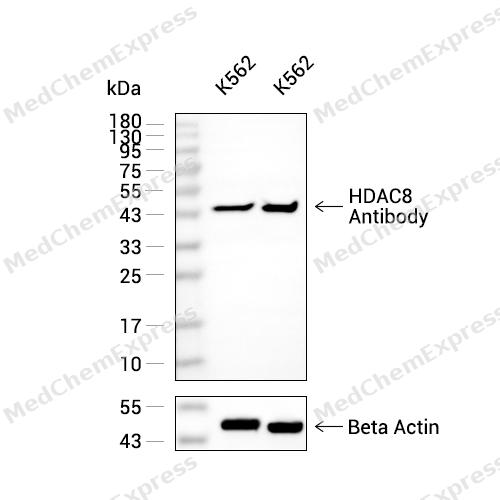 Western blot analysis of extracts from K562(lane 2(20ug) and K562(lane 3(40ug) using HDAC8 Antibody (HY-P83249) Rabbit mAb. Proteins were transferred to a PVDF membrane and blocked with 5% non-fat milk in TBST for 2 hour at room temperature. The primary antibody (1/1000) and Loading control antibody (Beta Actin, HY-P80438, 1/10000) was used in 5% non-fat milk in TBST at 4°C overnight. Goat Anti-Mouse/Rabbit IgG-HRP Secondary Antibody (1/10000) was used for 1 hour at room temperature.


Background
-
Function
HDAC8 (histone deacetylase 8) is a zinc-dependent class I histone deacetylase that regulates chromatin organization and transcription through deacetylation of both histone and nonhistone substrates, placing it at the center of epigenetic control mechanisms.[1] Mechanistically, HDAC8 participates in transcriptional regulation, cell-cycle progression, and genome maintenance, and recent evidence shows that HDAC8 activity contributes to replication-fork stability through regulation of the cohesin component SMC3 and suppression of replication-associated stress.[2] These functions connect HDAC8 to biological processes that govern proliferation, differentiation, and cellular homeostasis.[1][2] In disease settings, dysregulated HDAC8 has been implicated in multiple cancers, where it is associated with tumor cell proliferation, metastasis, immune evasion, and drug resistance, supporting its relevance as an epigenetic therapeutic target.[3][1] HDAC8 has also been linked to developmental and genetic disorders, including Cornelia de Lange syndrome and X-linked intellectual disability, indicating functions that extend beyond oncology.[1] Compared with related class I isoforms such as HDAC1, HDAC2, and HDAC3, HDAC8 displays distinct structural and substrate-recognition properties, recognizes both histone and nonhistone proteins, and therefore offers opportunities for isoform-selective pharmacological modulation.[1][4] For experimental applications, selective HDAC8 inhibitors have been developed to minimize the off-target effects associated with pan-HDAC inhibition, and these compounds are widely used to investigate HDAC8-dependent pathways and evaluate therapeutic strategies in cancer and other disease models.[1][4]
-
Subcellular Localization
Nucleus; Chromosome; Cytoplasm
-
Expression
Tissue_specificity:Weakly expressed in most tissues. Expressed at higher level in heart, brain, kidney and pancreas and also in liver, lung, placenta, prostate and kidney -
Isoforms & Post-Translational Modification
Q9BY41 has 6 isomers: Q9BY41-1: 41758 Da (predicted); Q9BY41-4: 31935 Da (predicted); Q9BY41-5: 28353 Da (predicted); Q9BY41-6: 15685 Da (predicted); Q9BY41-7: 17439 Da (predicted); Q9BY41-8: 16050 Da (predicted).
Phosphorylated by PKA on serine 39. Phosphorylation reduces deacetylase activity observed preferentially on histones H3 and H4 -
Subunit
Interacts with PEPB2-MYH11, a fusion protein consisting of the 165 N-terminal residues of CBF-beta (PEPB2) with the tail region of MYH11 produced by the inversion Inv(16)(p13q22), a translocation associated with acute myeloid leukemia of M4EO subtype (PubMed:12509458). The PEPB2-MYH1 fusion protein also interacts with RUNX1, a well known transcriptional regulator, suggesting that the interaction with HDAC8 may participate in the conversion of RUNX1 into a constitutive transcriptional repressor (PubMed:12509458). Interacts with CBFA2T3 (PubMed:11533236). Interacts with phosphorylated SMG5/EST1B; this interaction protects SMG5 from ubiquitin-mediated degradation (PubMed:16809764). Associates with alpha-SMA (smooth muscle alpha-actin) (PubMed:15772115)
-
SwissProt ID
-
Synonyms
HDAC8; HDACL1; CDA07; Histone deacetylase 8; HD8
-
Research Field
Epigenetics and Nuclear Signaling


Documentation
-
Data Sheet (261 KB)
-
SDS (251 KB)
- English - EN (251 KB)
- Français - FR (251 KB)
- Deutsch - DE (251 KB)
- Norwegian - NO (251 KB)
- Español - ES (251 KB)
- Swedish - SV (251 KB)
- Italian - IT (251 KB)
- Korean - KR (251 KB)
- Portuguese - PT (251 KB)
-
User Guide for Antibodies (1077 KB)
References
[1]. Chakrabarti A, et al. HDAC8: a multifaceted target for therapeutic interventions. Trends Pharmacol Sci. 2015 Jul;36(7):481-92. doi: 10.1016/j.tips.2015.04.013. Epub 2015 May 23. PMID: 26013035. [Content Brief]
[2]. Chang TY, et al. Combined HDAC8 and checkpoint kinase inhibition induces tumor-selective synthetic lethality in preclinical models. J Clin Invest. 2024 Oct 22;134(23):e165448. doi: 10.1172/JCI165448. PMID: 39436709; PMCID: PMC11601943. [Content Brief]
[3]. Kim JY, et al. Pathological Role of HDAC8: Cancer and Beyond. Cells. 2022 Oct 9;11(19):3161. [Content Brief]
[4]. Fontana A, et al. A Therapeutic Perspective of HDAC8 in Different Diseases: An Overview of Selective Inhibitors. Int J Mol Sci. 2022 Sep 2;23(17):10014. doi: 10.3390/ijms231710014. PMID: 36077415; PMCID: PMC9456347. [Content Brief]

 Powered by Bioz
