



MMP-9 Antibody (YA6348)
(Synonyms: Matrix metalloproteinase-9 precursor; MMP-9; MMP9; MMP 9; 92 kDa type IV; Collagenase; 92 kDa gelatinase; Gelatinase B; GELB; MMP9_HUMAN; 82 kDa matrix metalloproteinase-9; 92 kDa type IV collagenase; CLG 4B; CLG-4B; CLG4B; Collagenase Type 4 beta; Collagenase Type-4 beta; Collagenase type IV 92 KD; Collagenase type IV 92 KD; EC 3.4.24.35; Gelatinase 92 KD; Gelatinase 92 KD; Gelatinase beta; Gelatinase-beta; GelatinaseB; GELB; Macrophage gelatinase; MANDP2; Matrix metallopeptidase 9(gelatinase B, 92kDa gelatinase, 92kDa type IV collagenase); Matrix Metalloproteinase 9; Type V collagenase.)
Based on 1 Customer Validation
MMP-9 Antibody (YA6348) is a Rabbit-derived and non-conjugated IgG monoclonal antibody, targeting to MMP-9.
-
Host:
Rabbit
-
Isotype:
IgG
-
Application:
WB, IHC-P, IHC-F, IF-Tissue
-
Reactivity :
Human, Mouse, Rat
-
Formulation:
Supplied in 0.01M TBS (pH7.4) with 1% BSA, 0.02% Proclin300 and 50% Glycerol.
-
Conjugation:
Non-conjugated


To place orders, for customer services and technical support, please contact: MedChemExpress USA
Tel: 609-228-6898 E-mail: [email protected] [email protected]





Applications
| Application |
WB

WB: Western Blot
|
IHC-P
IHC-P: Immunohistochemistry-Paraffin
|
IHC-F
IHC-F: Immunohistochemistry-Frozen
|
ICC/IF
ICC/IF: Immunocytochemistry/
Immunofluorescence |
|---|---|---|---|---|
| Dilution Ratio | 1:2000-20000 | 1:200-1000 | 1:200-1000 | 1:200-1000 |


Product Details
MMP-9 Antibody (YA6348) is a Rabbit-derived and non-conjugated IgG monoclonal antibody, targeting to MMP-9.
-
Host Rabbit

-
Clonality Monoclonal

-
Species ReactivityHuman, Mouse, Rat
-
Calculated Molecular Weight Predicted band size: 100 kDa

A synthesized peptide derived from human MMP9 aa 100-165/707
affinity purified.
Non-conjugated
Unmodified
IgG


Product Properties
-
Appearance
Solution
-
Formulation
Supplied in 0.01M TBS (pH7.4) with 1% BSA, 0.02% Proclin300 and 50% Glycerol.
-
Concentration
Batch-dependent, Please check the COA for the concentration of each lot. Check Lot Concentration
-
Storage & Stability
Stored at -20°C for 1 year. Avoid repeated freeze / thaw cycles.
-
Shipping
Shipping with blue ice.


Verification Images
-
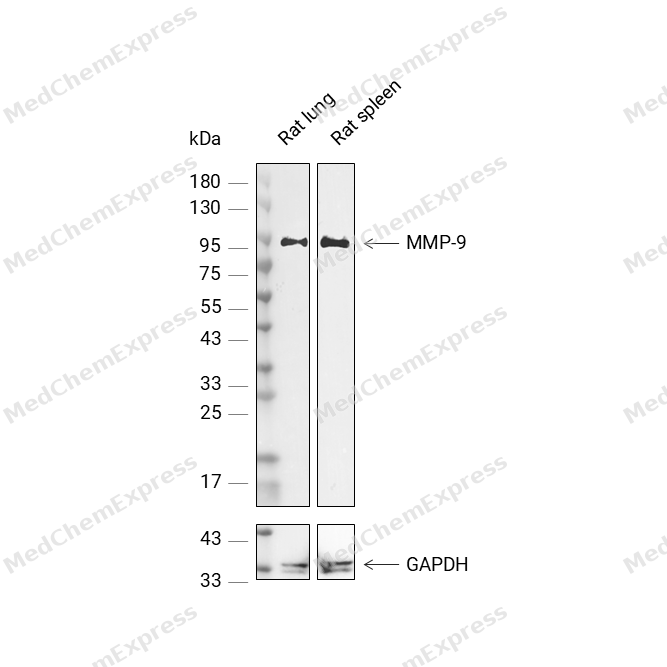 Western blot analysis was performed on protein extracts (30 μg) from Rat lung (lane 2) and Rat spleen (lane 3) using MMP-9 antibody. Proteins were transferred onto a 0.45 μm PVDF membrane using the Trans-Blot® Turbo™ system for 13 min. The membrane was then blocked with 5% nonfat milk in TBST (HY-K1025) for 1 h at room temperature. Thhe primary antibody (1:500) and loading control antibody GAPDH Antibody (HRP) (HY-P80954A) (1:5000) were diluted in 5% nonfat milk in TBST and incubated with the membrane overnight at 4°C. After washing, the membrane of primary antibody was incubated with HRP-conjugated goat anti-rabbit/mouse IgG secondary antibody (HY-P8001/HY-P8004) (1:5000) diluted in 5% nonfat milk in TBST for 1 h at room temperature. Protein bands were visualized using an Ultra High Sensitivity ECL detection kit (HY-K1005).
 -
 Immunohistochemical analysis of paraffin-embedded human appendix tissue using MMP-9 Antibody (HY-P86656, 1/500). The section was pretreated using heat mediated antigen retrieval with sodium citrate buffer (pH 6.0) for 8 minutes. The tissues were blocked with quick block buffer for 0.5 hours at room temperature, washed with PBS and PBST, and then incubated with the primary antibody overnight at 4℃. The detection was performed using an HRP conjugated compact polymer system. DAB was used as the chromogen. Tissues were counterstained with hematoxylin and mounted with DPX.
 -
 Immunohistochemical analysis of paraffin-embedded human rectum tissue using MMP-9 Antibody (HY-P86656, 1/500). The section was pretreated using heat mediated antigen retrieval with sodium citrate buffer (pH 6.0) for 8 minutes. The tissues were blocked with quick block buffer for 0.5 hours at room temperature, washed with PBS and PBST, and then incubated with the primary antibody overnight at 4℃. The detection was performed using an HRP conjugated compact polymer system. DAB was used as the chromogen. Tissues were counterstained with hematoxylin and mounted with DPX.
 -
 Immunohistochemical analysis of paraffin-embedded human tonsil tissue using MMP-9 Antibody (HY-P86656, 1/500). The section was pretreated using heat mediated antigen retrieval with sodium citrate buffer (pH 6.0) for 8 minutes. The tissues were blocked with quick block buffer for 0.5 hours at room temperature, washed with PBS and PBST, and then incubated with the primary antibody overnight at 4℃. The detection was performed using an HRP conjugated compact polymer system. DAB was used as the chromogen. Tissues were counterstained with hematoxylin and mounted with DPX.
 -
 Immunohistochemical analysis of paraffin-embedded human spleen tissue using MMP-9 Antibody (HY-P86656, 1/500). The section was pretreated using heat mediated antigen retrieval with sodium citrate buffer (pH 6.0) for 8 minutes. The tissues were blocked with quick block buffer for 0.5 hours at room temperature, washed with PBS and PBST, and then incubated with the primary antibody overnight at 4℃. The detection was performed using an HRP conjugated compact polymer system. DAB was used as the chromogen. Tissues were counterstained with hematoxylin and mounted with DPX.
 -
 Immunohistochemical analysis of paraffin-embedded human lymph node tissue using MMP-9 Antibody (HY-P86656, 1/500). The section was pretreated using heat mediated antigen retrieval with sodium citrate buffer (pH 6.0) for 8 minutes. The tissues were blocked with quick block buffer for 0.5 hours at room temperature, washed with PBS and PBST, and then incubated with the primary antibody overnight at 4℃. The detection was performed using an HRP conjugated compact polymer system. DAB was used as the chromogen. Tissues were counterstained with hematoxylin and mounted with DPX.
 -
 Immunohistochemical analysis of paraffin-embedded mouse colon tissue using MMP-9 Antibody (HY-P86656, 1/500). The section was pretreated using heat mediated antigen retrieval with sodium citrate buffer (pH 6.0) for 8 minutes. The tissues were blocked with quick block buffer for 0.5 hours at room temperature, washed with PBS and PBST, and then incubated with the primary antibody overnight at 4℃. The detection was performed using an HRP conjugated compact polymer system. DAB was used as the chromogen. Tissues were counterstained with hematoxylin and mounted with DPX.


Background
-
Function
MMP-9 (matrix metalloproteinase-9), also known as gelatinase B, is a zinc-dependent extracellular endopeptidase that mediates extracellular matrix remodeling through proteolytic cleavage of gelatin, type IV collagen, laminin, elastin, and additional matrix-associated substrates, thereby regulating tissue turnover, cell migration, and microenvironmental remodeling[1][2]. Mechanistically, MMP-9 is synthesized as an inactive proenzyme and becomes activated through proteolytic removal of its prodomain, enabling participation in inflammatory signaling, leukocyte trafficking, angiogenesis, and tissue repair processes[1][3]. MMP-9 also modulates biological activity of cytokines, chemokines, growth factors, and cell-surface signaling molecules, linking extracellular matrix degradation with immune and vascular responses[3][4]. In disease settings, dysregulated or persistent MMP-9 expression is associated with cancer progression, invasion, metastasis, vascular remodeling, neuroinflammatory disorders, and blood-brain barrier disruption, making MMP-9 a widely studied pathogenic mediator and biomarker candidate[3][5][6]. Compared with the closely related gelatinase MMP-2, MMP-9 displays distinct substrate preferences, inducible expression in inflammatory conditions, predominant storage in neutrophils, and primary inhibition by TIMP-1, whereas MMP-2 is generally constitutively expressed and preferentially regulated by TIMP-2[4]. Structural differences, including a unique loop region and distinct regulatory mechanisms, further support functional separation between the two gelatinases in physiological and pathological remodeling[2][4]. For experimental applications, MMP-9-selective inhibitors and neutralizing antibodies are widely used to investigate extracellular matrix remodeling, angiogenesis, inflammatory responses, and tumor progression, although achieving high selectivity remains a major challenge because of structural homology within the matrix metalloproteinase family[5][7].
-
Subcellular Localization
Secreted, extracellular space, extracellular matrix
-
Expression
Tissue_specificity:Protein levels were detected in neutrophils (PubMed: 7683678) . Produced by normal alveolar macrophages and granulocytes.
Induction:Activated by 4-aminophenylmercuric acetate and phorbol ester. Up-regulated by ARHGEF4, SPATA13 and APC via the JNK signaling pathway in colorectal tumor cells; (Microbial infection) Expression induced by M.bovis MPB83 (at protein level) (PubMed:20800577) -
Subunit
Exists as monomer or homodimer; disulfide-linked (PubMed:1281792, PubMed:7683678). Also exists as heterodimer with LCN2 (PubMed:1281792, PubMed:7683678). Macrophages and transformed cell lines produce only the monomeric form. Interacts with ECM1 (PubMed:16512877)
-
SwissProt ID
-
Synonyms
Matrix metalloproteinase-9 precursor; MMP-9; MMP9; MMP 9; 92 kDa type IV; Collagenase; 92 kDa gelatinase; Gelatinase B; GELB; MMP9_HUMAN; 82 kDa matrix metalloproteinase-9; 92 kDa type IV collagenase; CLG 4B; CLG-4B; CLG4B; Collagenase Type 4 beta; Collagenase Type-4 beta; Collagenase type IV 92 KD; Collagenase type IV 92 KD; EC 3.4.24.35; Gelatinase 92 KD; Gelatinase 92 KD; Gelatinase beta; Gelatinase-beta; GelatinaseB; GELB; Macrophage gelatinase; MANDP2; Matrix metallopeptidase 9(gelatinase B, 92kDa gelatinase, 92kDa type IV collagenase); Matrix Metalloproteinase 9; Type V collagenase.


Documentation
-
Data Sheet (262 KB)
-
SDS (254 KB)
- English - EN (254 KB)
- Français - FR (254 KB)
- Deutsch - DE (254 KB)
- Norwegian - NO (254 KB)
- Español - ES (254 KB)
- Swedish - SV (254 KB)
- Italian - IT (254 KB)
- Korean - KR (254 KB)
- Portuguese - PT (254 KB)
-
User Guide for Antibodies (1077 KB)
References
[1]. Mondal S, et al. Matrix metalloproteinase-9 (MMP-9) and its inhibitors in cancer: A minireview. Eur J Med Chem. 2020 May 15;194:112260. [Content Brief]
[2]. Rashid ZA, et al. Novel Matrix Metalloproteinase-9 (MMP-9) Inhibitors in Cancer Treatment. Int J Mol Sci. 2023 Jul 28;24(15):12133. [Content Brief]
[3]. Li H, et al. Matrix Metalloproteinase-9 as an Important Contributor to the Pathophysiology of Depression. Front Neurol. 2022 Mar 18;13:861843. [Content Brief]
[4]. Nikolov A, et al. Role of Gelatinases MMP-2 and MMP-9 in Healthy and Complicated Pregnancy and Their Future Potential as Preeclampsia Biomarkers. Diagnostics (Basel). 2021 Mar 9;11(3):480. [Content Brief]
[5]. Huang H. Matrix Metalloproteinase-9 (MMP-9) as a Cancer Biomarker and MMP-9 Biosensors: Recent Advances. Sensors (Basel). 2018 Sep 27;18(10):3249. doi: 10.3390/s18103249. PMID: 30262739; PMCID: PMC6211011. et al. Matrix Metalloproteinase-9 (MMP-9) as a Cancer Biomarker and MMP-9 Biosensors: Recent Advances. Sensors (Basel). 2018 Sep 27;18(10):3249. [Content Brief]
[6]. Vandooren J, et al. Biochemistry and molecular biology of gelatinase B or matrix metalloproteinase-9 (MMP-9): the next decade. Crit Rev Biochem Mol Biol. 2013 May-Jun;48(3):222-72. [Content Brief]
[7]. Vandenbroucke RE, et al. Is there new hope for therapeutic matrix metalloproteinase inhibition? Nat Rev Drug Discov. 2014 Dec;13(12):904-27. [Content Brief]

 Powered by Bioz
