



Orai1 Antibody (YA3157)
(Synonyms: CRACM1; Orai 1; ORAI calcium release activated calcium modulator 1; orai1; ORAT1; Protein orai 1; TMEM142A)
Based on 1 Customer Validation
Orai1 Antibody (YA3157) is a Rabbit-derived and non-conjugated IgG monoclonal antibody, targeting to Orai1.
-
Host:
Rabbit
-
Isotype:
IgG
-
Application:
WB
-
Reactivity :
Human
-
Formulation:
Supplied in rabbit IgG in 50 mM Tris-Glycine (pH 7.4), 0.15 M NaCl, 40% Glycerol, 0.01% sodium azide and 0.05% BSA.
-
Conjugation:
Non-conjugated


To place orders, for customer services and technical support, please contact: MedChemExpress USA
Tel: 609-228-6898 E-mail: [email protected] [email protected]





Applications
| Application |
WB

WB: Western Blot
|
|---|---|
| Dilution Ratio | 1:500-1:1000 |


Product Details
Orai1 Antibody (YA3157) is a Rabbit-derived and non-conjugated IgG monoclonal antibody, targeting to Orai1.
-
Host Rabbit

-
Clonality Recombinant,Monoclonal

-
Species ReactivityHuman
-
Observed Molecular WeightObserved band size: 33 kDa
Note: Due to possible protein modifications or aggregation, the molecular weight should be confirmed by actual measurement, and the predicted value is for reference only.

-
Calculated Molecular Weight Predicted band size: 33 kDa

A synthesized peptide derived from human Orai1 aa200-250/301.
Endogenous
Affinity Chromatography
Non-conjugated
Unmodified
IgG


Product Properties
-
Appearance
Liquid
-
Formulation
Supplied in rabbit IgG in 50 mM Tris-Glycine (pH 7.4), 0.15 M NaCl, 40% Glycerol, 0.01% sodium azide and 0.05% BSA.
-
Concentration
Batch-dependent, Please check the COA for the concentration of each lot. Check Lot Concentration
-
Storage & Stability
Stored at -20°C for 1 year. Avoid repeated freeze / thaw cycles.
-
Shipping
Shipping with blue ice.


Verification Images
-
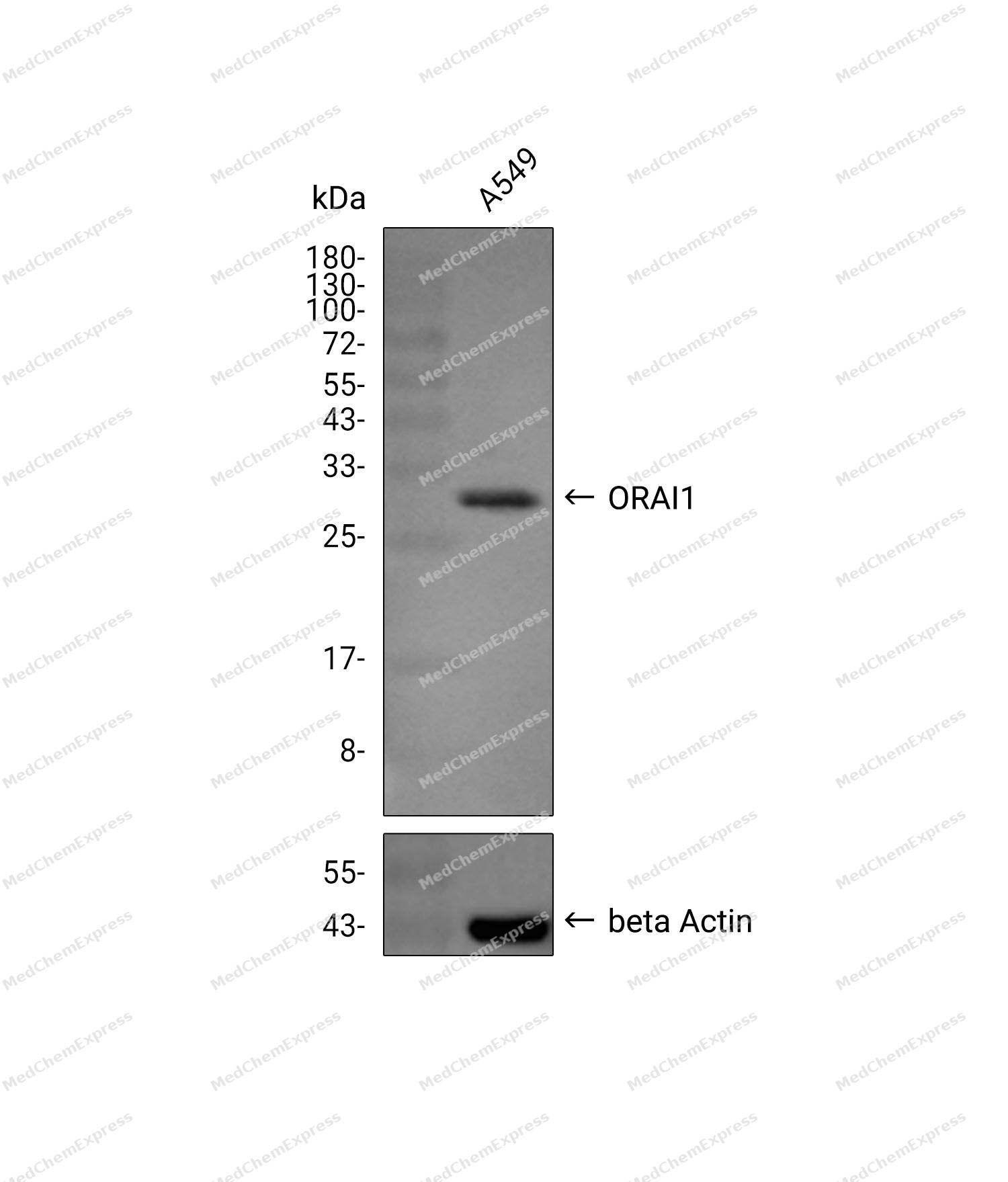
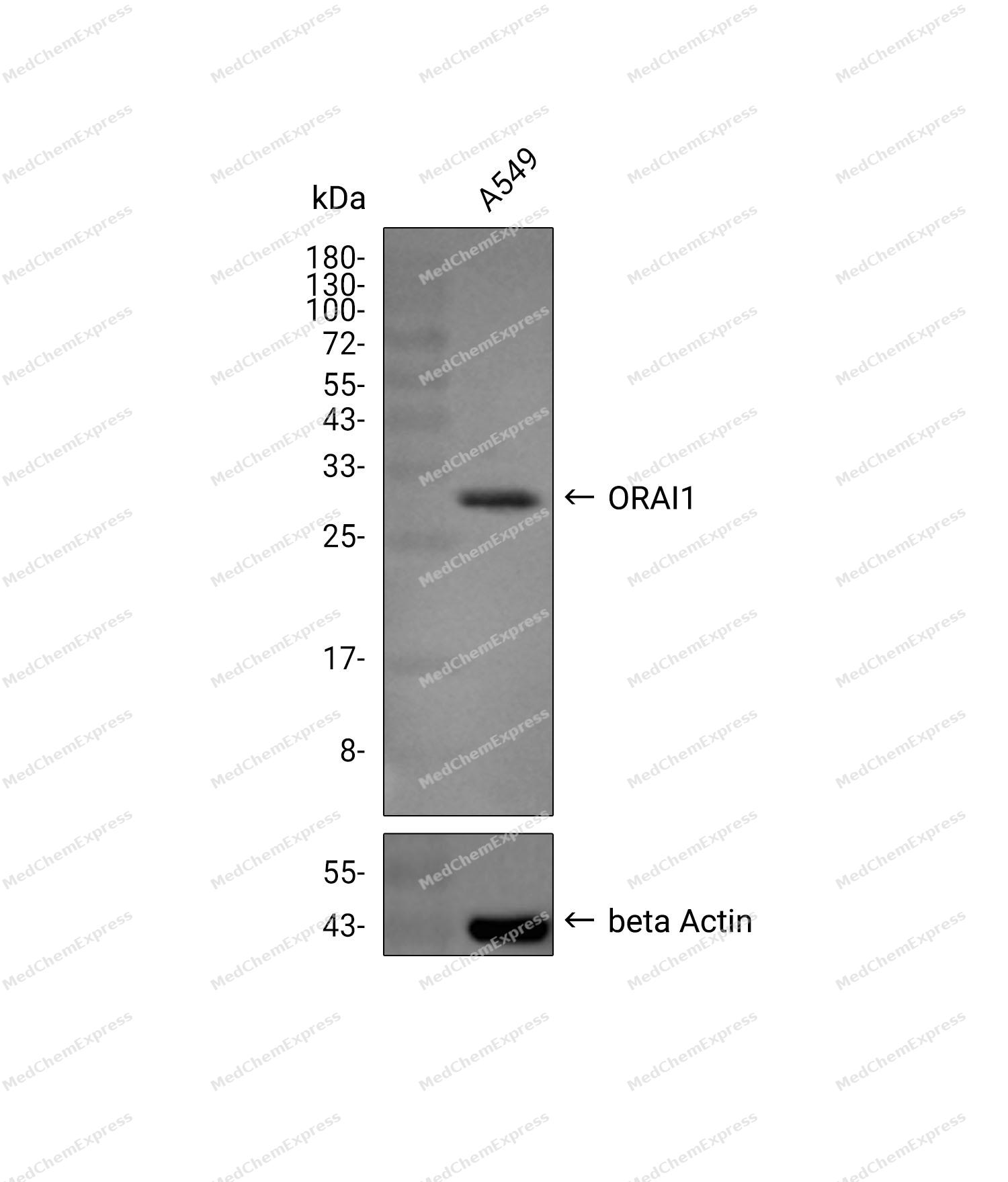 Western blot analysis was performed on extracts from A549 (lane 1, 15 μg) using ORAI1 Rabbit mAb.Proteins were transferred to a PVDF membrane and blocked with 5% non-fat milk in TBST at 4°C overnight.The primary antibody (1:500 dilution) and the loading control antibody (beta-Actin, HY-P80438, 1:20000 dilution) were incubated in 5% non-fat milk in TBST for 1 hour at 37°C.Goat Anti-Rabbit IgG-HRP Secondary Antibody (1:20000 dilution) was then applied for 40 minutes at 37°C.
 -
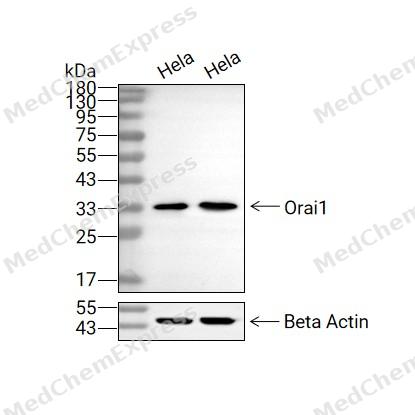 Western blot analysis of extracts from Hela (lane 2(20μg) and Hela (lane 3(40μg) using Orai1 (HY-P83412) Rabbit mAb. Proteins were transferred to a PVDF membrane and blocked with 5% non-fat milk in TBST for 2 hour at room temperature. The primary antibody (1/1000) and Loading control antibody (Beta Actin, HY-P80438, 1/10000) was used in 5% non-fat milk in TBST at 4°C overnight. Goat Anti-Rabbit IgG-HRP Secondary Antibody (1/10000) was used for 1 hour at room temperature.


Background
-
Function
Orai1 is a Pore-forming subunit of two major inward rectifying Ca(2+) channels at the plasma membrane: Ca(2+) release-activated Ca(2+) (CRAC) channels and arachidonate-regulated Ca(2+)-selective (ARC) channels (Probable). Assembles with ORAI2 and ORAI3 to form hexameric CRAC channels that mediate Ca(2+) influx upon depletion of endoplasmic reticulum Ca(2+) store and channel activation by Ca(2+) sensor STIM1, a process known as store-operated Ca(2+) entry (SOCE). Various pore subunit combinations may account for distinct CRAC channel spatiotemporal and cell-type specific dynamics. ORAI1 mainly contributes to the generation of Ca(2+) plateaus involved in sustained Ca(2+) entry and is dispensable for cytosolic Ca(2+) oscillations, whereas ORAI2 and ORAI3 generate oscillatory patterns. CRAC channels assemble in Ca(2+) signaling microdomains where Ca(2+) influx is coupled to calmodulin and calcineurin signaling and activation of NFAT transcription factors recruited to ORAI1 via AKAP5. Activates NFATC2/NFAT1 and NFATC3/NFAT4-mediated transcriptional responses. CRAC channels are the main pathway for Ca(2+) influx in T cells and promote the immune response to pathogens by activating NFAT-dependent cytokine and chemokine transcription. Assembles with ORAI3 to form channels that mediate store-independent Ca(2+) influx in response to inflammatory metabolites arachidonate or its derivative leukotriene C4, termed ARC and LRC channels respectively. Plays a prominent role in Ca(2+) influx at the basolateral membrane of mammary epithelial cells independently of the Ca(2+) content of endoplasmic reticulum or Golgi stores. May mediate transepithelial transport of large quantities of Ca(2+) for milk secretion; Pore-forming subunit of both CRAC and ARC channels. Couples Ca(2+) influx to NFAT-mediated transcriptional responses; Pore-forming subunit of CRAC channels exclusively[1][2][3][4][5][6][7][8][9][10][11][12][13][14][15][16][17][18][19].
-
Subcellular Localization
Cell membrane; Multi-pass membrane protein; Basolateral cell membrane; Multi-pass membrane protein; Cell membrane; Cell membrane
-
Expression
Tissue_specificity:Expressed in naive CD4 and CD8 T cells (at protein level) (PubMed:26956484) . Expressed at similar levels in naive and effector T helper cells (PubMed:20354224) -
Isoforms & Post-Translational Modification
Q96D31 has 2 isomers: Q96D31-1: 32668 Da (predicted); Q96D31-2: 25337 Da (predicted).
N-glycosylated (PubMed:16921383, PubMed:19249086, PubMed:26956484). N-glycosylation inhibits channel activity in T cells (PubMed:26956484);Ubiquitinated;Cys-195 is oxidated, leading to inactivation of channel activity -
Subunit
Oligomerizes in homomeric and heteromeric ORAI complexes. Native CRAC channels most likely consist of hexameric ORAI heteromers, implying that diverse ORAI1, ORAI2 and ORAI3 subunit combinations with distinct biophysical properties can operate in a cell-type specific way (PubMed:17442569, PubMed:32415068). ARC channels are heteropentamers consisting of three ORAI1 and two ORAI3 subunits (PubMed:19622606). Interacts with STIM1 and STIM2; this regulates channel activity (PubMed:17905723, PubMed:19249086, PubMed:19706554, PubMed:24351972, PubMed:27185316, PubMed:28219928, PubMed:30481768). Interacts with CALM; this may displace STIM1 and STIM2 and might thereby modulate channel activity (PubMed:23109337). Interacts with CRACR2A/EFCAB4B; the interaction is direct and takes place in absence of Ca(2+) (PubMed:20418871). Forms a complex with CRACR2A/EFCAB4B and STIM1 at low concentration of Ca(2+), the complex dissociates at elevated Ca(2+) concentrations. Interacts with ASPH (isoform 8) (PubMed:22586105). Interacts with SLC35G1 (PubMed:22084111). Interacts with UBQLN1 (PubMed:23307288). Interacts with ADCY8; interaction is calcium store depletion independent; interaction occurs in membrane raft; interaction increases markedly after store depletion; positively regulates SOCE-induced adenylate cyclase activity; contributes to the targeting of ADCY8 to discrete regions of the plasma membrane that are shielded from other calcium events (PubMed:22494970). Interacts with EFHB; the interaction takes place upon Ca(2+)-store depletion (PubMed:30481768). Interacts (via N- and C-termini) with ATP2C2 (via N-terminus); this interaction regulates Ca(2+) influx at the plasma membrane. Interacts with TSPAN18; this interaction regulates ORAI1 exit from the endoplasmic (ER), and/or Golgi, and trafficking to the cell surface (PubMed:30573509)
-
SwissProt ID
-
Synonyms
CRACM1; Orai 1; ORAI calcium release activated calcium modulator 1; orai1; ORAT1; Protein orai 1; TMEM142A
-
Research Field
Immunology


Documentation
-
Data Sheet (232 KB)
-
SDS (252 KB)
- English - EN (252 KB)
- Français - FR (252 KB)
- Deutsch - DE (252 KB)
- Norwegian - NO (252 KB)
- Español - ES (252 KB)
- Swedish - SV (252 KB)
- Italian - IT (252 KB)
- Korean - KR (252 KB)
- Portuguese - PT (252 KB)
-
User Guide for Antibodies (1077 KB)

 Powered by Bioz
