



Phospho-CDK2 (Tyr15) Antibody (YA217)
(Synonyms: CDK2; CDKN2; Cyclin-dependent kinase 2; Cell division protein kinase 2; p33 protein kinase)Based on 1 publication(s) in Google Scholar
Phospho-CDK2 (Tyr15) Antibody (YA217) is a Rabbit-derived and non-conjugated IgG monoclonal antibody, targeting to Phospho-CDK2 (Tyr15).
-
Host:
Rabbit
-
Isotype:
IgG
-
Application:
WB, IP
-
Reactivity :
Human, Hamster, Rat
-
Formulation:
Supplied in 50 mM Tris-Glycine (pH 7.4), 0.15 M NaCl, 40% Glycerol and 0.05% BSA. Preservative: 0.01% Sodium azide
-
Conjugation:
Non-conjugated


To place orders, for customer services and technical support, please contact: MedChemExpress USA
Tel: 609-228-6898 E-mail: [email protected] [email protected]



Publications Citing Use of MedChemExpress (MCE) Phospho-CDK2 (Tyr15) Antibody (YA217)
More

Applications
| Application |
WB

WB: Western Blot
|
IP
IP: Immunoprecipitation
|
|---|---|---|
| Dilution Ratio | 1:500-1:1000 | 1:20 |


Product Details
Phospho-CDK2 (Tyr15) Antibody (YA217) is a Rabbit-derived and non-conjugated IgG monoclonal antibody, targeting to Phospho-CDK2 (Tyr15).
-
Host Rabbit

-
Clonality Recombinant,Monoclonal

-
Species ReactivityHuman, Hamster, Rat
-
Observed Molecular WeightObserved band size: 34 kDa
Note: Due to possible protein modifications or aggregation, the molecular weight should be confirmed by actual measurement, and the predicted value is for reference only.

-
Calculated Molecular Weight Predicted band size: 34 kDa

Entrez Gene: 100689039 Chinese ; 12566 Mouse ; 362817 Rat
SwissProt: O55076 Chinese ; P97377 Mouse ; Q63699 Rat
Synthetic phosphopeptide corresponding to residues surrounding Tyr15 of Human Cdk2.The exact sequence is proprietary to MCE.
Endogenous
affinity purified
Non-conjugated
Phosphorylated
IgG


Product Properties
-
Appearance
Solution
-
Formulation
Supplied in 50 mM Tris-Glycine (pH 7.4), 0.15 M NaCl, 40% Glycerol and 0.05% BSA. Preservative: 0.01% Sodium azide
-
Concentration
Batch-dependent, Please check the COA for the concentration of each lot. Check Lot Concentration
-
Storage & Stability
Stored at -20°C for 1 year. Avoid repeated freeze / thaw cycles.
-
Shipping
Shipping with blue ice.


Publications (1)
-
Journal Impact Factor
-
Most Recent
-
FASEB J
MS275 Inhibits Neuroblastoma Cell Growth by Mediating H3K27ac/PROX1 Axis In Silico and In Vitro. [Abstract]2025 Jul 15;39(13):e70797. PMID: 40601211


Verification Images
-
 Western blot analysis was performed on protein extracts (25 μg) from HeLa (lane 2) and 293T (lane 3) using Phospho-CDK2 (Tyr15) antibody. Proteins were transferred onto a 0.45 μm PVDF membrane using the Trans-Blot® Turbo™ system for 13 min. The membrane was then blocked with 5% nonfat milk in TBST (HY-K1025) for 1 h at room temperature. The primary antibody (1:1000) and loading control antibody GAPDH Antibody (HRP) (HY-P80954A) (1:5000) were diluted in 5% nonfat milk in TBST and incubated with the membrane overnight at 4°C. After washing, the membrane of primary antibody was incubated with HRP-conjugated goat anti-rabbit/mouse IgG secondary antibody (HY-P8001/HY-P8004) (1:5000) diluted in 5% nonfat milk in TBST for 1 h at room temperature. Protein bands were visualized using an Ultra High Sensitivity ECL detection kit (HY-K1005).
 -
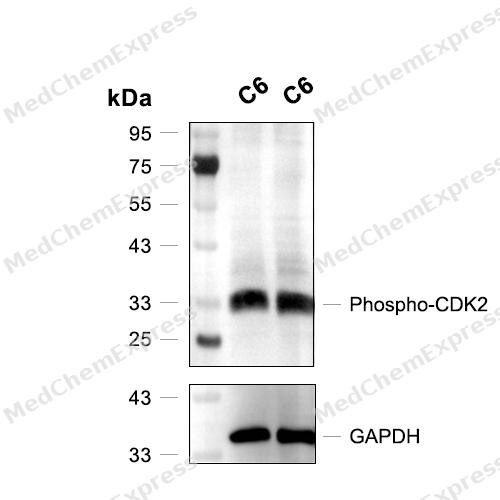 Western blot analysis of extracts from C6(lane 2(20μg) or lane 3(40μg)), using Phospho-CDK2 (HY-P80798) Rabbit mAb. Proteins were transferred to a PVDF membrane and blocked with 5% BSA in TBST for 2 hour at room temperature. The primary antibody (HY-P80798, 1/1000) and Loading control antibody (GAPDH, HY-P80954, 1/3000) was used in 5% BSA in TBST at 4°C overnight. Goat Anti-Mouse/Rabbit IgG-HRP Secondary Antibody (HY-P8004/HY-P8001, 1/10,000) was used for 1 hour at room temperature.


Background
-
Function
Cyclin-dependent kinase 2 (CDK2) is a serine/threonine kinase that forms active complexes with cyclin E and cyclin A to regulate the G1/S transition and S-phase progression during cell-cycle control[1][2]. CDK2 functions within the cyclin-CDK regulatory network that coordinates DNA replication, cell proliferation, and checkpoint signaling, thereby linking cell-cycle progression to genome stability mechanisms[2][3]. Mechanistically, aberrant CDK2 activation promotes uncontrolled proliferation and contributes to tumor development in multiple cancer types, making CDK2 a relevant therapeutic target in oncology research[1][3]. In disease models, elevated CDK2 activity has been associated with tumor growth, while genetic or pharmacological suppression of CDK2 can impair cancer-cell proliferation and enhance antitumor responses[1][4]. Compared with related cell-cycle kinases such as CDK1, CDK2 preferentially associates with cyclins E and A and exhibits distinct conformational and regulatory properties that support selective inhibitor development[5]. This isoform-specific behavior is important because CDK1 can compensate for several cell-cycle functions, whereas CDK2 remains particularly relevant in cyclin E-driven and replication-associated oncogenic contexts[1][3]. For experimental applications, selective CDK2 inhibitors are widely used to investigate cell-cycle regulation, DNA-replication stress, and cancer-cell dependency on cyclin E/CDK2 signaling, supporting both mechanistic studies and therapeutic discovery programs[1][3].
-
Subcellular Localization
Cytoplasm, cytoskeleton, microtubule organizing center, centrosome; Nucleus, Cajal body; Cytoplasm; Endosome
-
Expression
Induction:Induced transiently by TGFB1 at an early phase of TGFB1-mediated apoptosis -
Isoforms & Post-Translational Modification
P24941 has 2 isomers: P24941-1: 33930 Da (predicted); P24941-2: 30035 Da (predicted).
Phosphorylated at Thr-160 by CDK7 in a CAK complex (PubMed:28666995). Phosphorylation at Thr-160 promotes kinase activity, whereas phosphorylation at Tyr-15 by WEE1 reduces slightly kinase activity. Phosphorylated on Thr-14 and Tyr-15 during S and G2 phases before being dephosphorylated by CDC25A;Nitrosylated after treatment with nitric oxide (DETA-NO) -
Subunit
Found in a complex with CABLES1, CCNA1 and CCNE1. Interacts with CABLES1 (By similarity). Interacts with UHRF2. Part of a complex consisting of UHRF2, CDK2 and CCNE1. Interacts with the Speedy/Ringo proteins SPDYA and SPDYC (PubMed:15611625). Interaction with SPDYA promotes kinase activation via a conformation change that alleviates obstruction of the substrate-binding cleft by the T-loop (PubMed:28666995). Found in a complex with both SPDYA and CDKN1B/KIP1 (PubMed:12972555, PubMed:28666995). Binds to RB1 and CDK7. Binding to CDKN1A (p21) leads to CDK2/cyclin E inactivation at the G1-S phase DNA damage checkpoint, thereby arresting cells at the G1-S transition during DNA repair. Associated with PTPN6 and beta-catenin/CTNNB1. Interacts with CACUL1. May interact with CEP63. Interacts with ANKRD17. Interacts with CEBPA (when phosphorylated) (PubMed:15107404). Forms a ternary complex with CCNA2 and CDKN1B; CDKN1B inhibits the kinase activity of CDK2 through conformational rearrangements (PubMed:24670654, PubMed:8684460). Interacts with cyclins A, B1, B3, D, or E (PubMed:10499802, PubMed:10884347, PubMed:12185076, PubMed:23781148). Interacts with CDK2AP2 (PubMed:23781148)
-
SwissProt ID
-
Gene ID
-
Synonyms
CDK2; CDKN2; Cyclin-dependent kinase 2; Cell division protein kinase 2; p33 protein kinase
-
Research Field
Cell Biology
Documentation
-
Data Sheet (262 KB)
-
SDS (252 KB)
- English - EN (252 KB)
- Français - FR (252 KB)
- Deutsch - DE (252 KB)
- Norwegian - NO (252 KB)
- Español - ES (252 KB)
- Swedish - SV (252 KB)
- Italian - IT (252 KB)
- Korean - KR (252 KB)
- Portuguese - PT (252 KB)
-
User Guide for Antibodies (1077 KB)
References
[1]. Tadesse S, et al. Cyclin-Dependent Kinase 2 Inhibitors in Cancer Therapy: An Update. J Med Chem. 2019 May 9;62(9):4233-4251. [Content Brief]
[2]. Pellarin I, et al. Cyclin-dependent protein kinases and cell cycle regulation in biology and disease. Signal Transduct Target Ther. 2025 Jan 13;10(1):11. doi: 10.1038/s41392-024-02080-z. PMID: 39800748; PMCID: PMC11734941. [Content Brief]
[3]. Asghar U, et al. The history and future of targeting cyclin-dependent kinases in cancer therapy. Nat Rev Drug Discov. 2015 Feb;14(2):130-46. [Content Brief]
[4]. Chen Y, et al. CDK2 inhibition sensitizes anthracycline-induced immunogenic cell death and enhances the efficacy of anti-PD-1 therapy. Front Immunol. 2025 Jun 10;16:1570040. doi: 10.3389/fimmu.2025.1570040. PMID: 40557162; PMCID: PMC12185487. [Content Brief]
[5]. Foster WJ, et al. Hippocampal mGluR1-dependent long-term potentiation requires NAADP-mediated acidic store Ca2+ signaling. Sci Signal. 2018 Nov 27;11(558):eaat9093. [Content Brief]

 Powered by Bioz
