



Presenilin 1 Antibody (YA1722)
(Synonyms: PSEN1; AD3; PS1; PSNL1; Presenilin-1; PS-1; Protein S182)
Based on 1 Customer Validation
Presenilin 1 Antibody (YA1722) is a Rabbit-derived and non-conjugated IgG monoclonal antibody, targeting to Presenilin 1.
-
Host:
Rabbit
-
Isotype:
IgG
-
Application:
WB, ICC/IF, IP
-
Reactivity :
Human, Mouse, Rat
-
Formulation:
Supplied in 50mM Tris-Glycine(pH 7.4), 0.15M NaCl, 40% Glycerol, 0.01% Sodium azide and 0.05% BSA
-
Conjugation:
Non-conjugated


To place orders, for customer services and technical support, please contact: MedChemExpress USA
Tel: 609-228-6898 E-mail: [email protected] [email protected]





Applications
| Application |
WB

WB: Western Blot
|
ICC/IF
ICC/IF: Immunocytochemistry/
Immunofluorescence |
IP
IP: Immunoprecipitation
|
|---|---|---|---|
| Dilution Ratio | 1:500-1:1000 | 1:50-1:200 | 1:20 |


Product Details
Presenilin 1 Antibody (YA1722) is a Rabbit-derived and non-conjugated IgG monoclonal antibody, targeting to Presenilin 1.
-
Host Rabbit

-
Clonality Recombinant,Monoclonal

-
Species ReactivityHuman, Mouse, Rat
-
Observed Molecular WeightObserved band size: 20 kDa
Note: Due to possible protein modifications or aggregation, the molecular weight should be confirmed by actual measurement, and the predicted value is for reference only.

-
Calculated Molecular Weight Predicted band size: 53 kDa

Entrez Gene: 5663 Human ; 19164 Mouse ; 29192 Rat
SwissProt: P49768 Human ; P49769 Mouse ; P97887 Rat
OMIM: 607822 Human
A synthetic peptide of human Presenilin 1 300-400.
Endogenous
Affinity Purified
Non-conjugated
Unmodified
IgG


Product Properties
-
Appearance
Liquid
-
Formulation
Supplied in 50mM Tris-Glycine(pH 7.4), 0.15M NaCl, 40% Glycerol, 0.01% Sodium azide and 0.05% BSA
-
Concentration
Batch-dependent, Please check the COA for the concentration of each lot. Check Lot Concentration
-
Storage & Stability
Stored at -20°C for 1 year. Avoid repeated freeze / thaw cycles.
-
Shipping
Shipping with blue ice.


Verification Images
-
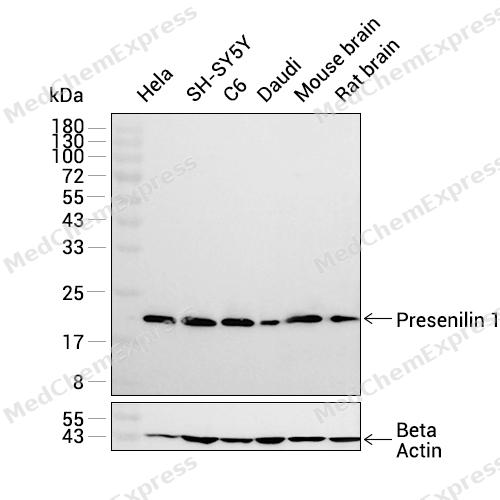 Western blot analysis was performed on extracts from Hela (lane 1, 15 μg), SH-SY5Y (lane 2, 15 μg), C6 (lane 3, 15 μg), Daudi (lane 4, 15 μg), Mouse brain (lane 5, 15 μg), and Rat brain (lane 6, 15 μg) using Presenilin 1 Rabbit mAb.Proteins were transferred to a PVDF membrane and blocked with 5% non-fat milk in TBST at 4°C overnight.The primary antibody (1:2000 dilution) and the loading control antibody (beta-Actin, HY-P83730, 1:20000 dilution) were incubated in 5% non-fat milk in TBST for 1 hour at 37°C.Goat Anti-Rabbit IgG-HRP Secondary Antibody (1:20000 dilution) was then applied for 40 minutes at 37°C.
 -
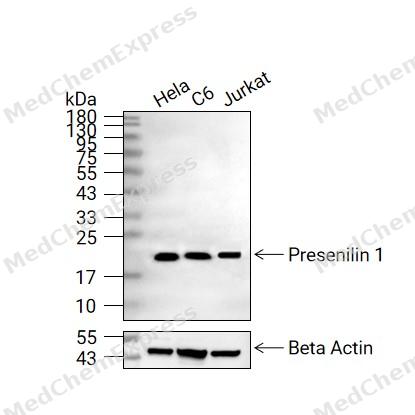 Western blot analysis of extracts from Hela (lane 2(20μg), C6(lane 3(20μg), Jurkat (lane 4(20μg) using Presenilin 1 (HY-P81977) Rabbit mAb. Proteins were transferred to a PVDF membrane and blocked with 5% non-fat milk in TBST for 2 hour at room temperature. The primary antibody (1/1000) and Loading control antibody (Beta Actin, HY-P80438, 1/10000) was used in 5% non-fat milk in TBST at 4°C overnight. Goat Anti-Rabbit IgG-HRP Secondary Antibody (1/10000) was used for 1 hour at room temperature.
 -
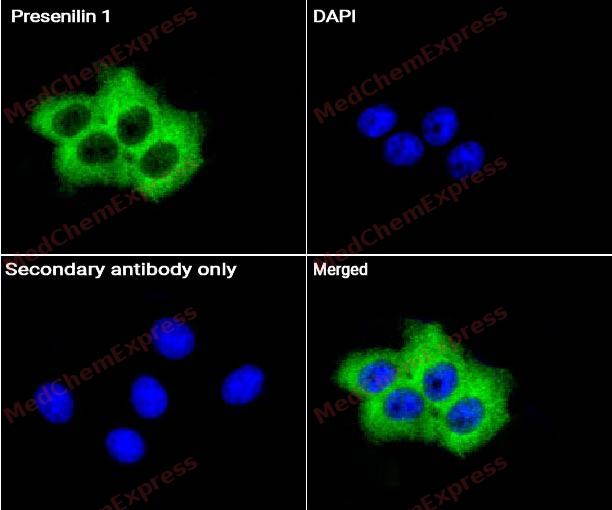 Immunocytochemistry analysis of MCF-7 cells labeling Presenilin 1 Antibody (HY-P81977) at 1/50 dilution. Cells were fixed in 4% paraformaldehyde for 15 minutes at room temperature, permeabilized with 0.1% Triton X-100 for 10 minutes at room temperature, then blocked with BSA for Immunol Staining for 10 min at room temperature. Cells were then incubated with Presenilin 1 Antibody (HY-P81977) at 1/50 dilution in BSA for Immunol Staining at 4 ℃ Overnight. AF488-conjugated AffiniPure Goat Anti-Rabbit IgG H&L(HY-P8002, Green) was used as the secondary antibody at 1/1,000 dilution. PBS instead of the primary antibody was used as the secondary antibody only control. The Nuclear counterstain was DAPI (Blue).
 -
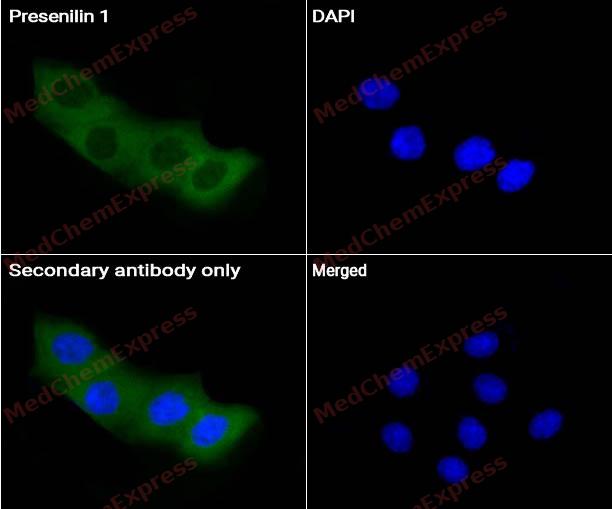 Immunocytochemistry analysis of MCF-7 cells labeling Presenilin 1 Antibody (HY-P81977) at 1/200 dilution. Cells were fixed in 4% paraformaldehyde for 15 minutes at room temperature, permeabilized with 0.1% Triton X-100 for 10 minutes at room temperature, then blocked with BSA for Immunol Staining for 10 min at room temperature. Cells were then incubated with Presenilin 1 Antibody (HY-P81977) at 1/200 dilution in BSA for Immunol Staining at 4 ℃ Overnight. AF488-conjugated AffiniPure Goat Anti-Rabbit IgG H&L(HY-P8002, Green) was used as the secondary antibody at 1/1,000 dilution. PBS instead of the primary antibody was used as the secondary antibody only control. The Nuclear counterstain was DAPI (Blue).


Background
-
Function
Presenilin 1 is a Catalytic subunit of the gamma-secretase complex, an endoprotease complex that catalyzes the intramembrane cleavage of integral membrane proteins such as Notch receptors and APP (amyloid-beta precursor protein). Requires the presence of the other members of the gamma-secretase complex for protease activity. Plays a role in Notch and Wnt signaling cascades and regulation of downstream processes via its role in processing key regulatory proteins, and by regulating cytosolic CTNNB1 levels. Stimulates cell-cell adhesion via its interaction with CDH1; this stabilizes the complexes between CDH1 (E-cadherin) and its interaction partners CTNNB1 (beta-catenin), CTNND1 and JUP (gamma-catenin). Under conditions of apoptosis or calcium influx, cleaves CDH1. This promotes the disassembly of the complexes between CDH1 and CTNND1, JUP and CTNNB1, increases the pool of cytoplasmic CTNNB1, and thereby negatively regulates Wnt signaling. Required for normal embryonic brain and skeleton development, and for normal angiogenesis. Mediates the proteolytic cleavage of EphB2/CTF1 into EphB2/CTF2. The holoprotein functions as a calcium-leak channel that allows the passive movement of calcium from endoplasmic reticulum to cytosol and is therefore involved in calcium homeostasis. Involved in the regulation of neurite outgrowth. Is a regulator of presynaptic facilitation, spike transmission and synaptic vesicles replenishment in a process that depends on gamma-secretase activity. It acts through the control of SYT7 presynaptic expression[1][2][3][4][5][6][7][8][9][10][11][12][13][14][15][16][17][18][19][20].
-
Subcellular Localization
Endoplasmic reticulum; Endoplasmic reticulum membrane; Multi-pass membrane protein; Golgi apparatus membrane; Multi-pass membrane protein; Cytoplasmic granule; Cell membrane; Multi-pass membrane protein; Cell projection, growth cone; Early endosome; Early endosome membrane; Multi-pass membrane protein; Cell projection, neuron projection; Cell projection, axon; Synapse
-
Expression
Tissue_specificity:Protein levels were detected in azurophilic granules of neutrophils and cytoplasmic granules of platelets (PubMed: 11987239) . It was also expressed in multiple tissues, including the brain, liver, spleen, and lymph nodes (PubMed: 7596406, PubMed: 8574969, PubMed: 8641442) . -
Isoforms & Post-Translational Modification
P49768 has 7 isomers: P49768-1: 52668 Da (predicted); P49768-2: 52197 Da (predicted); P49768-3: 42287 Da (predicted); P49768-4: 21073 Da (predicted); P49768-5: 42757 Da (predicted); P49768-6: 46328 Da (predicted); P49768-7: 48997 Da (predicted).
Heterogeneous proteolytic processing generates N-terminal (NTF) and C-terminal (CTF) fragments of approximately 35 and 20 kDa, respectively. During apoptosis, the C-terminal fragment (CTF) is further cleaved by caspase-3 to produce the fragment, PS1-CTF12;After endoproteolysis, the C-terminal fragment (CTF) is phosphorylated on serine residues by PKA and/or PKC. Phosphorylation on Ser-346 inhibits endoproteolysis -
Subunit
Homodimer. The functional gamma-secretase complex is composed of at least four polypeptides: a presenilin homodimer (PSEN1 or PSEN2), nicastrin (NCSTN), APH1 (APH1A/APH1B) and PEN2 (PubMed:12679784, PubMed:12740439, PubMed:15274632, PubMed:25043039, PubMed:25394380, PubMed:26280335, PubMed:30598546, PubMed:30630874). Such minimal complex is sufficient for secretase activity (PubMed:12679784, PubMed:12740439, PubMed:15274632, PubMed:25043039, PubMed:26280335, PubMed:30598546, PubMed:30630874). Other components which are associated with the complex include SLC25A64, SLC5A7, PHB and PSEN1 isoform 3. As part of the gamma-secretase complex, interacts with CRB2 (via transmembrane domain) (PubMed:20299451). Predominantly heterodimer of a N-terminal (NTF) and a C-terminal (CTF) endoproteolytical fragment (PubMed:15274632). Associates with proteolytic processed C-terminal fragments C83 and C99 of the amyloid precursor protein (APP) (via transmembrane domain) (PubMed:30630874). Associates with NOTCH1 (via transmembrane domain) (PubMed:10593990, PubMed:30598546). Associates with cadherin/catenin adhesion complexes through direct binding to CDH1 or CDH2 (PubMed:11953314, PubMed:14515347, PubMed:16126725). Interaction with CDH1 stabilizes the complex and stimulates cell-cell aggregation (PubMed:11953314). Interaction with CDH2 is essential for trafficking of CDH2 from the endoplasmic reticulum to the plasma membrane (PubMed:14515347). Interacts with CTNND2, CTNNB1, CTNND1, JUP, HERPUD1, FLNA, FLNB, MTCH1, PKP4 and PARL (PubMed:10037471, PubMed:10551805, PubMed:11799129, PubMed:11953314, PubMed:16126725, PubMed:9437013, PubMed:9738936). Interacts through its N-terminus with GFAP (isoform 2) (PubMed:12058025). Interacts with DOCK3 (By similarity). Interacts with isoform 1 and isoform 3 of UBQLN1 (PubMed:21143716)
-
SwissProt ID
-
Synonyms
PSEN1; AD3; PS1; PSNL1; Presenilin-1; PS-1; Protein S182
-
Research Field
Neuroscience


Documentation
-
Data Sheet (234 KB)
-
SDS (251 KB)
- English - EN (251 KB)
- Français - FR (251 KB)
- Deutsch - DE (251 KB)
- Norwegian - NO (251 KB)
- Español - ES (251 KB)
- Swedish - SV (251 KB)
- Italian - IT (251 KB)
- Korean - KR (251 KB)
- Portuguese - PT (251 KB)
-
User Guide for Antibodies (1077 KB)

 Powered by Bioz
