



Proteasome 20S LMP2 Antibody (YA1747)(PBS only)
(Synonyms: Beta1i; LMP2; PSMB 9; PSMB6i; PSMB9; RING12)Proteasome 20S LMP2 Antibody (YA1747) is a Rabbit-derived and non-conjugated IgG monoclonal antibody, targeting to Proteasome 20S LMP2.
-
Host:
Rabbit
-
Isotype:
IgG
-
Application:
WB, ICC/IF
-
Reactivity :
Human, Mouse, Rat
-
Formulation:
Supplied in PBS, pH 7.4.
-
Conjugation:
Non-conjugated


To place orders, for customer services and technical support, please contact: MedChemExpress USA
Tel: 609-228-6898 E-mail: [email protected] [email protected]





Applications
| Application |
WB

WB: Western Blot
|
ICC/IF
ICC/IF: Immunocytochemistry/
Immunofluorescence |
|---|---|---|
| Dilution Ratio | 1:500-1:1000 | 1:50-1:200 |


Product Details
Proteasome 20S LMP2 Antibody (YA1747) is a Rabbit-derived and non-conjugated IgG monoclonal antibody, targeting to Proteasome 20S LMP2.
-
Host Rabbit

-
Species ReactivityHuman, Mouse, Rat

-
Observed Molecular WeightObserved band size: 23 kDa
Note: Due to possible protein modifications or aggregation, the molecular weight should be confirmed by actual measurement, and the predicted value is for reference only.

-
Calculated Molecular Weight Predicted band size: 23 kDa

A synthetic peptide of human Proteasome 20S LMP2
Affinity Purified
Non-conjugated
IgG


Product Properties
-
Appearance
Liquid
-
Formulation
Supplied in PBS, pH 7.4.
-
Storage & Stability
Stored at -20°C for 1 year. Avoid repeated freeze / thaw cycles.
-
Shipping
Shipping with blue ice.


Verification Images
-
 Western blot analysis was performed on extracts from Raji (lane 1, 15 μg), Ramos (lane 2, 15 μg), HL-60 (lane 3, 15 μg), A431 (lane 4, 15 μg), RAW264.7 (lane 5, 15 μg), and C6 (lane 6, 15 μg) using PSMB9 Rabbit mAb.Proteins were transferred to a PVDF membrane and blocked with 5% non-fat milk in TBST at 4°C overnight.The primary antibody (1:1000 dilution) and the loading control antibody (beta Actin, HY-P80438, 1:20000 dilution) were incubated in 5% non-fat milk in TBST for 1 hour at 37°C.Goat Anti-Rabbit IgG-HRP Secondary Antibody (1:20000 dilution) was then applied for 40 minutes at 37°C.
 -
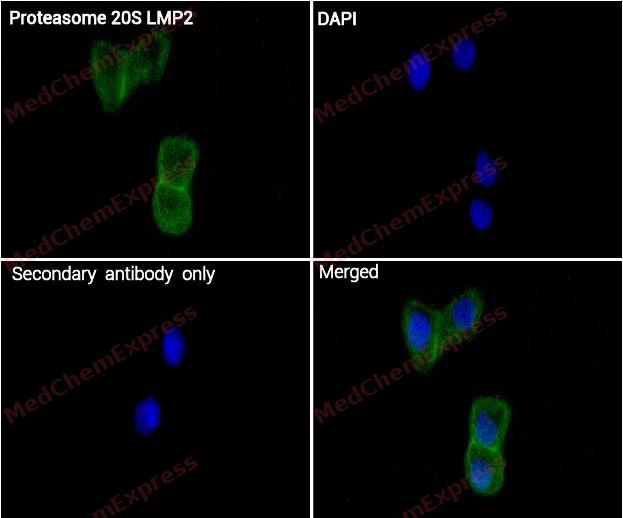 Immunocytochemistry analysis of Hela cells labeling Proteasome 20S LMP2 with Proteasome 20S LMP2 Antibody (HY-P82002) at 1/100 dilution. Cells were fixed in 4% paraformaldehyde for 15 minutes at room temperature, permeabilized with 0.1% Triton X-100 in PBS for 15 minutes at room temperature, then blocked with quick block buffer for 10 minutes at room temperature. Cells were then incubated with Proteasome 20S LMP2 Antibody (HY-P82002) at 1/100 dilution in quick block buffer overnight at 4 ℃. AF488-conjugated Goat Anti-Rabbit IgG H&L (HY-P8002, Green) was used as the secondary antibody at 1/1,000 dilution. PBS instead of the primary antibody was used as the secondary antibody only control. The Nuclear counterstain was DAPI (Blue).
 -
 Immunocytochemistry analysis of Hela cells labeling Proteasome 20S LMP2 with Proteasome 20S LMP2 Antibody (HY-P82002) at 1/200 dilution. Cells were fixed in 4% paraformaldehyde for 15 minutes at room temperature, permeabilized with 0.1% Triton X-100 in PBS for 15 minutes at room temperature, then blocked with quick block buffer for 10 minutes at room temperature. Cells were then incubated with Proteasome 20S LMP2 Antibody (HY-P82002) at 1/200 dilution in quick block buffer overnight at 4 ℃. AF488-conjugated Goat Anti-Rabbit IgG H&L (HY-P8002, Green) was used as the secondary antibody at 1/1,000 dilution. PBS instead of the primary antibody was used as the secondary antibody only control. The Nuclear counterstain was DAPI (Blue).


Background
-
Function
Proteasome 20S LMP2 is a The proteasome is a multicatalytic proteinase complex which is characterized by its ability to cleave peptides with Arg, Phe, Tyr, Leu, and Glu adjacent to the leaving group at neutral or slightly basic pH. The proteasome has an ATP-dependent proteolytic activity. This subunit is involved in antigen processing to generate class I binding peptides. Replacement of PSMB6 by PSMB9 increases the capacity of the immunoproteasome to cleave model peptides after hydrophobic and basic residues[1][2].
-
Subcellular Localization
Cytoplasm; Nucleus
-
Expression
Induction:Up-regulated by interferon gamma (at protein level) . Up-regulated by IRF1. Up-regulated by tumor necrosis factor-alpha (at protein level) . Up-regulated by tetrodotoxin (TTX) in glial cells. Up-regulated in Crohn's bowel disease (CD) . Up-regulated by heat shock treatment. Up-regulated by CD40L via the NFKB1 pathway in cancer cells -
Isoforms & Post-Translational Modification
P28065 has 2 isomers: P28065-1: 23264 Da (predicted); P28065-2: 22328 Da (predicted).
Autocleaved. The resulting N-terminal Thr residue of the mature subunit is responsible for the nucleophile proteolytic activity -
Subunit
The 26S proteasome consists of a 20S proteasome core and two 19S regulatory subunits. The 20S proteasome core is composed of 28 subunits that are arranged in four stacked rings, resulting in a barrel-shaped structure. The two end rings are each formed by seven alpha subunits, and the two central rings are each formed by seven beta subunits. The catalytic chamber with the active sites is on the inside of the barrel. Component of the immunoproteasome, where it displaces the equivalent housekeeping subunit PSMB6. Component of the spermatoproteasome, a form of the proteasome specifically found in testis
-
SwissProt ID
-
Synonyms
Beta1i; LMP2; PSMB 9; PSMB6i; PSMB9; RING12
-
Research Field
Cell Biology


Documentation

 Powered by Bioz
