



PTN Antibody (YA1773)
(Synonyms: PTN; HBNF1; NEGF1; Pleiotrophin; PTN; Heparin-binding brain mitogen; HBBM; Heparin-binding growth factor 8; HBGF-8; Heparin-binding growth-associated molecule; HB-GAM; Heparin-binding neurite outgrowth-promoting factor 1; HBNF-1; Osteoblast-specific factor 1; OSF-1)
Based on 1 Customer Validation
PTN Antibody (YA1773) is a Rabbit-derived and non-conjugated IgG monoclonal antibody, targeting to PTN.
-
Host:
Rabbit
-
Isotype:
IgG
-
Application:
WB, IP
-
Reactivity :
Human, Rat
-
Formulation:
Supplied in 50mM Tris-Glycine(pH 7.4), 0.15M NaCl, 40% Glycerol, 0.01% Sodium azide and 0.05% BSA
-
Conjugation:
Non-conjugated


To place orders, for customer services and technical support, please contact: MedChemExpress USA
Tel: 609-228-6898 E-mail: [email protected] [email protected]





Applications
| Application |
WB

WB: Western Blot
|
IP
IP: Immunoprecipitation
|
|---|---|---|
| Dilution Ratio | 1:500-1:1000 | 1:20 |


Product Details
PTN Antibody (YA1773) is a Rabbit-derived and non-conjugated IgG monoclonal antibody, targeting to PTN.
-
Host Rabbit

-
Clonality Recombinant,Monoclonal

-
Species ReactivityHuman, Rat
-
Observed Molecular WeightObserved band size: 19 kDa
Note: Due to possible protein modifications or aggregation, the molecular weight should be confirmed by actual measurement, and the predicted value is for reference only.

-
Calculated Molecular Weight Predicted band size: 19 kDa

Entrez Gene: 5764 Human ; 19242 Mouse ; 24924 Rat
SwissProt: P21246 Human ; P63089 Mouse ; P63090 Rat
OMIM: 162095 Human
A synthetic peptide of human PTN
Endogenous
Affinity Purified
Non-conjugated
Unmodified
IgG


Product Properties
-
Appearance
Liquid
-
Formulation
Supplied in 50mM Tris-Glycine(pH 7.4), 0.15M NaCl, 40% Glycerol, 0.01% Sodium azide and 0.05% BSA
-
Concentration
Batch-dependent, Please check the COA for the concentration of each lot. Check Lot Concentration
-
Storage & Stability
Stored at -20°C for 1 year. Avoid repeated freeze / thaw cycles.
-
Shipping
Shipping with blue ice.


Verification Images
-
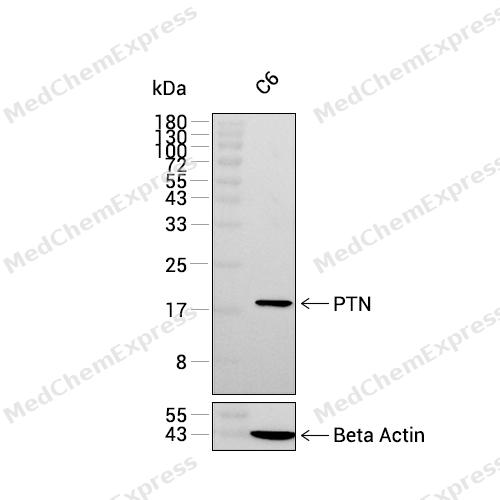
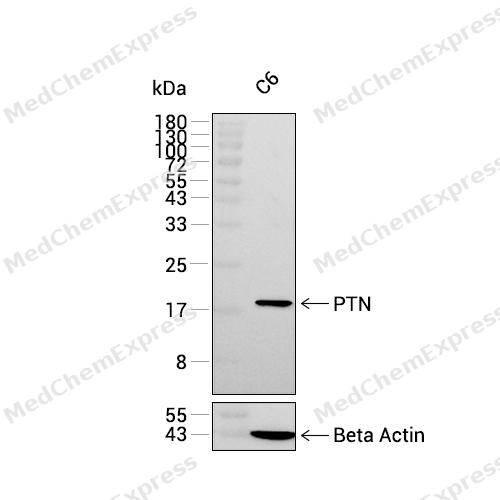 Western blot analysis was performed on extracts from C6 (lane 1, 15 μg) using PTN Rabbit mAb.Proteins were transferred to a PVDF membrane and blocked with 5% non-fat milk in TBST at 4°C overnight.The primary antibody (1:2000 dilution) and the loading control antibody (beta-Actin, HY-P83730, 1:20000 dilution) were incubated in 5% non-fat milk in TBST for 1 hour at 37°C.Goat Anti-Rabbit IgG-HRP Secondary Antibody (1:20000 dilution) was then applied for 40 minutes at 37°C.
 -
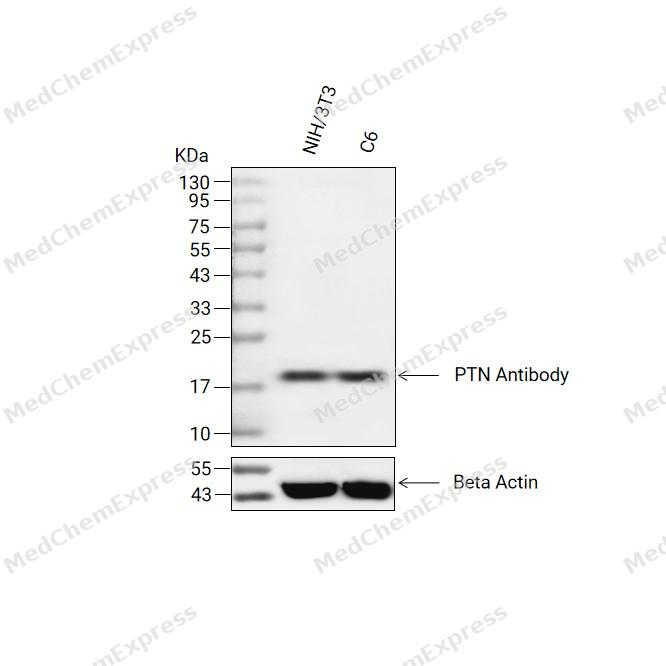 Western blot analysis of extracts from NIH/3T3(lane 2(20ug) and C6(lane 3(20ug) using PTN Antibody (HY-P82028) Rabbit mAb. Proteins were transferred to a PVDF membrane and blocked with 5% non-fat milk in TBST for 2 hour at room temperature. The primary antibody (1/1000) and Loading control antibody (Beta Actin, HY-P83730, 1/10000) was used in 5% non-fat milk in TBST at 4°C overnight. Goat Anti-Mouse/Rabbit IgG-HRP Secondary Antibody (1/10000) was used for 1 hour at room temperature.


Background
-
Function
PTN secreted growth factor that mediates its signal through cell-surface proteoglycan and non-proteoglycan receptors. Binds cell-surface proteoglycan receptor via their chondroitin sulfate (CS) groups. Thereby regulates many processes like cell proliferation, cell survival, cell growth, cell differentiation and cell migration in several tissues namely neuron and bone. Also plays a role in synaptic plasticity and learning-related behavior by inhibiting long-term synaptic potentiation. Binds PTPRZ1, leading to neutralization of the negative charges of the CS chains of PTPRZ1, inducing PTPRZ1 clustering, thereby causing the dimerization and inactivation of its phosphatase activity leading to increased tyrosine phosphorylation of each of the PTPRZ1 substrates like ALK, CTNNB1 or AFAP1L2 in order to activate the PI3K-AKT pathway. Through PTPRZ1 binding controls oligodendrocyte precursor cell differentiation by enhancing the phosphorylation of AFAP1L2 in order to activate the PI3K-AKT pathway. Forms a complex with PTPRZ1 and integrin alpha-V/beta-3 (ITGAV:ITGB3) that stimulates endothelial cell migration through SRC dephosphorylation and activation that consequently leads to ITGB3 'Tyr-773' phosphorylation. In adult hippocampus promotes dendritic arborization, spine development, and functional integration and connectivity of newborn granule neurons through ALK by activating AKT signaling pathway. Binds GPC2 and chondroitin sulfate proteoglycans (CSPGs) at the neuron surface, leading to abrogation of binding between PTPRS and CSPGs and neurite outgrowth promotion. Binds SDC3 and mediates bone formation by recruiting and attaching osteoblasts/osteoblast precursors to the sites for new bone deposition. Binds ALK and promotes cell survival and cell proliferation through MAPK pathway activation. Inhibits proliferation and enhances differentiation of neural stem cells by inhibiting FGF2-induced fibroblast growth factor receptor signaling pathway. Mediates regulatory mechanisms in normal hemostasis and in hematopoietic regeneration and in maintaining the balance of myeloid and lymphoid regeneration. In addition may play a role in the female reproductive system, auditory response and the progesterone-induced decidualization pathway[1][2][3][4][5][6][7][8][9][10][11].
-
Subcellular Localization
Secreted
-
Expression
Tissue_specificity:Osteoblast and brain
Induction:By heparin and retinoic acid -
Subunit
Interacts with ALK and NEK6 (PubMed:11278720, PubMed:20873783). Interacts with PTPRZ1 (via chondroitin sulfate groups); promotes formation of homooligomers; oligomerization impairs tyrosine phosphatase activity (Probable) (PubMed:16814777). Forms a complex with PTPRZ1 and CTNNB1; this complex inactivates PTPRZ1 protein tyrosine phosphatase activity through PTN interaction and stimulates tyrosine phosphorylation of CTNNB1 (PubMed:10706604). Interacts with ITGB3 and ITGA5 (PubMed:19141530). Forms a complex with PTPRZ1 and integrin alpha-V/beta-3 (ITGAV:ITGB3) that stimulates endothelial cell migration through ITGB3 'Tyr-773' phosphorylation (PubMed:19141530). Interacts with SDC3 (via heparan sulfate chains); this interaction mediates the neurite outgrowth-promoting signal from PTN to the cytoskeleton of growing neurites; this interaction mediates osteoblast recruitment. Interacts with GPC2 (via heparan sulfate); this interaction promotes neurite outgrowth through binding of PTN with chondroitin sulfate of proteoglycans, thereby releasing PTPRS of chondroitin sulfate proteoglycans (CSPGs) and leading to binding with heparan sulfate of GPC2 (By similarity)
-
SwissProt ID
-
Synonyms
PTN; HBNF1; NEGF1; Pleiotrophin; PTN; Heparin-binding brain mitogen; HBBM; Heparin-binding growth factor 8; HBGF-8; Heparin-binding growth-associated molecule; HB-GAM; Heparin-binding neurite outgrowth-promoting factor 1; HBNF-1; Osteoblast-specific factor 1; OSF-1
-
Research Field
Neuroscience


Documentation
-
Data Sheet (235 KB)
-
SDS (252 KB)
- English - EN (252 KB)
- Français - FR (252 KB)
- Deutsch - DE (252 KB)
- Norwegian - NO (252 KB)
- Español - ES (252 KB)
- Swedish - SV (252 KB)
- Italian - IT (252 KB)
- Korean - KR (252 KB)
- Portuguese - PT (252 KB)
-
User Guide for Antibodies (1077 KB)

 Powered by Bioz
