



SPT5 Antibody (YA2904)
(Synonyms: hSPT5; SPT5; SPT5H; supt5h; Tat CT1)
Based on 1 Customer Validation
SPT5 Antibody (YA2904) is a Rabbit-derived and non-conjugated IgG monoclonal antibody, targeting to SPT5.
-
Host:
Rabbit
-
Isotype:
IgG
-
Application:
WB, IHC-P, ICC/IF
-
Reactivity :
Human, Mouse, Rat
-
Formulation:
Supplied in rabbit IgG in 50mM Tris-Glycine(pH 7.4), 0.15M NaCl, 40%Glycerol, 0.01% sodium azide and 0.05% BSA.
-
Conjugation:
Non-conjugated


To place orders, for customer services and technical support, please contact: MedChemExpress USA
Tel: 609-228-6898 E-mail: [email protected] [email protected]





Applications
| Application |
WB

WB: Western Blot
|
IHC-P
IHC-P: Immunohistochemistry-Paraffin
|
ICC/IF
ICC/IF: Immunocytochemistry/
Immunofluorescence |
|---|---|---|---|
| Dilution Ratio | 1:500-1:1000 | 1:50-1:100 | 1:50-1:200 |


Product Details
SPT5 Antibody (YA2904) is a Rabbit-derived and non-conjugated IgG monoclonal antibody, targeting to SPT5.
-
Host Rabbit

-
Clonality Recombinant,Monoclonal

-
Species ReactivityHuman, Mouse, Rat
-
Observed Molecular WeightObserved band size: 155 kDa
Note: Due to possible protein modifications or aggregation, the molecular weight should be confirmed by actual measurement, and the predicted value is for reference only.

-
Calculated Molecular Weight Predicted band size: 121 kDa

Entrez Gene: 6829 Human ; 20924 Mouse ; 308472 Rat
SwissProt: O00267 Human ; Q99639 Human ; O55201 Mouse ;
OMIM: 602102 Human
A synthesized peptide derived from human SUPT5H aa770-825.
Endogenous
Affinity Purified
Non-conjugated
Unmodified
IgG


Product Properties
-
Appearance
Solution
-
Formulation
Supplied in rabbit IgG in 50mM Tris-Glycine(pH 7.4), 0.15M NaCl, 40%Glycerol, 0.01% sodium azide and 0.05% BSA.
-
Concentration
Batch-dependent, Please check the COA for the concentration of each lot. Check Lot Concentration
-
Storage & Stability
Stored at -20°C for 1 year. Avoid repeated freeze / thaw cycles.
-
Shipping
Shipping with blue ice.


Verification Images
-
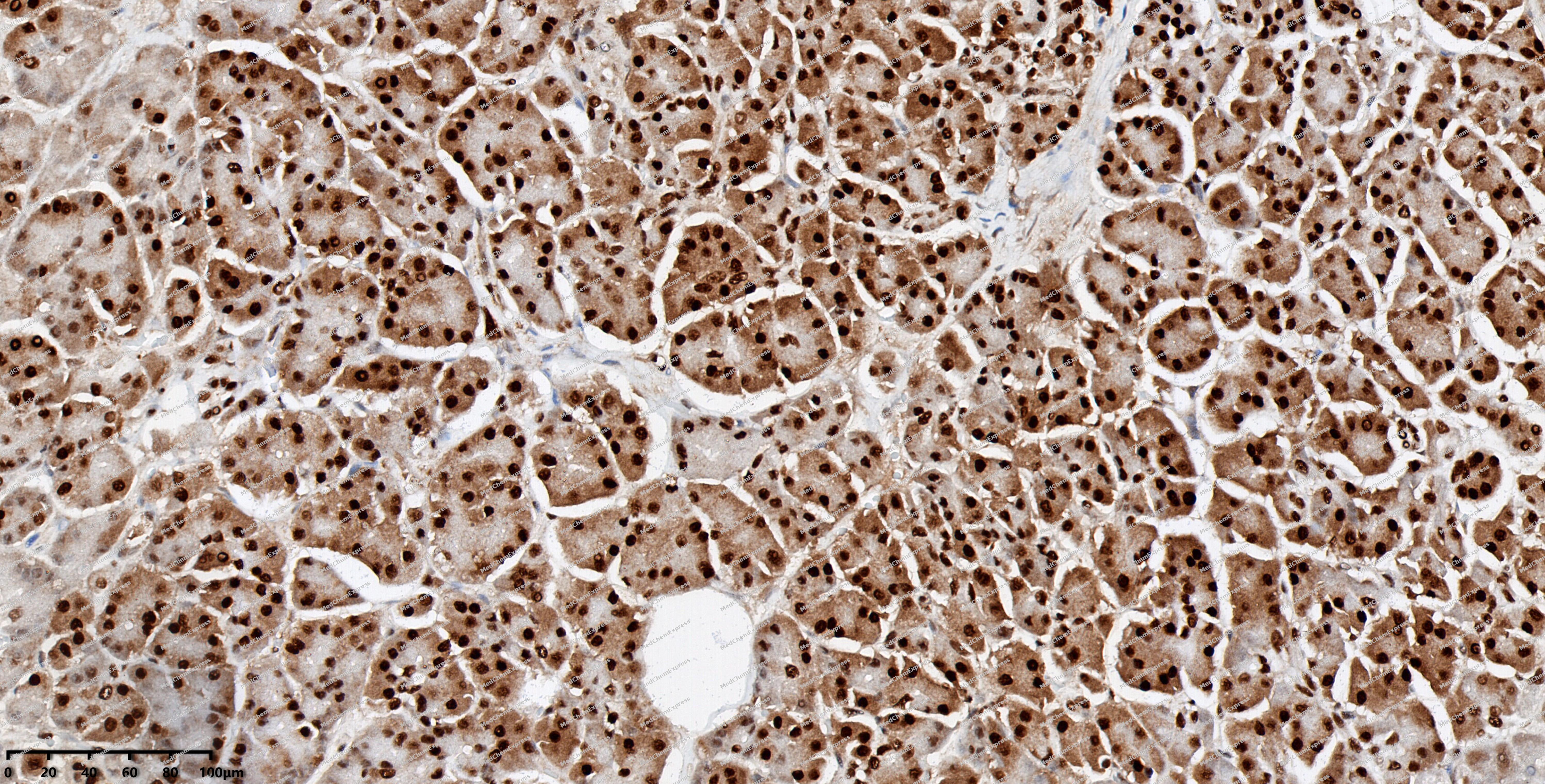 Immunohistochemical analysis of paraffin-embedded human pancreas using SPT5 antibody. The section was pre-treated using heat mediated antigen retrieval with EDTA (pH 9.0) for 14 minutes. The tissues were blocked in 5% BSA for 30 minutes at room temperature, washed with TBST, and then probed with the primary antibody (HY-P83159, 1/100) for 30 minutes at room temperature. The detection was performed using Polymer HRP-conjugated Goat Anti-Mouse/Rabbit lgG(H&L) secondary antibody (HY-P83652). DAB was used as the chromogen. Tissues were counterstained with hematoxylin and mounted with DPX.
 -
 Immunohistochemical analysis of paraffin-embedded human lung cancer using SPT5 antibody. The section was pre-treated using heat mediated antigen retrieval with EDTA (pH 9.0) for 14 minutes. The tissues were blocked in 5% BSA for 30 minutes at room temperature, washed with TBST, and then probed with the primary antibody (HY-P83159, 1/100) for 30 minutes at room temperature. The detection was performed using Polymer HRP-conjugated Goat Anti-Mouse/Rabbit lgG(H&L) secondary antibody (HY-P83652). DAB was used as the chromogen. Tissues were counterstained with hematoxylin and mounted with DPX.
 -
 Immunohistochemical analysis of paraffin-embedded human cervical cancer using SPT5 antibody. The section was pre-treated using heat mediated antigen retrieval with EDTA (pH 9.0) for 14 minutes. The tissues were blocked in 5% BSA for 30 minutes at room temperature, washed with TBST, and then probed with the primary antibody (HY-P83159, 1/100) for 30 minutes at room temperature. The detection was performed using Polymer HRP-conjugated Goat Anti-Mouse/Rabbit lgG(H&L) secondary antibody (HY-P83652). DAB was used as the chromogen. Tissues were counterstained with hematoxylin and mounted with DPX.
 -
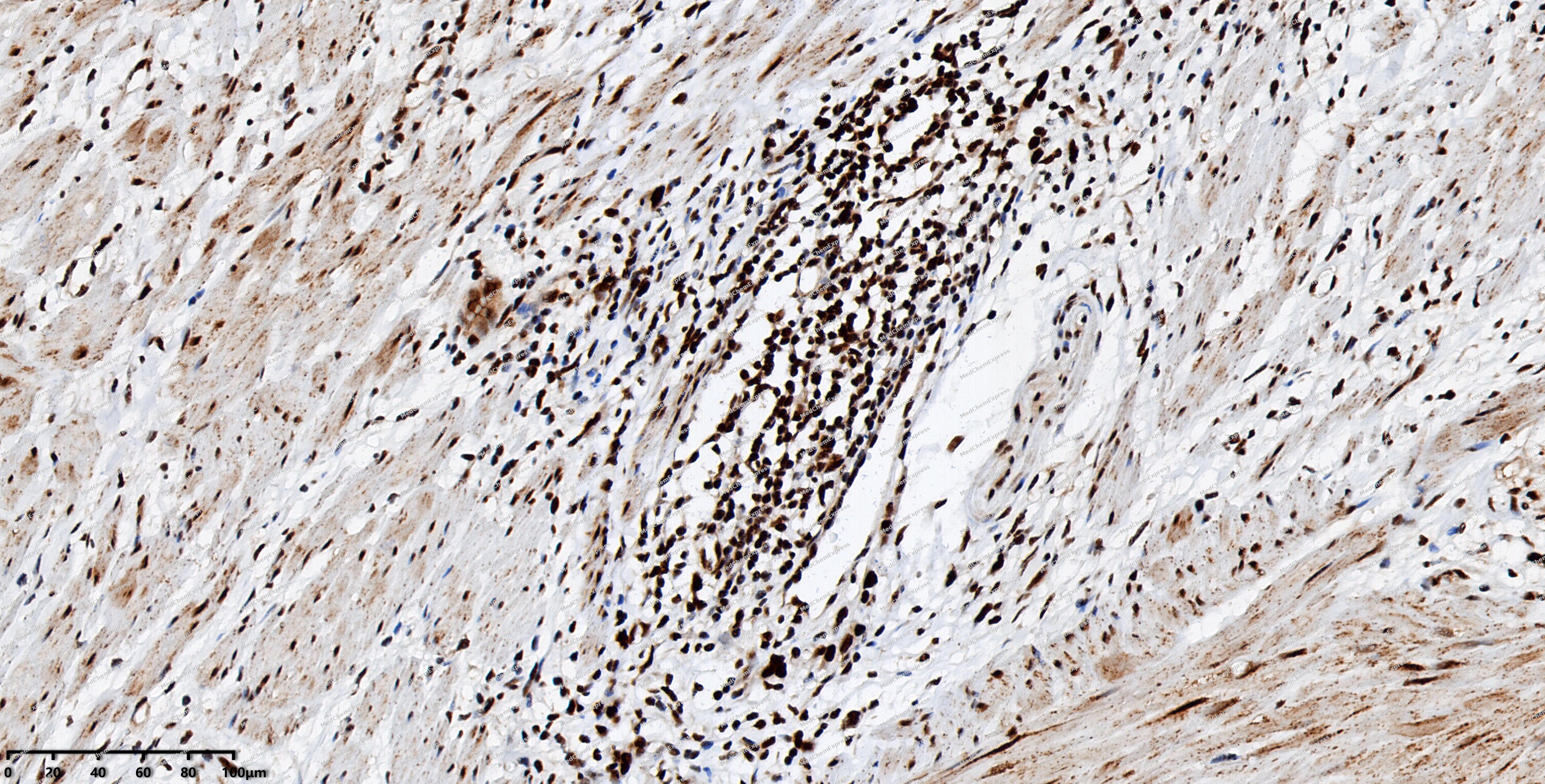 Immunohistochemical analysis of paraffin-embedded human stomach cancer using SPT5 antibody. The section was pre-treated using heat mediated antigen retrieval with EDTA (pH 9.0) for 14 minutes. The tissues were blocked in 5% BSA for 30 minutes at room temperature, washed with TBST, and then probed with the primary antibody (HY-P83159, 1/100) for 30 minutes at room temperature. The detection was performed using Polymer HRP-conjugated Goat Anti-Mouse/Rabbit lgG(H&L) secondary antibody (HY-P83652). DAB was used as the chromogen. Tissues were counterstained with hematoxylin and mounted with DPX.
 -
 Immunohistochemical analysis of paraffin-embedded human prostate cancer using SPT5 antibody. The section was pre-treated using heat mediated antigen retrieval with EDTA (pH 9.0) for 14 minutes. The tissues were blocked in 5% BSA for 30 minutes at room temperature, washed with TBST, and then probed with the primary antibody (HY-P83159, 1/100) for 30 minutes at room temperature. The detection was performed using Polymer HRP-conjugated Goat Anti-Mouse/Rabbit lgG(H&L) secondary antibody (HY-P83652). DAB was used as the chromogen. Tissues were counterstained with hematoxylin and mounted with DPX.
 -
 Immunohistochemical analysis of paraffin-embedded human bladder cancer using SPT5 antibody. The section was pre-treated using heat mediated antigen retrieval with EDTA (pH 9.0) for 14 minutes. The tissues were blocked in 5% BSA for 30 minutes at room temperature, washed with TBST, and then probed with the primary antibody (HY-P83159, 1/100) for 30 minutes at room temperature. The detection was performed using Polymer HRP-conjugated Goat Anti-Mouse/Rabbit lgG(H&L) secondary antibody (HY-P83652). DAB was used as the chromogen. Tissues were counterstained with hematoxylin and mounted with DPX.
 -
 Immunohistochemical analysis of paraffin-embedded human tonsil using SPT5 antibody. The section was pre-treated using heat mediated antigen retrieval with EDTA (pH 9.0) for 14 minutes. The tissues were blocked in 5% BSA for 30 minutes at room temperature, washed with TBST, and then probed with the primary antibody (HY-P83159, 1/100) for 30 minutes at room temperature. The detection was performed using Polymer HRP-conjugated Goat Anti-Mouse/Rabbit lgG(H&L) secondary antibody (HY-P83652). DAB was used as the chromogen. Tissues were counterstained with hematoxylin and mounted with DPX.


Background
-
Function
SPT5 component of the DRB sensitivity-inducing factor complex (DSIF complex), which regulates mRNA processing and transcription elongation by RNA polymerase II. DSIF positively regulates mRNA capping by stimulating the mRNA guanylyltransferase activity of RNGTT/CAP1A. DSIF also acts cooperatively with the negative elongation factor complex (NELF complex) to enhance transcriptional pausing at sites proximal to the promoter. Transcriptional pausing may facilitate the assembly of an elongation competent RNA polymerase II complex. DSIF and NELF promote pausing by inhibition of the transcription elongation factor TFIIS/S-II. TFIIS/S-II binds to RNA polymerase II at transcription pause sites and stimulates the weak intrinsic nuclease activity of the enzyme. Cleavage of blocked transcripts by RNA polymerase II promotes the resumption of transcription from the new 3' terminus and may allow repeated attempts at transcription through natural pause sites. Following phosphorylation by CDK9, DSIF can also positively regulate transcriptional elongation. Required for the efficient activation of transcriptional elongation by the HIV-1 nuclear transcriptional activator, Tat. DSIF acts to suppress transcriptional pausing in transcripts derived from the HIV-1 LTR and blocks premature release of HIV-1 transcripts at terminator sequences[1][2][3][4][5][6][7][8][9][10][11][12][13][14][15][16][17][18][19][20].
-
Subcellular Localization
Nucleus
-
Expression
Tissue_specificity:Ubiquitously expressed -
Isoforms & Post-Translational Modification
O00267 has 2 isomers: O00267-1: 121000 Da (predicted); O00267-2: 120499 Da (predicted).
Methylated by PRMT1/HRMT1L2 and PRMT5/SKB1. Methylation negatively regulates interaction with P-TEFb and RNA polymerase II;Phosphorylated by CDK7 and CDK9 (PubMed:10757782, PubMed:11112772, PubMed:11145967, PubMed:11809800, PubMed:15564463, PubMed:16327805). Phosphorylation by P-TEFb (CDK9) at Thr residues of the C-terminal repeats alleviates transcriptional pausing and promotes transcription elongation (PubMed:11112772, PubMed:11145967, PubMed:11809800, PubMed:15564463). Dephosphorylated by the INTAC complex when transcripts are unfavorably configured for transcriptional elongation, leading to premature transcription termination: dephosphorylation is mediated by the PPP2CA component of the INTAC complex (PubMed:34004147). Dephosphorylated by the PNUTS-PP1 complex in termination zones downstream of poly(A) sites, thereby promoting deceleration of RNA polymerase II transcription (PubMed:34004147). Phosphorylation may also stimulate interaction with PIN1 (PubMed:11575923). Bulk phosphorylation occurs predominantly in mitosis (PubMed:9199507). Phosphorylation by P-TEFb can stimulate transcriptional elongation from the HIV-1 LTR (PubMed:11112772, PubMed:11145967, PubMed:11809800, PubMed:15564463). P-TEFb dependent phosphorylation is stimulated by the HIV-1 Tat protein (PubMed:11112772);Ubiquitinated by UBR5 when not assembled in the DSIF complex, leading to its degradation: UBR5 recognizes and binds a degron that is not accessible when SUPT5H is part of the DSIF complex -
Subunit
Interacts with SUPT4H1 to form DSIF. DSIF interacts with the positive transcription elongation factor b complex (P-TEFb complex), which is composed of CDK9 and cyclin-T (CCNT1 or CCNT2). DSIF interacts with RNA polymerase II (Pol II); forms DNA and RNA clamps that stabilize Pol II elongation complex while maintaining the nontemplate DNA strand in the transcription bubble and nascent RNA in the exit channel. This interaction is reduced by phosphorylation of the C-terminal domain (CTD) of POLR2A by P-TEFb. DSIF also interacts with the NELF complex, which is composed of NELFA, NELFB, NELFD and NELFE, and this interaction occurs following prior binding of DSIF to RNA polymerase II. DSIF also interacts with PRMT1/HRMT1L2, HTATSF1/TATSF1, RNGTT/CAP1A, PRMT5/SKB1, SUPT6H, and can interact with PIN1. Component of a complex which is at least composed of HTATSF1/Tat-SF1, the P-TEFb complex components CDK9 and CCNT1, RNA polymerase II, SUPT5H, and NCL/nucleolin. Interacts with MCM3AP isoform GANP (PubMed:23652018)
-
SwissProt ID
-
Synonyms
hSPT5; SPT5; SPT5H; supt5h; Tat CT1
-
Research Field
Epigenetics and Nuclear Signaling


Documentation

 Powered by Bioz
