



SV40 T Antigen Antibody (YA3256)
(Synonyms: Large T antigen; LT; LT-AG)Based on 2 publication(s) in Google Scholar
SV40 T Antigen Antibody (YA3256) is a Rabbit-derived and non-conjugated IgG monoclonal antibody, targeting to SV40 T Antigen.
-
Host:
Rabbit
-
Isotype:
IgG
-
Application:
WB, ICC/IF, IP
-
Reactivity :
Species independent
-
Formulation:
Supplied in 50mM Tris-Glycine(pH 7.4), 0.15M NaCl, 40% Glycerol, 0.01% Sodium azide and 0.05% BSA
-
Conjugation:
Non-conjugated


To place orders, for customer services and technical support, please contact: MedChemExpress USA
Tel: 609-228-6898 E-mail: [email protected] [email protected]



Publications Citing Use of MedChemExpress (MCE) SV40 T Antigen Antibody (YA3256)
More

Applications
| Application |
WB

WB: Western Blot
|
ICC/IF
ICC/IF: Immunocytochemistry/
Immunofluorescence |
IP
IP: Immunoprecipitation
|
|---|---|---|---|
| Dilution Ratio | 1:500-1:1000 | 1:50-1:200 | 1:20 |


Product Details
SV40 T Antigen Antibody (YA3256) is a Rabbit-derived and non-conjugated IgG monoclonal antibody, targeting to SV40 T Antigen.
-
Host Rabbit

-
Clonality Recombinant,Monoclonal

-
Species ReactivitySpecies independent
-
Observed Molecular WeightObserved band size: 90 kDa
Note: Due to possible protein modifications or aggregation, the molecular weight should be confirmed by actual measurement, and the predicted value is for reference only.

-
Calculated Molecular Weight Predicted band size: 82 kDa

A synthetic peptide of SV40 T-antigen
Endogenous
Affinity Purified
Non-conjugated
Unmodified
IgG


Product Properties
-
Appearance
Liquid
-
Formulation
Supplied in 50mM Tris-Glycine(pH 7.4), 0.15M NaCl, 40% Glycerol, 0.01% Sodium azide and 0.05% BSA
-
Concentration
Batch-dependent, Please check the COA for the concentration of each lot. Check Lot Concentration
-
Storage & Stability
Stored at -20°C for 1 year. Avoid repeated freeze / thaw cycles.
-
Shipping
Shipping with blue ice.


Publications (2)
-
Journal Impact Factor
-
Most Recent
-
Cells
Establishment of an Immortalized Canine Hippocampal Neural Stem Cell Line via SV40LT Retroviral Transduction. [Abstract]2026 Mar 19;15(6):543. PMID: 41892333 -
Vet Sci
Establishment and Characterization of an Immortalized Porcine Satellite Cell Line from China Junmu No.1 Pigs. [Abstract]2026 Jun 4;13(6):556. PMID: 42357754


Verification Images
-
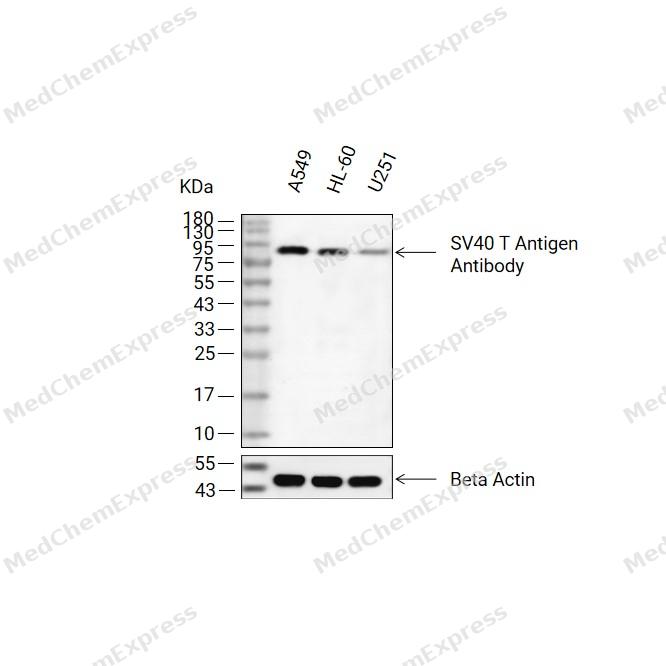 Western blot analysis of extracts from A549(lane 2(20ug) , HL-60(lane 3(20ug) and U251(lane 4(20ug) using SV40 T Antigen Antibody (HY-P83511) Rabbit mAb. Proteins were transferred to a PVDF membrane and blocked with 5% non-fat milk in TBST for 2 hour at room temperature. The primary antibody (1/1000) and Loading control antibody (Beta Actin, HY-P80438, 1/10000) was used in 5% non-fat milk in TBST at 4°C overnight. Goat Anti-Mouse/Rabbit IgG-HRP Secondary Antibody (1/10000) was used for 1 hour at room temperature.
 -
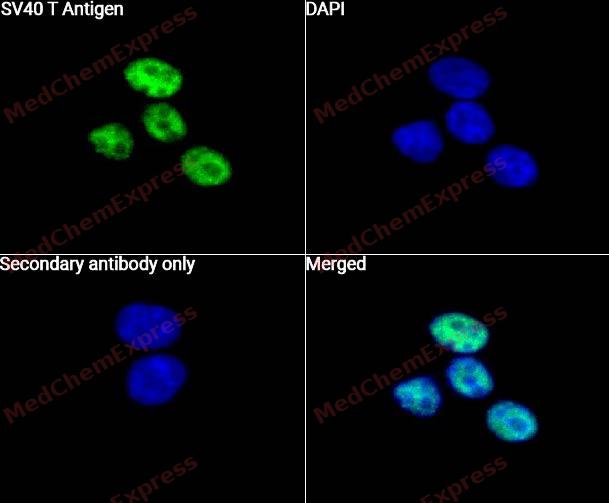 Immunocytochemistry analysis of HEK-293T cells labeling SV40 T Antigen with SV40 T Antigen Antibody (HY-P83511)at 1/50 dilution. Cells were fixed in 4% paraformaldehyde for 15 minutes at room temperature, permeabilized with 0.1% Triton X-100 for 10 minutes at room temperature, then blocked with QuickBlock™ Blocking Buffer for Immunol Staining for 10 min at room temperature. Cells were then incubated with SV40 T Antigen Antibody (HY-P83511) at 1/50 dilution in QuickBlock™ Blocking Buffer for Immunol Staining at 4 ℃. Alexa Fluor® 488-conjugated AffiniPure Goat Anti-Rabbit IgG H&L(HY-P8002, Green) was used as the secondary antibody at 1/1,000 dilution. PBS instead of the primary antibody was used as the secondary antibody only control. The Nuclear counterstain was DAPI (Blue).
 -
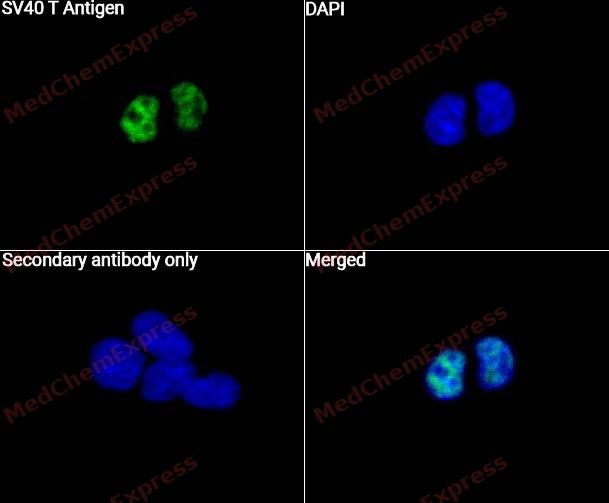 Immunocytochemistry analysis of HEK-293T cells labeling SV40 T Antigen with SV40 T Antigen Antibody (HY-P83511) at 1/100 dilution. Cells were fixed in 4% paraformaldehyde for 15 minutes at room temperature, permeabilized with 0.1% Triton X-100 for 10 minutes at room temperature, then blocked with QuickBlock™ Blocking Buffer for Immunol Staining for 10 min at room temperature. Cells were then incubated with SV40 T Antigen Antibody (HY-P83511) at 1/100 dilution in QuickBlock™ Blocking Buffer for Immunol Staining at 4 ℃. Alexa Fluor® 488-conjugated AffiniPure Goat Anti-Rabbit IgG H&L(HY-P8002, Green) was used as the secondary antibody at 1/1,000 dilution. PBS instead of the primary antibody was used as the secondary antibody only control. The Nuclear counterstain was DAPI (Blue).


Background
-
Function
SV40 T Antigen is an Isoform large T antigen is a key early protein essential for both driving viral replication and inducing cellular transformation. Plays a role in viral genome replication by driving entry of quiescent cells into the cell cycle and by autoregulating the synthesis of viral early mRNA. Displays highly oncogenic activities by corrupting the host cellular checkpoint mechanisms that guard cell division and the transcription, replication, and repair of DNA. Participates in the modulation of cellular gene expression preceeding viral DNA replication. This step involves binding to host key cell cycle regulators retinoblastoma protein RB1/pRb and TP53. Induces the disassembly of host E2F1 transcription factors from RB1, thus promoting transcriptional activation of E2F1-regulated S-phase genes. Inhibits host TP53 binding to DNA, abrogating the ability of TP53 to stimulate gene expression. Plays the role of a TFIID-associated factor (TAF) in transcription initiation for all three RNA polymerases, by stabilizing the TBP-TFIIA complex on promoters. Initiates viral DNA replication and unwinding via interactions with the viral origin of replication. Binds two adjacent sites in the SV40 origin. The replication fork movement is facilitated by Large T antigen helicase activity. Has processive 3'-5' DNA helicase activity which requires a short 3' single-stranded region and ATP; other (d)NTPs can partially replace ATP. Activates the transcription of viral late mRNA, through host TBP and TFIIA stabilization. Interferes with histone deacetylation mediated by HDAC1, leading to activation of transcription. May inactivate the growth-suppressing properties of the E3 ubiquitin ligase CUL7; Isoform 17kT antigen targets host RBL2 for degradation and promotes cell proliferation. Transactivates host cyclin A promoter through its J domain; Unwinds G4 DNA (planar arrays of 4 guanine bases stabilized by hydrogen bonds, parallel and antiparallel arrays were tested); unwinding occurs in the 3'-5' direction, requires a 3' single-stranded end and hydrolyzable ATP[1][2][3].
-
Subcellular Localization
Host nucleus
-
Isoforms & Post-Translational Modification
P03070 has 4 isomers: P03070-1: 81624 Da (predicted); P03081-1: 20449 Da (predicted); P03070-2: 15754 Da (predicted); P0C6L2-1: 2705 Da (predicted).
Phosphorylated on both serine and threonine residues. Phosphorylation on Ser-120 and Ser-123 inhibits viral replication, while phosphorylation on Thr-124 enhances replication by activating the DNA-binding domain. Phosphorylation on Thr-701 is required for binding to host FBW7gamma isoform. Dephosphorylated preferentially by PP2A on Ser-120, Ser-123, Ser-677 and perhaps Ser-679. Small t antigen inhibits the dephosphorylation by the AC form of PP2A;O-Glycosylated near the C-terminal region;Acetylated by CBP in a TP53-dependent manner -
Subunit
Isoform large T antigen forms homohexamers in the presence of ATP. Interacts with host HDAC1. Interacts (via LXCXE domain) with host RB1; the interaction induces the aberrant dissociation of RB1-E2F1 complex thereby disrupting RB1's activity. Interacts (via LXCXE domain) with host pRB-related proteins RBL1 and RBL2. Interacts (via C-terminus) with host TOP1 and POLA1 allowing DNA replication. Interacts with host TP53, inhibiting TP53 binding to DNA. Interacts with host preinitiation complex components TBP, TFIIA and TFIID to regulate transcription initiation. LT interacts (via CPD region) with host FBW7gamma isoform (via WD repeats); seems to function as a competitive inhibitor of FBW7gamma function for physiologic substrates. LT interacts with host E3 ubiquitin ligase CUL7; this interaction seems to inhibit CUL7. Component of a SCF(CUL7)-like complex composed of SV40 Lt and host proteins CUL7, SKP1, RBX1, and FBXW8. LT interacts with host BUB1; this interaction induces activation of a DNA damage response and promotes p53 stabilization and phosphorylation (Probable). Interacts with host FAM111A and this interaction is required for efficient viral replication and sustained viral gene expression in restrictive cell types
-
SwissProt ID
-
Synonyms
Large T antigen; LT; LT-AG
-
Research Field
Infectious Diseases
Documentation
-
Data Sheet (235 KB)
-
SDS (251 KB)
- English - EN (251 KB)
- Français - FR (251 KB)
- Deutsch - DE (251 KB)
- Norwegian - NO (251 KB)
- Español - ES (251 KB)
- Swedish - SV (251 KB)
- Italian - IT (251 KB)
- Korean - KR (251 KB)
- Portuguese - PT (251 KB)
-
User Guide for Antibodies (1077 KB)

 Powered by Bioz
