



VEGFA Antibody (YA5487)
(Synonyms: VEGFA; VEGF; Vascular endothelial growth factor A; VEGF-A; Vascular permeability factor; VPF)
Based on 1 Customer Validation
VEGFA Antibody (YA5487) is a Mouse-derived and non-conjugated IgG1 monoclonal antibody, targeting to VEGFA.
-
Host:
Mouse
-
Isotype:
IgG1
-
Application:
WB, ICC/IF, ELISA
-
Reactivity :
Human, Mouse, Rat
-
Formulation:
Supplied in PBS, 50% glycerol, 0.05% Proclin 300, 0.05%BSA
-
Conjugation:
Non-conjugated


To place orders, for customer services and technical support, please contact: MedChemExpress USA
Tel: 609-228-6898 E-mail: [email protected] [email protected]





Applications
| Application |
WB

WB: Western Blot
|
ICC/IF
ICC/IF: Immunocytochemistry/
Immunofluorescence |
ELISA
ELISA: Enzyme Linked Immunosorbent Assay
|
|---|---|---|---|
| Dilution Ratio | 1:500-2000 | 1:100-500 | 1:1000-5000 |


Product Details
VEGFA Antibody (YA5487) is a Mouse-derived and non-conjugated IgG1 monoclonal antibody, targeting to VEGFA.
-
Host Mouse

-
Clonality Monoclonal

-
Species ReactivityHuman, Mouse, Rat
-
Observed Molecular WeightObserved band size: 37 kDa
Note: Due to possible protein modifications or aggregation, the molecular weight should be confirmed by actual measurement, and the predicted value is for reference only.

-
Calculated Molecular Weight Predicted band size: 27 kDa

The antiserum was produced against synthesized peptide derived from human VEGF-A. AA range: 100-200
Protein G
Non-conjugated
Unmodified
IgG1


Product Properties
-
Appearance
Liquid
-
Formulation
Supplied in PBS, 50% glycerol, 0.05% Proclin 300, 0.05%BSA
-
Concentration
Batch-dependent, Please check the COA for the concentration of each lot. Check Lot Concentration
-
Storage & Stability
Stored at -20°C for 1 year. Avoid repeated freeze / thaw cycles.
-
Shipping
Shipping with blue ice.


Verification Images
-
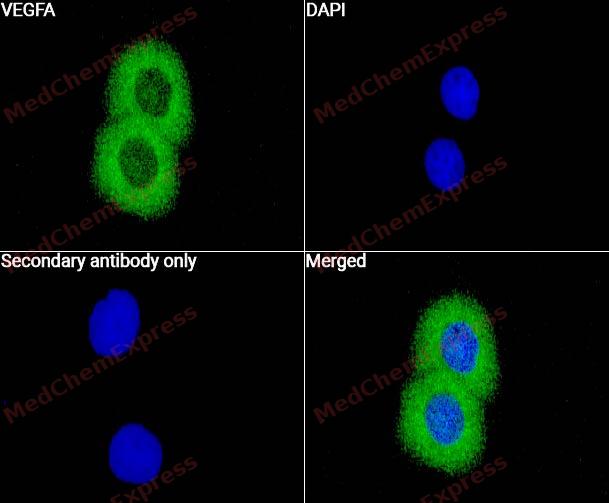 Immunocytochemistry analysis of HeLa cells labeling VEGFA with VEGFA antibody (HY-P85795) at 1/200 dilution. Cells were fixed in 4% paraformaldehyde for 15 minutes at room temperature, permeabilized with 0.1% Triton X-100 in PBS for 15 minutes at room temperature, then blocked with quick block buffer for 10 minutes at room temperature. Cells were then incubated with VEGFA antibody (HY-P85795) at 1/200 dilution in quick block buffer overnight at 4 ℃. AF488-conjugated Goat Anti-Mouse IgG H&L(HY-P8005, Green) was used as the secondary antibody at 1/1,000 dilution. PBS instead of the primary antibody was used as the secondary antibody only control. The Nuclear counterstain was DAPI (Blue).
 -
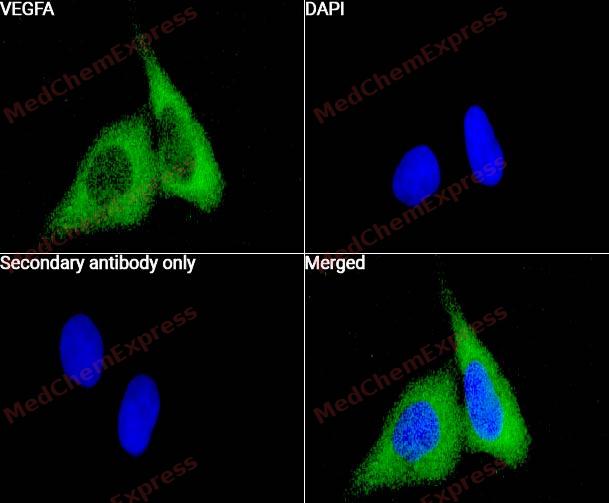 Immunocytochemistry analysis of NIH3T3 cells labeling VEGFA with VEGFA antibody (HY-P85795) at 1/200 dilution. Cells were fixed in 4% paraformaldehyde for 15 minutes at room temperature, permeabilized with 0.1% Triton X-100 in PBS for 15 minutes at room temperature, then blocked with quick block buffer for 10 minutes at room temperature. Cells were then incubated with VEGFA antibody (HY-P85795) at 1/200 dilution in quick block buffer overnight at 4 ℃. AF488-conjugated Goat Anti-Mouse IgG H&L(HY-P8005, Green) was used as the secondary antibody at 1/1,000 dilution. PBS instead of the primary antibody was used as the secondary antibody only control. The Nuclear counterstain was DAPI (Blue).


Background
-
Function
VEGFA participates in the induction of key genes involved in the response to hypoxia and in the induction of angiogenesis such as HIF1A. Involved in protecting cells from hypoxia-mediated cell death; Growth factor active in angiogenesis, vasculogenesis and endothelial cell growth. Induces endothelial cell proliferation, promotes cell migration, inhibits apoptosis and induces permeabilization of blood vessels. Binds to the FLT1/VEGFR1 and KDR/VEGFR2 receptors, heparan sulfate and heparin. Binds to the NRP1/neuropilin-1 receptor. Binding to NRP1 initiates a signaling pathway needed for motor neuron axon guidance and cell body migration, including for the caudal migration of facial motor neurons from rhombomere 4 to rhombomere 6 during embryonic development. Also binds the DEAR/FBXW7-AS1 receptor; Binds to the KDR receptor but does not activate downstream signaling pathways, does not activate angiogenesis and inhibits tumor growth[1][2][3].
-
Subcellular Localization
Cytoplasm; Nucleus; Secreted; Endoplasmic reticulum; Golgi apparatus; Secreted, extracellular space, extracellular matrix; Secreted; Secreted; Secreted
-
Expression
Tissue_specificity:Higher expression in pituitary tumors than in the pituitary gland; widespread expression; widespread expression; widespread expression; not widely expressed; not widely expressed
Induction:By hypoxia. Regulated by growth factors, cytokines, gonadotropins, nitric oxide, hypoglycemia and oncogenic mutations -
Isoforms & Post-Translational Modification
P15692 has 17 isomers: P15692-13: 43597 Da (predicted); P15692-1: 27042 Da (predicted); P15692-2: 25173 Da (predicted); P15692-3: 24422 Da (predicted); P15692-4: 22314 Da (predicted); P15692-5: 20218 Da (predicted); P15692-6: 20064 Da (predicted); P15692-8: 22259 Da (predicted); P15692-9: 17219 Da (predicted); P15692-10: 15981 Da (predicted); P15692-11: 40738 Da (predicted); P15692-12: 35643 Da (predicted); P15692-14: 45467 Da (predicted); P15692-15: 40683 Da (predicted); P15692-16: 42846 Da (predicted); P15692-17: 38642 Da (predicted); P15692-18: 34406 Da (predicted).
Produced by use of an alternative upstream CUG codon and post-translationally processed into the N-terminal N-VEGF form and the C-terminal secreted VEGFA form -
Subunit
Homodimer; disulfide-linked (By similarity). Interacts with NRP1 (PubMed:26503042). Interacts with isoform 2 of BSG (PubMed:25825981)
-
SwissProt ID
-
Synonyms
VEGFA; VEGF; Vascular endothelial growth factor A; VEGF-A; Vascular permeability factor; VPF


Documentation
-
Data Sheet (234 KB)
-
SDS (252 KB)
- English - EN (252 KB)
- Français - FR (252 KB)
- Deutsch - DE (252 KB)
- Norwegian - NO (252 KB)
- Español - ES (252 KB)
- Swedish - SV (252 KB)
- Italian - IT (252 KB)
- Korean - KR (252 KB)
- Portuguese - PT (252 KB)
-
User Guide for Antibodies (1077 KB)

 Powered by Bioz
