



ZO-1/TJP1 Antibody (YA5942)
Based on 1 publication(s) in Google Scholar
ZO-1/TJP1 Antibody (YA5942) is a Rabbit-derived and non-conjugated IgG monoclonal antibody, targeting to ZO-1/TJP1.
-
Host:
Rabbit
-
Isotype:
IgG/Kappa
-
Application:
WB, IHC-P, ICC/IF, IP, ELISA
-
Reactivity :
Human, Mouse, Rat, Pig
-
Formulation:
Supplied in PBS, 50% glycerol, 0.05% Proclin 300, 0.05%BSA
-
Conjugation:
Non-conjugated


To place orders, for customer services and technical support, please contact: MedChemExpress USA
Tel: 609-228-6898 E-mail: [email protected] [email protected]



Publications Citing Use of MedChemExpress (MCE) ZO-1/TJP1 Antibody (YA5942)
More

Applications
| Application |
IHC-P

IHC-P: Immunohistochemistry-Paraffin
|
WB
WB: Western Blot
|
ICC/IF
ICC/IF: Immunocytochemistry/
Immunofluorescence |
ELISA
ELISA: Enzyme Linked Immunosorbent Assay
|
IP
IP: Immunoprecipitation
|
|---|---|---|---|---|---|
| Dilution Ratio | 1:1000-1:4000 | 1:2000-1:10000 | 1:200-1:1000 | 1:5000-1:20000 | 1:50-1:200 |


Product Details
ZO-1/TJP1 Antibody (YA5942) is a Rabbit-derived and non-conjugated IgG monoclonal antibody, targeting to ZO-1/TJP1.
-
Host Rabbit

-
Clonality Monoclonal

-
Species ReactivityHuman, Mouse, Rat, Pig
-
Observed Molecular WeightObserved band size: 220 kDa
Note: Due to possible protein modifications or aggregation, the molecular weight should be confirmed by actual measurement, and the predicted value is for reference only.

-
Calculated Molecular Weight Predicted band size: 195 kDa

Protein A
Non-conjugated
Unmodified
IgG/Kappa


Product Properties
-
Appearance
Liquid
-
Formulation
Supplied in PBS, 50% glycerol, 0.05% Proclin 300, 0.05%BSA
-
Concentration
Batch-dependent, Please check the COA for the concentration of each lot. Check Lot Concentration
-
Storage & Stability
Stored at -20°C for 1 year. Avoid repeated freeze / thaw cycles.
-
Shipping
Shipping with blue ice.


Publications (1)
-
Journal Impact Factor
-
Most Recent
-
Chem Biol Interact
A microfluidic human blood-brain barrier model reveals neurovascular toxicity and barrier disruption induced by E-cigarette additives. [Abstract]2026 Aug 1:436:112206. PMID: 42285244


Verification Images
-
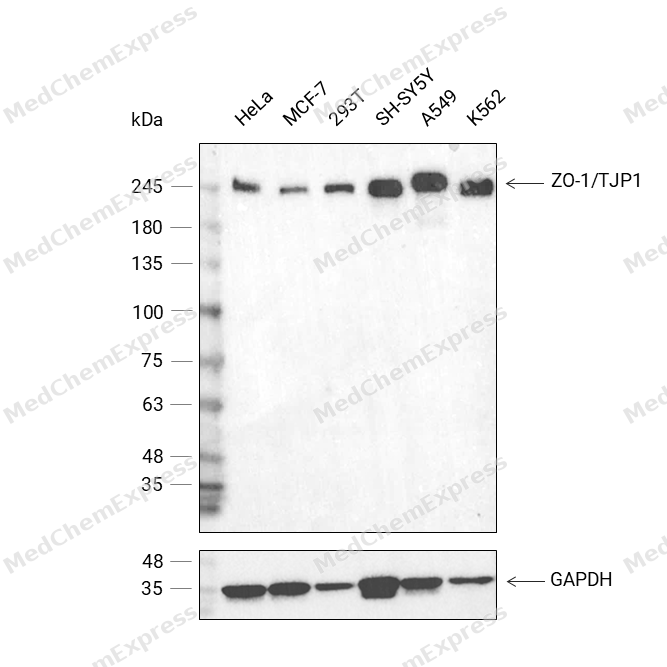 Western blot analysis was performed on protein extracts (30 μg) from HeLa (lane 2), MCF-7 (lane 3), 293T (lane 4), SH-SY5Y (lane 5), A549 (lane 6), and K562 (lane 7) using ZO-1/TJP1 antibody. Proteins were transferred onto a 0.45 μm PVDF membrane using a wet transfer system for 90 min. The membrane was then blocked with 5% nonfat milk in TBST (HY-K1025) for 1 h at room temperature. Thhe primary antibody (1:2000) and loading control antibody GAPDH Antibody (HRP) (HY-P80954A) (1:5000) were diluted in 5% nonfat milk in TBST and incubated with the membrane overnight at 4°C. After washing, the membrane of primary antibody was incubated with HRP-conjugated goat anti-rabbit/mouse IgG secondary antibody (HY-P8001/HY-P8004) (1:5000) diluted in 5% nonfat milk in TBST for 1 h at room temperature. Protein bands were visualized using an Ultra High Sensitivity ECL detection kit (HY-K1005).


Background
-
Function
ZO-1/TJP1 is a TJP1, TJP2, and TJP3 are closely related scaffolding proteins that link tight junction (TJ) transmembrane proteins such as claudins, junctional adhesion molecules, and occludin to the actin cytoskeleton. Forms a multistranded TJP1/ZO1 condensate which elongates to form a tight junction belt, the belt is anchored at the apical cell membrane via interaction with PATJ. The tight junction acts to limit movement of substances through the paracellular space and as a boundary between the compositionally distinct apical and basolateral plasma membrane domains of epithelial and endothelial cells. Necessary for lumenogenesis, and particularly efficient epithelial polarization and barrier formation. Plays a role in the regulation of cell migration by targeting CDC42BPB to the leading edge of migrating cells. Plays an important role in podosome formation and associated function, thus regulating cell adhesion and matrix remodeling. With TJP2 and TJP3, participates in the junctional retention and stability of the transcription factor DBPA, but is not involved in its shuttling to the nucleus. May play a role in mediating cell morphology changes during ameloblast differentiation via its role in tight junctions[1][2][3][4].
-
Subcellular Localization
Cell membrane; Peripheral membrane protein; Cytoplasmic side; Cell junction, tight junction; Cell junction; Cell junction, gap junction; Cell projection, podosome
-
Expression
Tissue_specificity:Isoforms containing the α subunit are present at most epithelial cell junctions. Short isoforms are present at highly specialized epithelial junctions, such as those of endothelial cells, glomeruli, and seminiferous tubules. -
Isoforms & Post-Translational Modification
Q07157 has 2 isomers: Q07157-1: 195459 Da (predicted); Q07157-2: 186966 Da (predicted).
Phosphorylated at tyrosine redidues in response to epidermal growth factor (EGF) (PubMed:19332538, PubMed:7542259). This response is dependent on an intact actin microfilament system (PubMed:7542259). Dephosphorylated by PTPRJ (PubMed:19332538) -
Subunit
Homodimer (PubMed:16737969, PubMed:17928286).
-
SwissProt ID
Documentation
-
Data Sheet (235 KB)
-
SDS (252 KB)
- English - EN (252 KB)
- Français - FR (252 KB)
- Deutsch - DE (252 KB)
- Norwegian - NO (252 KB)
- Español - ES (252 KB)
- Swedish - SV (252 KB)
- Italian - IT (252 KB)
- Korean - KR (252 KB)
- Portuguese - PT (252 KB)
-
User Guide for Antibodies (1077 KB)

 Powered by Bioz
