



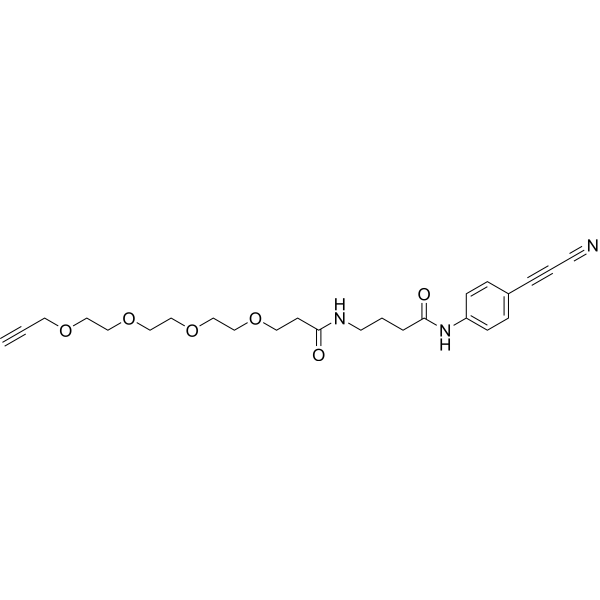
APN-C3-PEG4-alkyne
APN-C3-PEG4-alkyne is a PEG-based PROTAC linker that can be used in the synthesis of PROTACs. APN-C3-PEG4-alkyne is a click chemistry reagent, it contains an Alkyne group and can undergo copper-catalyzed azide-alkyne cycloaddition (CuAAc) with molecules containing Azide groups.
For research use only. We do not sell to patients.
- CAS No.: 2183440-36-8
- Formula: C25H31N3O6
- Molecular Weight:469.53
-
Storage:
Please store the product under the recommended conditions in the Certificate of Analysis.

To place orders, for customer services and technical support, please contact: MedChemExpress USA
Tel: 609-228-6898 E-mail: [email protected] [email protected]


-
 Biological Activity
-
Chemical Information
- Protocols
- Purity & Documentation
- References
-
 Help & FAQs


All PROTAC Linkers Isoforms
More

Biological Activity
Description
IC50 & Target
|
PEGs |
In Vitro
PROTACs contain two different ligands connected by a linker; one is a ligand for an E3 ubiquitin ligase and the other is for the target protein. PROTACs exploit the intracellular ubiquitin-proteasome system to selectively degrade target proteins[1].
MedChemExpress (MCE) has not independently confirmed the accuracy of these methods. They are for reference only.


Chemical Information
-
CAS No. 2183440-36-8
-
Molecular Weight 469.53
-
Formula C25H31N3O6
-
SMILES
C#CCOCCOCCOCCOCCC(NCCCC(NC1=CC=C(C=C1)C#CC#N)=O)=O
-
Shipping
Room temperature in continental US; may vary elsewhere.
-
Storage
Please store the product under the recommended conditions in the Certificate of Analysis.


Purity & Documentation
References

Calculators
Concentration (start) × Volume (start) = Concentration (final) × Volume (final)


APN-C3-PEG4-alkyne Related Classifications
HY-116025 Related Classifications
 Powered by Bioz