



Arecoline
Based on 7 publication(s) in Google Scholar
Arecoline, a naturally brain-penetrant and orally active occurring psychoactive alkaloid, is a partial agonist of nicotinic and muscarinic acetylcholine receptor. Arecoline exhibits stimulation, alertness, anxiolysis and anti-parasitic effects. Arecoline also can induce oxidative stress.
Nur für Forschungszwecke. Wir verkaufen nicht an Patienten.
- Reinheit : 99.84%
- CAS. Nr.: 63-75-2
- Formel: C8H13NO2
- Molecular Weight:155.19
-
Speicherung:
4°C, protect from light
* In solvent : -80°C, 6 months; -20°C, 1 month (protect from light)


To place orders, for customer services and technical support, please contact: MedChemExpress USA
Tel: 609-228-6898 E-mail: [email protected] [email protected]


-
 Biologische Aktivität
-
Chemical Information
-
Lösungsmittel & Löslichkeit
- Protokoll
- Reinheit & Dokumentation
- Verweise
-
 Help & FAQs


-
HY-B0489
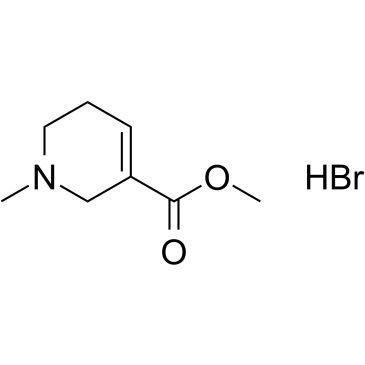
Arecoline hydrobromidenAChR/mAChR Agonist -
HY-B0407A
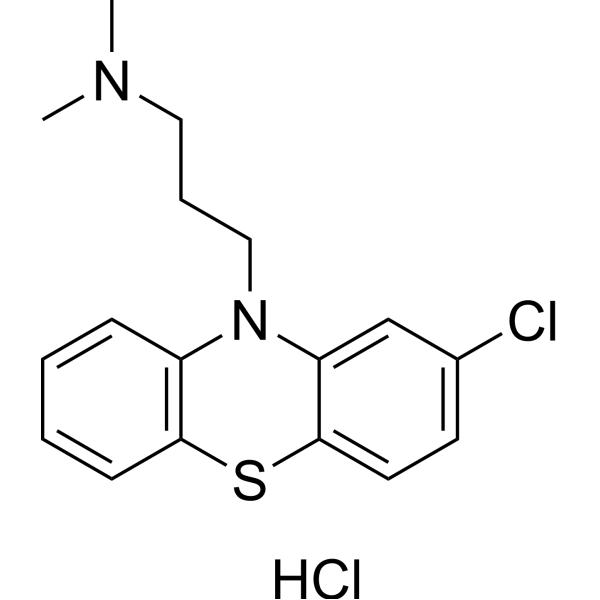
Chlorpromazine hydrochlorideAntipsychotic Agent -
HY-B0532A
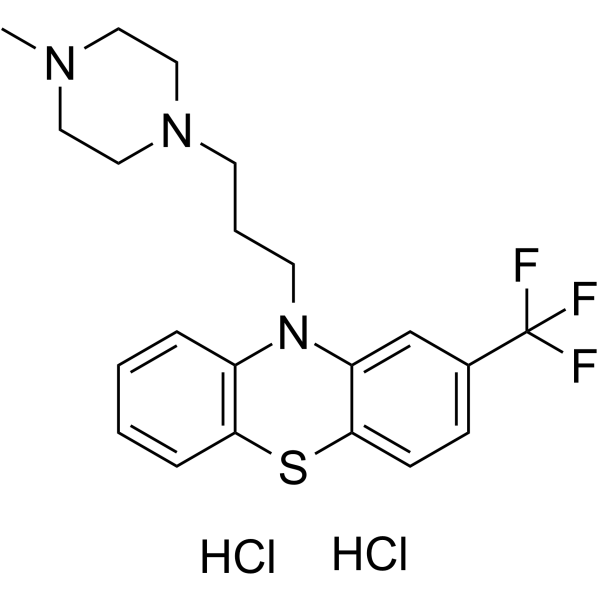
Trifluoperazine dihydrochlorideDopamine Receptors Blocker -
HY-B0979
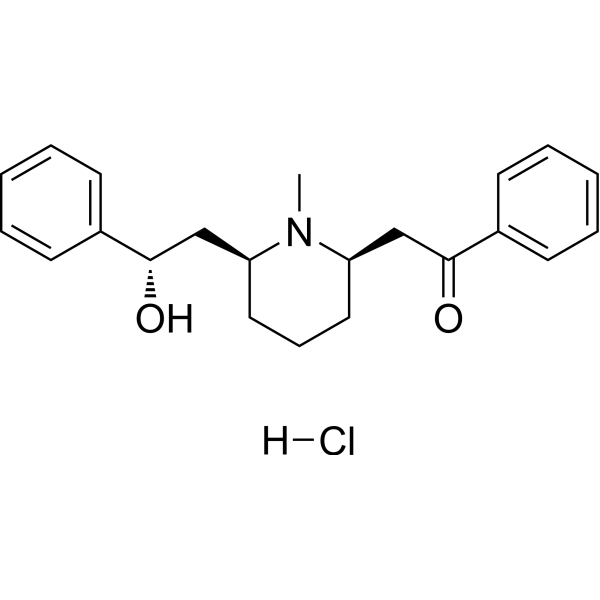
Lobeline hydrochlorideNicotinic Receptor Agonist -

HY-B0979R
Lobeline hydrochloride (Standard)Nicotinic Receptor Agonist
Publications Citing Use of MedChemExpress (MCE) Arecoline
More- Cardiovasc Diabetol. 2026 Jan 14;25(1):38.
- Ecotoxicol Environ Saf. 2025 Apr 1:294:118108. [Abstract]
- Int J Mol Sci. 2023 Mar 28;24(7):6327. [Abstract]
- Sci Rep. 2026 Mar 31. [Abstract]
- Vet Microbiol. 2026 Jan:312:110818. [Abstract]
- J Oral Pathol Med. 2022 Oct;51(9):780-790. [Abstract]
- SSRN. 2026 Jul 6.
 Customer Validation & Images

-
Bio/Physico-chemical Assay
-
Bio/Physico-chemical Assay
-
Cell Imaging/Staining

-
WB

-
IF


Biologische Aktivität
Beschreibung
IC50 & Target
nAChR/mAChR[3]
Cellular Effect
|
Cell Line

|
Type | Value | Description | References |
|---|---|---|---|---|
| CHO | IC50 |
0.115 μM
Compound: Arecoline
|
Ability to displace [3H]oxotremorine from Muscarinic acetylcholine receptor M1 expressed in CHO cells.
Ability to displace [3H]oxotremorine from Muscarinic acetylcholine receptor M1 expressed in CHO cells.
|
[PMID: 11597415] |
| CHO | IC50 |
115.5 μM
Compound: Arecoline
|
Ability to displace [3H]N-methylscopolamine from Muscarinic acetylcholine receptor M1 expressed in CHO cells.
Ability to displace [3H]N-methylscopolamine from Muscarinic acetylcholine receptor M1 expressed in CHO cells.
|
[PMID: 11597415] |
| CHO | IC50 |
145 μM
Compound: arecoline
|
Compound was evaluated for its ability to displace [3H]N-methylscopolamine ([3H]NMS) binding to cloned CHO cell lines expressing Muscarinic acetylcholine receptor M1
Compound was evaluated for its ability to displace [3H]N-methylscopolamine ([3H]NMS) binding to cloned CHO cell lines expressing Muscarinic acetylcholine receptor M1
|
[PMID: 9438027] |
| CHO | IC50 |
4.5 μM
Compound: arecoline
|
Compound was evaluated for its ability to displace [3H]- N-methyl-scopolamine ([3H]NMS) binding to cloned CHO cell lines expressing Muscarinic acetylcholine receptor M2
Compound was evaluated for its ability to displace [3H]- N-methyl-scopolamine ([3H]NMS) binding to cloned CHO cell lines expressing Muscarinic acetylcholine receptor M2
|
[PMID: 9438027] |
| CHO | IC50 |
47.5 μM
Compound: arecoline
|
Compound was evaluated for its ability to displace [3H]- N-methyl-scopolamine ([3H]-NMS) binding to cloned CHO cell lines expressing Muscarinic acetylcholine receptor M4
Compound was evaluated for its ability to displace [3H]- N-methyl-scopolamine ([3H]-NMS) binding to cloned CHO cell lines expressing Muscarinic acetylcholine receptor M4
|
[PMID: 9438027] |
| CHO | IC50 |
58 μM
Compound: arecoline
|
Compound was evaluated for its ability to displace [3H]N-methylscopolamine ([3H]NMS) binding to cloned CHO cell lines expressing Muscarinic acetylcholine receptor M3
Compound was evaluated for its ability to displace [3H]N-methylscopolamine ([3H]NMS) binding to cloned CHO cell lines expressing Muscarinic acetylcholine receptor M3
|
[PMID: 9438027] |
| CHO | IC50 |
62.5 μM
Compound: arecoline
|
Compound was evaluated for its ability to displace [3H]- N-methyl-scopolamine ([3H]NMS) binding to cloned CHO cell lines expressing Muscarinic acetylcholine receptor M5
Compound was evaluated for its ability to displace [3H]- N-methyl-scopolamine ([3H]NMS) binding to cloned CHO cell lines expressing Muscarinic acetylcholine receptor M5
|
[PMID: 9438027] |
| CHO | EC50 |
10 μM
Compound: Arecoline
|
Stimulation of cAMP in CHO cells expressing human m2 receptor
Stimulation of cAMP in CHO cells expressing human m2 receptor
|
[PMID: 9873644] |
In Vitro
Arecoline induces the generation of reactive oxygen species and cell cycle arrest at the G1/G0 phase in HaCaT cells without affecting the expression of p21/Cip1. Arecoline-induced epithelial cell death at higher concentrations is caused by oxidative trauma without eliciting apoptosis. Arecoline upregulates the expression of the following stress-responsive genes: hemeoxygenase-1; ferritin light chain; glucose-6-phosphate dehydrogenase; glutamatecysteine ligase catalytic subunit; and glutathione reductase[1].
MedChemExpress (MCE) has not independently confirmed the accuracy of these methods. They are for reference only.
In Vivo
MedChemExpress (MCE) has not independently confirmed the accuracy of these methods. They are for reference only.


Chemical Information
-
CAS. Nr. 63-75-2
-
Appearance Liquid (Density: 1.0495 g/cm3)
-
Molecular Weight 155.19
-
Formel C8H13NO2
-
Color Light yellow to brown
-
SMILES
O=C(C1=CCCN(C)C1)OC
-
Structure Classification
-
Initial Source
-
Versand
Room temperature in continental US; may vary elsewhere.
-
Speicherung
4°C, protect from light
* In solvent : -80°C, 6 months; -20°C, 1 month (protect from light)


Publications (7)
-
Journal Impact Factor
-
Most Recent
-
-
Ecotoxicol Environ Saf
Assessing the carcinogenic potential and molecular mechanisms of arecoline in human lungs: from in silico methods to in vitro validation. [Abstract]2025 Apr 1:294:118108. PMID: 40147173
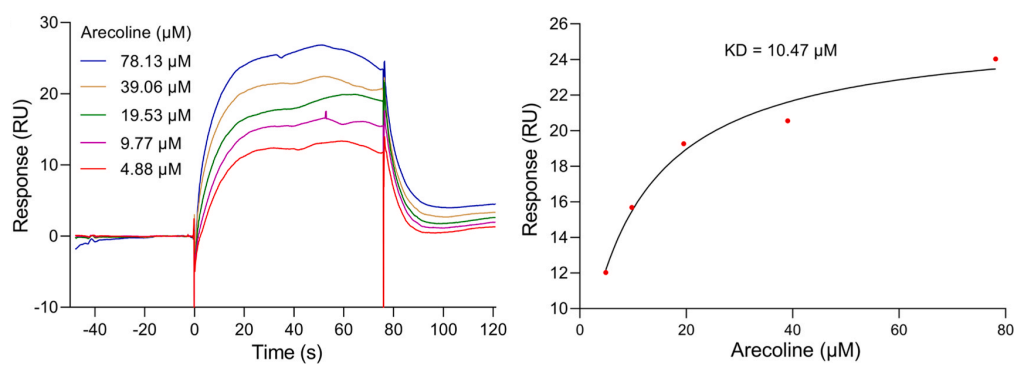
Arecoline purchased from MedChemExpress. Usage Cited in: Ecotoxicol Environ Saf. 2025 Apr 1:294:118108. [Abstract]
Arecoline exhibited a relatively strong binding affinity to PTGS2 in vitro, with a KD value of 10.47 μM.
-
Int J Mol Sci
Oxidative Stress and Endoplasmic Reticulum Stress Contributes to Arecoline and Its Secondary Metabolites-Induced Dyskinesia in Zebrafish Embryos. [Abstract]2023 Mar 28;24(7):6327. PMID: 37047326 -
Sci Rep
Pomolic acid alleviates CCl4‑induced liver fibrosis in mice by suppressing β-arrestin 2-mediated pro-fibrotic macrophage polarization. [Abstract]2026 Mar 31. PMID: 41917130 -
Vet Microbiol
Mechanistic link between eIF4E phosphorylation and viral pathogenesis: Therapeutic insights from a porcine model. [Abstract]2026 Jan:312:110818. PMID: 41418357
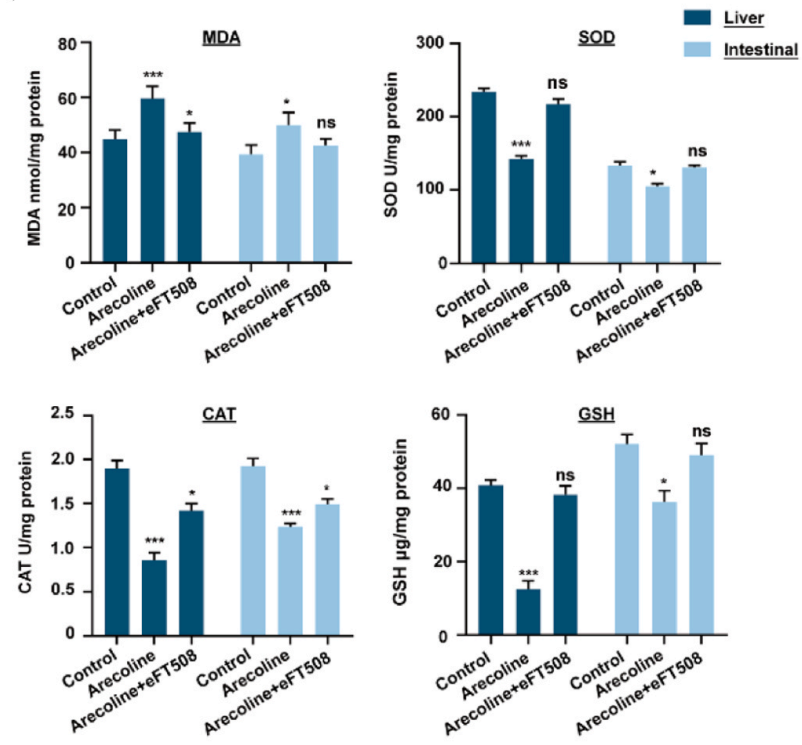
Arecoline purchased from MedChemExpress. Usage Cited in: Vet Microbiol. 2026 Jan:312:110818. [Abstract]
Arecoline (i.p.; single dose) stimulation led to a significant decrease in hepatic and intestinal GSH, SOD, and CAT activities and a significant increase in the MDA content, which were reversed by eFT508 (i.g.; 12 h) administration in BALB/c mice.
-
J Oral Pathol Med
Overexpression of DEC1 in the epithelium of OSF promotes mesenchymal transition via activating FAK/Akt signal axis. [Abstract]2022 Oct;51(9):780-790. PMID: 36053880
Arecoline purchased from MedChemExpress. Usage Cited in: J Oral Pathol Med. 2022 Oct;51(9):780-790. [Abstract]
Cell morphological images of HOKs after treatment with Arecoline (Arecoline hydrobromide; 150 μM; 24 h) and/or hypoxia (scale bar = 100 μm). Several HOKs treated with Arecoline (150 μM) and/or hypoxia (24 h) presented morphological alterations similar to mesenchymal cells, and were most pronounced with combination treatment.
Arecoline purchased from MedChemExpress. Usage Cited in: J Oral Pathol Med. 2022 Oct;51(9):780-790. [Abstract]
Western blot analysis of DEC1 expression in HOKs after treatment with Arecoline (Arecoline hydrobromide; 0-150 μM; 24 h). Arecoline dose-dependently increased DEC1 expression.
Arecoline purchased from MedChemExpress. Usage Cited in: J Oral Pathol Med. 2022 Oct;51(9):780-790. [Abstract]
Fluorescence triple staining of DEC1 (red), phosphorylated FAK (Y397; green), and phosphorylated Akt (Ser473; magenta) in the oral mucosal epithelium of mice after local buccal mucosal injection of Arecoline (Arecoline hydrobromide; 10 mg/kg; once daily) for 2 weeks. Arecoline-induced OSF tissues showed higher DEC1, phosphorylated FAK, and phosphorylated Akt expression than normal oral mucosa.
-


Lösungsmittel & Löslichkeit
In Vitro:
H2O : 250 mg/mL (1610.93 mM; Need ultrasonic)
DMSO : 100 mg/mL (644.37 mM; Need ultrasonic; Hygroscopic DMSO has a significant impact on the solubility of product, please use newly opened DMSO)
Please refer to the solubility information to select the appropriate solvent. Once prepared, please aliquot and store the solution to prevent product inactivation from repeated freeze-thaw cycles.
Storage method and period of stock solution: -80°C, 6 months; -20°C, 1 month (protect from light). When stored at -80°C, please use it within 6 months. When stored at -20°C, please use it within 1 month.
* Note: If you choose water as the stock solution, please dilute it to the working solution, then filter and sterilize it with a 0.22 μm filter before use.
Please refer to the solubility information to select the appropriate solvent. Once prepared, please aliquot and store the solution to prevent product inactivation from repeated freeze-thaw cycles.
Storage method and period of stock solution: -80°C, 6 months; -20°C, 1 month (protect from light). When stored at -80°C, please use it within 6 months. When stored at -20°C, please use it within 1 month.
* Note: If you choose water as the stock solution, please dilute it to the working solution, then filter and sterilize it with a 0.22 μm filter before use.
Konzentration (Stammlösung) × Volumen (Stammlösung) = Konzentration (Ziellösung) × Volumen (Ziellösung)
In Vivo:
Select the appropriate dissolution method based on your experimental animal and administration route.
- For the following dissolution methods, please ensure to first prepare a clear stock solution using an In Vitro approach and then sequentially add co-solvents:
- To ensure reliable experimental results, the clarified stock solution can be appropriately stored based on storage conditions. As for the working solution for In Vivo experiments, it is recommended to prepare freshly and use it on the same day.
- The percentages shown for the solvents indicate their volumetric ratio in the final prepared solution. If precipitation or phase separation occurs during preparation, heat and/or sonication can be used to aid dissolution.
Add each solvent one by one: 10% DMSO 40% PEG300 5% Tween-80 45% Saline
Solubility: ≥ 2.5 mg/mL (16.11 mM); Clear solution
This protocol yields a clear solution of ≥ 2.5 mg/mL (saturation unknown).
Taking 1 mL working solution as an example, add 100 μL DMSO stock solution (25.0 mg/mL) to 400 μL PEG300, and mix evenly; then add 50 μL Tween-80 and mix evenly; then add 450 μL Saline to adjust the volume to 1 mL.
Preparation of Saline: Dissolve 0.9 g sodium chloride in ddH₂O and dilute to 100 mL to obtain a clear Saline solution.
Add each solvent one by one: 10% DMSO 90% (20% SBE-β-CD in Saline)
Solubility: ≥ 2.5 mg/mL (16.11 mM); Clear solution
This protocol yields a clear solution of ≥ 2.5 mg/mL (saturation unknown).
Taking 1 mL working solution as an example, add 100 μL DMSO stock solution (25.0 mg/mL) to 900 μL 20% SBE-β-CD in Saline, and mix evenly.
Preparation of 20% SBE-β-CD in Saline (4°C, storage for one week): 2 g SBE-β-CD powder is dissolved in 10 mL Saline, completely dissolve until clear.
In Vivo Dissolution Calculator
Please enter the basic information of animal experiments:
-
-
-
-
Recommended: Prepare an additional quantity of animals to account for potential losses during experiments.
Working solution concentration: 0.22 mg/mL
This product has good water solubility, please refer to the measured solubility data in water/PBS/Saline for details.


Reinheit & Dokumentation
-
Data Sheet (275 KB)
-
SDS (254 KB)
- English - EN (254 KB)
- Français - FR (254 KB)
- Deutsch - DE (254 KB)
- Norwegian - NO (254 KB)
- Español - ES (254 KB)
- Swedish - SV (254 KB)
- Italian - IT (254 KB)
- Korean - KR (254 KB)
- Portuguese - PT (254 KB)
-
Handling Instructions (2659 KB)
Verweise
[1]. G S Thangjam, et al. Regulation of oxidative-stress responsive genes by arecoline in human keratinocytes. J Periodontal Res. 2009 Oct;44(5):673-82. [Content Brief]
[2]. Liu YJ, et, al. The pharmacology, toxicology and potential applications of arecoline: a review. Pharm Biol. 2016 Nov;54(11):2753-2760. [Content Brief]
[3]. Volgin AD, et, al. DARK Classics in Chemical Neuroscience: Arecoline. ACS Chem Neurosci. 2019 May 15;10(5):2176-2185. [Content Brief]
[4]. Kuo TM, et, al. Arecoline induces TNF-alpha production and Zonula Occludens-1 redistribution in mouse Sertoli TM4 cells. J Biomed Sci. 2014 Sep 9;21(1):93. [Content Brief]
[5]. Chen QY, et al. Inhibition of cortical synaptic transmission, behavioral nociceptive, and anxiodepressive-like responses by arecoline in adult mice. Mol Brain. 2024 Jun 17;17(1):39. [Content Brief]


Complete Stock Solution Preparation Table
Please refer to the solubility information to select the appropriate solvent. Once prepared, please aliquot and store the solution to prevent product inactivation from repeated freeze-thaw cycles.
Storage method and period of stock solution: -80°C, 6 months; -20°C, 1 month (protect from light). When stored at -80°C, please use it within 6 months. When stored at -20°C, please use it within 1 month.
| Optional Solvent | Concentration Solvent Mass | 1 mg | 5 mg | 10 mg | 25 mg |
|---|---|---|---|---|---|
| DMSO / H2O | 1 mM | 6.4437 mL | 32.2186 mL | 64.4371 mL | 161.0929 mL |
| 5 mM | 1.2887 mL | 6.4437 mL | 12.8874 mL | 32.2186 mL | |
| 10 mM | 0.6444 mL | 3.2219 mL | 6.4437 mL | 16.1093 mL | |
| 15 mM | 0.4296 mL | 2.1479 mL | 4.2958 mL | 10.7395 mL | |
| 20 mM | 0.3222 mL | 1.6109 mL | 3.2219 mL | 8.0546 mL | |
| 25 mM | 0.2577 mL | 1.2887 mL | 2.5775 mL | 6.4437 mL | |
| 30 mM | 0.2148 mL | 1.0740 mL | 2.1479 mL | 5.3698 mL | |
| 40 mM | 0.1611 mL | 0.8055 mL | 1.6109 mL | 4.0273 mL | |
| 50 mM | 0.1289 mL | 0.6444 mL | 1.2887 mL | 3.2219 mL | |
| 60 mM | 0.1074 mL | 0.5370 mL | 1.0740 mL | 2.6849 mL | |
| 80 mM | 0.0805 mL | 0.4027 mL | 0.8055 mL | 2.0137 mL | |
| 100 mM | 0.0644 mL | 0.3222 mL | 0.6444 mL | 1.6109 mL |
* Note: If you choose water as the stock solution, please dilute it to the working solution, then filter and sterilize it with a 0.22 μm filter before use.


Arecoline Related Classifications
HY-N2364 Related Classifications
 Powered by Bioz