



Arecoline hydrochloride
Based on 7 publication(s) in Google Scholar
Arecoline hydrochloride, a naturally brain-penetrant and orally active occurring psychoactive alkaloid, is a partial agonist of nicotinic and muscarinic acetylcholine receptor. Arecoline hydrochloride exhibits stimulation, alertness, anxiolysis and anti-parasitic effects. Arecoline hydrochloride also can induce oxidative stress.
For research use only. We do not sell to patients.
- CAS No.: 61-94-9
- Formula: C8H14ClNO2
- Molecular Weight:191.66
-
Storage:
Please store the product under the recommended conditions in the Certificate of Analysis.


To place orders, for customer services and technical support, please contact: MedChemExpress USA
Tel: 609-228-6898 E-mail: [email protected] [email protected]


-
 Biological Activity
-
Chemical Information
- Protocols
- Purity & Documentation
- References
-
 Help & FAQs


Publications Citing Use of MedChemExpress (MCE) Arecoline hydrochloride
More- Cardiovasc Diabetol. 2026 Jan 14;25(1):38.
- Ecotoxicol Environ Saf. 2025 Apr 1:294:118108. [Abstract]
- Int J Mol Sci. 2023 Mar 28;24(7):6327. [Abstract]
- Sci Rep. 2026 Mar 31. [Abstract]
- Vet Microbiol. 2026 Jan:312:110818. [Abstract]
- J Oral Pathol Med. 2022 Oct;51(9):780-790. [Abstract]
- SSRN. 2026 Jul 6.
 Customer Validation & Images

-
Bio/Physico-chemical Assay
-
Bio/Physico-chemical Assay
-
Cell Imaging/Staining

-
WB

-
IF


Biological Activity
Description
IC50 & Target
nAChR/mAChR[3]
In Vitro
Arecoline hydrochloride induces the generation of reactive oxygen species and cell cycle arrest at the G1/G0 phase in HaCaT cells without affecting the expression of p21/Cip1. Arecoline hydrochloride-induced epithelial cell death at higher concentrations is caused by oxidative trauma without eliciting apoptosis. Arecoline hydrochloride upregulates the expression of the following stress-responsive genes: hemeoxygenase-1; ferritin light chain; glucose-6-phosphate dehydrogenase; glutamatecysteine ligase catalytic subunit; and glutathione reductase[1].
MedChemExpress (MCE) has not independently confirmed the accuracy of these methods. They are for reference only. Further protocols information, click here.
In Vivo
MedChemExpress (MCE) has not independently confirmed the accuracy of these methods. They are for reference only.


Chemical Information
-
CAS No. 61-94-9
-
Molecular Weight 191.66
-
Formula C8H14ClNO2
-
SMILES
O=C(OC)C1=CCCN(C1)C.[H]Cl
-
Structure Classification
-
Initial Source
-
Shipping
Room temperature in continental US; may vary elsewhere.
-
Storage
Please store the product under the recommended conditions in the Certificate of Analysis.


Publications (7)
-
Journal Impact Factor
-
Most Recent
-
-
Ecotoxicol Environ Saf
Assessing the carcinogenic potential and molecular mechanisms of arecoline in human lungs: from in silico methods to in vitro validation. [Abstract]2025 Apr 1:294:118108. PMID: 40147173
Arecoline hydrochloride purchased from MedChemExpress. Usage Cited in: Ecotoxicol Environ Saf. 2025 Apr 1:294:118108. [Abstract]
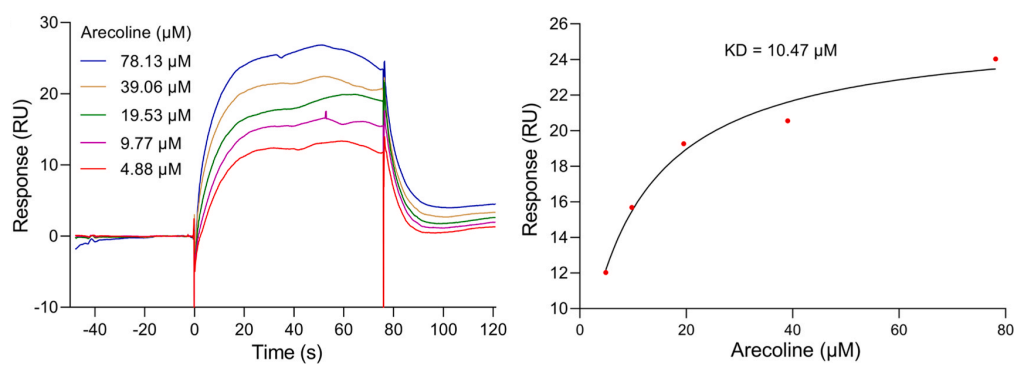
Arecoline exhibited a relatively strong binding affinity to PTGS2 in vitro, with a KD value of 10.47 μM.
-
Int J Mol Sci
Oxidative Stress and Endoplasmic Reticulum Stress Contributes to Arecoline and Its Secondary Metabolites-Induced Dyskinesia in Zebrafish Embryos. [Abstract]2023 Mar 28;24(7):6327. PMID: 37047326 -
Sci Rep
Pomolic acid alleviates CCl4‑induced liver fibrosis in mice by suppressing β-arrestin 2-mediated pro-fibrotic macrophage polarization. [Abstract]2026 Mar 31. PMID: 41917130 -
Vet Microbiol
Mechanistic link between eIF4E phosphorylation and viral pathogenesis: Therapeutic insights from a porcine model. [Abstract]2026 Jan:312:110818. PMID: 41418357
Arecoline hydrochloride purchased from MedChemExpress. Usage Cited in: Vet Microbiol. 2026 Jan:312:110818. [Abstract]
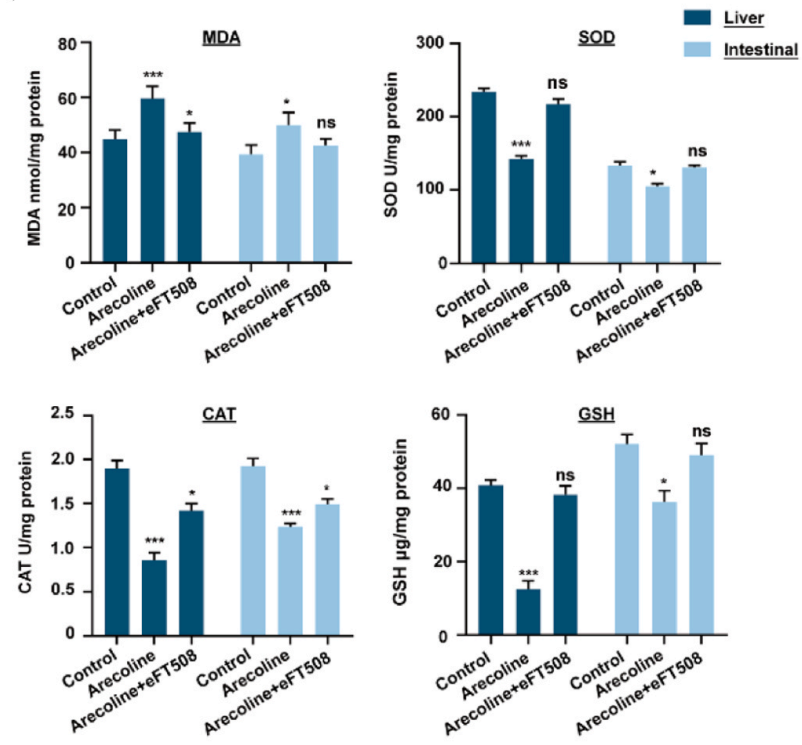
Arecoline (i.p.; single dose) stimulation led to a significant decrease in hepatic and intestinal GSH, SOD, and CAT activities and a significant increase in the MDA content, which were reversed by eFT508 (i.g.; 12 h) administration in BALB/c mice.
-
J Oral Pathol Med
Overexpression of DEC1 in the epithelium of OSF promotes mesenchymal transition via activating FAK/Akt signal axis. [Abstract]2022 Oct;51(9):780-790. PMID: 36053880
Arecoline hydrochloride purchased from MedChemExpress. Usage Cited in: J Oral Pathol Med. 2022 Oct;51(9):780-790. [Abstract]
Cell morphological images of HOKs after treatment with Arecoline (Arecoline hydrobromide; 150 μM; 24 h) and/or hypoxia (scale bar = 100 μm). Several HOKs treated with Arecoline (150 μM) and/or hypoxia (24 h) presented morphological alterations similar to mesenchymal cells, and were most pronounced with combination treatment.
Arecoline hydrochloride purchased from MedChemExpress. Usage Cited in: J Oral Pathol Med. 2022 Oct;51(9):780-790. [Abstract]
Western blot analysis of DEC1 expression in HOKs after treatment with Arecoline (Arecoline hydrobromide; 0-150 μM; 24 h). Arecoline dose-dependently increased DEC1 expression.
Arecoline hydrochloride purchased from MedChemExpress. Usage Cited in: J Oral Pathol Med. 2022 Oct;51(9):780-790. [Abstract]
Fluorescence triple staining of DEC1 (red), phosphorylated FAK (Y397; green), and phosphorylated Akt (Ser473; magenta) in the oral mucosal epithelium of mice after local buccal mucosal injection of Arecoline (Arecoline hydrobromide; 10 mg/kg; once daily) for 2 weeks. Arecoline-induced OSF tissues showed higher DEC1, phosphorylated FAK, and phosphorylated Akt expression than normal oral mucosa.
-

Protocols
-
ROS/oxidative-stress fluorescent staining
ROS/oxidative-stress fluorescent staining uses cell-permeant fluorogenic probes that become fluorescent after oxidation inside cells or tissues; commonly used examples include DCFH-DA/DCFDA for broad cellular oxidant detection, DHE for superoxide-related signal detection, MitoSOX for mitochondrial superoxide-related signal detection, and CellROX probes for oxidative-stress-associated fluorescence readouts. The assay detects probe oxidation rather than a single ROS species unless the probe and analysis method have been chemically validated for that species. DCFH-DA enters cells, is deacetylated by intracellular esterases to DCFH, and produces fluorescent DCF after oxidation, so the readout is used as an operational measure of total cellular oxidative stress rather than a species-specific ROS measurement. DHE and MitoSOX can report superoxide-related oxidation, but red fluorescence alone can include non-specific ethidium-like oxidation products; HPLC or optimized spectral approaches are


Purity & Documentation
References
[1]. Thangjam GS, et, al. Regulation of oxidative-stress responsive genes by arecoline in human keratinocytes. J Periodontal Res. 2009 Oct;44(5):673-82. [Content Brief]
[2]. Liu YJ, et, al. The pharmacology, toxicology and potential applications of arecoline: a review. Pharm Biol. 2016 Nov;54(11):2753-2760. [Content Brief]
[3]. Volgin AD, et, al. DARK Classics in Chemical Neuroscience: Arecoline. ACS Chem Neurosci. 2019 May 15;10(5):2176-2185. [Content Brief]
[4]. Kuo TM, et, al. Arecoline induces TNF-alpha production and Zonula Occludens-1 redistribution in mouse Sertoli TM4 cells. J Biomed Sci. 2014 Sep 9;21(1):93. [Content Brief]
[5]. Chen QY, et al. Inhibition of cortical synaptic transmission, behavioral nociceptive, and anxiodepressive-like responses by arecoline in adult mice. Mol Brain. 2024 Jun 17;17(1):39. [Content Brief]

Calculators
Concentration (start) × Volume (start) = Concentration (final) × Volume (final)


Arecoline hydrochloride Related Classifications
HY-B0489A Related Classifications
 Powered by Bioz