



CCG 203769

Based on 1 Customer Validation
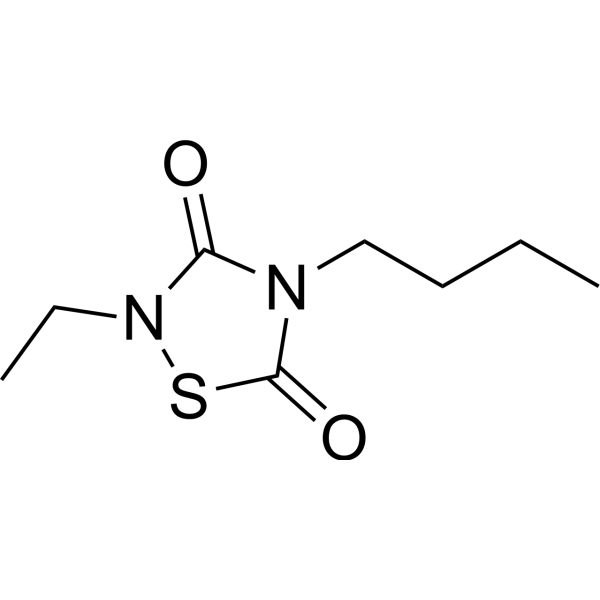
CCG 203769 is a selective G protein signaling (RGS4) inhibitor, which blocks the RGS4-Gαo protein-protein interaction in vitro with an IC50 of 17 nM.
Nur für Forschungszwecke. Wir verkaufen nicht an Patienten.
- Reinheit: 98.97%
- CAS. Nr.: 410074-60-1
- Formel: C8H14N2O2S
- Molecular Weight:202.27
-
Speicherung:Pure form -20°C, 3 years , 4°C, 2 years ; In solvent -80°C, 6 months , -20°C, 1 month

To place orders, for customer services and technical support, please contact: MedChemExpress USA
Tel: 609-228-6898 E-mail: [email protected] [email protected]


-
 Biologische Aktivität
-
Chemical Information
-
Lösungsmittel & Löslichkeit
- Protokoll
- Reinheit & Dokumentation
- Verweise
-
 Help & FAQs





Biologische Aktivität
Beschreibung
IC50 & Target
[1]|
RGS4 17 nM (IC50) |
RGS19 140 nM (IC50) |
RGS16 6 μM (IC50) |
RGS8 79 μM (IC50) |
GSK3β 5.4 μM (IC50) |
In Vitro
CCG 203769 also displays dramatic selectivity (8- to >5000-fold) for RGS4 over other RGS proteins. CCG 203769 inhibits RGS19 with an IC50 of 140 nM (8-fold selective for RGS4) and 6 μM for RGS16 (350-fold selective for RGS4). The closely related RGS8 is very weakly inhibited (IC50>60 μM) providing >4500-fold selectivity for RGS4. CCG 203769 inhibits GSK-3β with an IC50 value of 5 μM. CCG 203769 does not inhibit the cysteine protease papain at 100 μM. CCG 203769 does not inhibit RGS7, which lacks cysteines in the RGS domain. CCG 203769 inhibits RGS/Gαo binding in an RGS-selective manner. CCG 203769 enhances Gαq-dependent cellular Ca2+ signaling in an RGS4-dependent manner. CCG 203769 also blocks the GTPase accelerating protein (GAP) activity of RGS4. In single-turnover and steady-state GTPase experiments with Gαo and Gαi1, the rate of GTP hydrolysis is strongly stimulated by RGS4, and this effect is inhibited by CCG 203769 with an IC50<1 μM[1].
MedChemExpress (MCE) has not independently confirmed the accuracy of these methods. They are for reference only.
In Vivo
MedChemExpress (MCE) has not independently confirmed the accuracy of these methods. They are for reference only.


Chemical Information
-
CAS. Nr. 410074-60-1
-
Appearance Liquid (Density: 1.179±0.06 g/cm3)
-
Molecular Weight 202.27
-
Formel C8H14N2O2S
-
Color Colorless to light yellow
-
SMILES
O=C(N1CCCC)N(CC)SC1=O
-
Versand
Room temperature in continental US; may vary elsewhere.
-
Speicherung
Pure form -20°C 3 years 4°C 2 years In solvent -80°C 6 months -20°C 1 month


Lösungsmittel & Löslichkeit
In Vitro:
DMSO : 62.5 mg/mL (308.99 mM; Need ultrasonic; Hygroscopic DMSO has a significant impact on the solubility of product, please use newly opened DMSO)
Please refer to the solubility information to select the appropriate solvent. Once prepared, please aliquot and store the solution to prevent product inactivation from repeated freeze-thaw cycles.
Storage method and period of stock solution: -80°C, 6 months; -20°C, 1 month. When stored at -80°C, please use it within 6 months. When stored at -20°C, please use it within 1 month.
Please refer to the solubility information to select the appropriate solvent. Once prepared, please aliquot and store the solution to prevent product inactivation from repeated freeze-thaw cycles.
Storage method and period of stock solution: -80°C, 6 months; -20°C, 1 month. When stored at -80°C, please use it within 6 months. When stored at -20°C, please use it within 1 month.
Konzentration (Stammlösung) × Volumen (Stammlösung) = Konzentration (Ziellösung) × Volumen (Ziellösung)
In Vivo:
Select the appropriate dissolution method based on your experimental animal and administration route.
- For the following dissolution methods, please ensure to first prepare a clear stock solution using an In Vitro approach and then sequentially add co-solvents:
- To ensure reliable experimental results, the clarified stock solution can be appropriately stored based on storage conditions. As for the working solution for In Vivo experiments, it is recommended to prepare freshly and use it on the same day.
- The percentages shown for the solvents indicate their volumetric ratio in the final prepared solution. If precipitation or phase separation occurs during preparation, heat and/or sonication can be used to aid dissolution.
Add each solvent one by one: 10% DMSO 40% PEG300 5% Tween-80 45% Saline
Solubility: ≥ 2.08 mg/mL (10.28 mM); Clear solution
This protocol yields a clear solution of ≥ 2.08 mg/mL (saturation unknown).
Taking 1 mL working solution as an example, add 100 μL DMSO stock solution (20.8 mg/mL) to 400 μL PEG300, and mix evenly; then add 50 μL Tween-80 and mix evenly; then add 450 μL Saline to adjust the volume to 1 mL.
Preparation of Saline: Dissolve 0.9 g sodium chloride in ddH₂O and dilute to 100 mL to obtain a clear Saline solution.
Add each solvent one by one: 10% DMSO 90% (20% SBE-β-CD in Saline)
Solubility: ≥ 2.08 mg/mL (10.28 mM); Clear solution
This protocol yields a clear solution of ≥ 2.08 mg/mL (saturation unknown).
Taking 1 mL working solution as an example, add 100 μL DMSO stock solution (20.8 mg/mL) to 900 μL 20% SBE-β-CD in Saline, and mix evenly.
Preparation of 20% SBE-β-CD in Saline (4°C, storage for one week): 2 g SBE-β-CD powder is dissolved in 10 mL Saline, completely dissolve until clear.
In Vivo Dissolution Calculator
Please enter the basic information of animal experiments:
-
-
-
-
Recommended: Prepare an additional quantity of animals to account for potential losses during experiments.
Please enter your animal formula composition:
-
%DMSO +
Recommended: Keep the proportion of DMSO in working solution below 2% if your animal is weak.
-
%+
-
+%Tween-80 + +
-
%Saline +
The co-solvents required include: DMSO, . All of co-solvents are available by MedChemExpress (MCE). , Tween 80. All of co-solvents are available by MedChemExpress (MCE).
Working solution concentration: 0.22 mg/mL
Method for preparing stock solution: mg drug dissolved in μL DMSO. Stock solution concentration: mg/mL.
1. Take μL DMSO stock solution;
2. Add μL .
μL , mix evenly;
3. Then add μL Tween 80, mix evenly;
4. Then add μL
Please ensure that the stock solution in the first step is dissolved to a clear state, and add co-solvents in sequence. You can use ultrasonic heating (ultrasonic cleaner, recommended frequency 20-40 kHz), vortexing, etc. to assist dissolution.

Protokoll
Kinase Assay[1]
Steady-state hydrolysis of unlabeled GTP is measured using malachite green in a receptor-independent assay utilizing a mutant Gαi1 (R178M, A326S). These mutations facilitate the release of GDP from the enzyme making the GTP hydrolysis step rate-limiting. GTP hydrolysis is measured by mixing 6 μM mutant Gαi with 300 μM GTP in 100 μL in 96-well plates in the presence or absence of 200 nM RGS4 and CCG-203769 or DMSO (vehicle control). All assay components are diluted in a buffer comprising 50 mM HEPES at pH 7.4, 100 mM NaCl, 0.01% Lubrol, 5 mM MgCl, and 10 μg/mL BSA. The reaction is allowed to proceed for 2 h at room temperature and then is quenched with 60 μL of an HCl/malachite green dye solution. Immediately after the addition of malachite green, 10 μL of 32% w/v sodium citrate is added as a colorimetric stabilizer, followed by incubation at room temperature for 20 min. Released inorganic phosphate is measured as an increase in absorbance (A630) from the complex of phosphate with malachite green. Background control samples lacking Gα are used to determine the rate of nonenzymatic GTP hydrolysis which is subtracted[1].
MedChemExpress (MCE) has not independently confirmed the accuracy of these methods. They are for reference only.
Animal Administration[1]
Mice[1]
Young male (20-25 g; 8-9 weeks) C57BL/6J mice are used. Akinesia and bradykinesia are assessed 30 min after Raclopride, mice receive either DMSO or CCG-203769 (0.1-10 mg/kg, i.p.). Behavior is assessed 20 or 90 min after DMSO or CCG-203769.
Rats[1]
Adult Sprauge-Dawley rats receive CCG-203769 (10 mg/kg, i.v.) or saline (by i.v. infusion through the indwelling venous catheter over 30 s) while freely moving in their homecage. One minute later, saline or 0.1 mg/kg
Carbamoylcholine chloride (i.p.) is administered. Before and after i.v. infusions, catheters are flushed with approximately 0.5 mL of heparinized saline (50 U/mL) to check catheter patency and flush treatments from the dead space in the catheter.
MedChemExpress (MCE) has not independently confirmed the accuracy of these methods. They are for reference only.


Reinheit & Dokumentation
-
Data Sheet (279 KB)
-
SDS (252 KB)
- English - EN (252 KB)
- Français - FR (252 KB)
- Deutsch - DE (252 KB)
- Norwegian - NO (252 KB)
- Español - ES (252 KB)
- Swedish - SV (252 KB)
- Italian - IT (252 KB)
- Korean - KR (252 KB)
- Portuguese - PT (252 KB)
-
Handling Instructions (2659 KB)
Verweise


Complete Stock Solution Preparation Table
Please refer to the solubility information to select the appropriate solvent. Once prepared, please aliquot and store the solution to prevent product inactivation from repeated freeze-thaw cycles.
Storage method and period of stock solution: -80°C, 6 months; -20°C, 1 month. When stored at -80°C, please use it within 6 months. When stored at -20°C, please use it within 1 month.
| Optional Solvent | Concentration Solvent Mass | 1 mg | 5 mg | 10 mg | 25 mg |
|---|---|---|---|---|---|
| DMSO | 1 mM | 4.9439 mL | 24.7194 mL | 49.4389 mL | 123.5972 mL |
| 5 mM | 0.9888 mL | 4.9439 mL | 9.8878 mL | 24.7194 mL | |
| 10 mM | 0.4944 mL | 2.4719 mL | 4.9439 mL | 12.3597 mL | |
| 15 mM | 0.3296 mL | 1.6480 mL | 3.2959 mL | 8.2398 mL | |
| 20 mM | 0.2472 mL | 1.2360 mL | 2.4719 mL | 6.1799 mL | |
| 25 mM | 0.1978 mL | 0.9888 mL | 1.9776 mL | 4.9439 mL | |
| 30 mM | 0.1648 mL | 0.8240 mL | 1.6480 mL | 4.1199 mL | |
| 40 mM | 0.1236 mL | 0.6180 mL | 1.2360 mL | 3.0899 mL | |
| 50 mM | 0.0989 mL | 0.4944 mL | 0.9888 mL | 2.4719 mL | |
| 60 mM | 0.0824 mL | 0.4120 mL | 0.8240 mL | 2.0600 mL | |
| 80 mM | 0.0618 mL | 0.3090 mL | 0.6180 mL | 1.5450 mL | |
| 100 mM | 0.0494 mL | 0.2472 mL | 0.4944 mL | 1.2360 mL |


CCG 203769 Related Classifications
HY-U00431 Related Classifications
 Powered by Bioz