



84-75-3

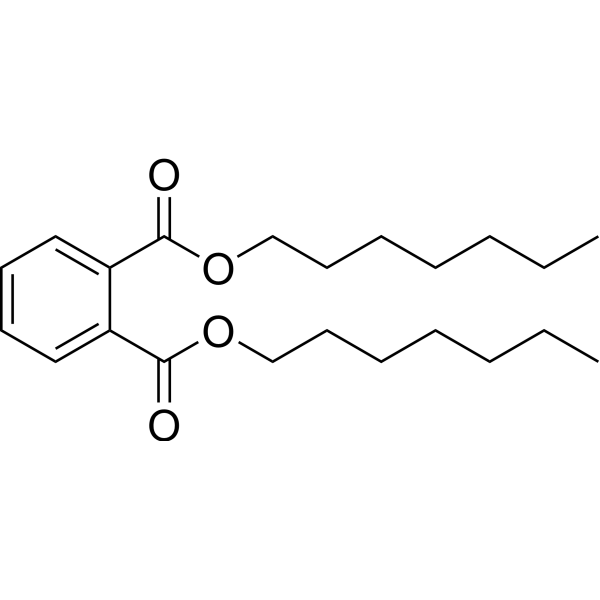
Chemical Structure
Dihexyl phthalate
- CAS. Nr.: 84-75-3
- Formula:C20H30O4
- Molecular Weight:334.46
IUPAC Name: dihexyl phthalate
InChIKey: KCXZNSGUUQJJTR-UHFFFAOYSA-N
SMILES: O=C(OCCCCCC)C1=CC=CC=C1C(OCCCCCC)=O
Biological Activity: Dihexyl phthalate is an orally active phthalate ester (PAEs) widely used as a plasticizer, and it acts as an environmental endocrine disruptor. Dihexyl phthalate exhibits endocrine-disrupting and reproductive toxic properties, induces oxidative stress and inflammation, and ultimately causes apoptosis and damage to reproductive organs such as the testes. Dihexyl phthalate can be used in studies related to developmental toxicity, embryonic lethality, teratogenicity, and abnormal development of the male reproductive system[1][2][3][4][5].
| Art. -Nr. | Produktname | Reinheit | Beschreibung | Pricing | |||||||||||||||||||
|---|---|---|---|---|---|---|---|---|---|---|---|---|---|---|---|---|---|---|---|---|---|---|---|
|
|
Dihexyl phthalate | 98.73% | Dihexyl phthalate is an orally active phthalate ester (PAEs) widely used as a plasticizer, and it acts as an environmental endocrine disruptor. Dihexyl phthalate exhibits endocrine-disrupting and reproductive toxic properties, induces oxidative stress and inflammation, and ultimately causes apoptosis and damage to reproductive organs such as the testes. Dihexyl phthalate can be used in studies related to developmental toxicity, embryonic lethality, teratogenicity, and abnormal development of the male reproductive system. | ||||||||||||||||||||
|
loading...
/
|
|||||||||||||||||||||||
|
|
Dihexyl phthalate (Standard) | ≥98% | Dihexyl phthalate (Standard) is the analytical standard of Dihexyl phthalate (HY-W011215). This product is intended for research and analytical applications. Dihexyl phthalate is an orally active phthalate ester (PAEs) widely used as a plasticizer, and it acts as an environmental endocrine disruptor. Dihexyl phthalate exhibits endocrine-disrupting and reproductive toxic properties, induces oxidative stress and inflammation, and ultimately causes apoptosis and damage to reproductive organs such as the testes. Dihexyl phthalate can be used in studies related to developmental toxicity, embryonic lethality, teratogenicity, and abnormal development of the male reproductive system. | ||||||||||||||||||||
|
loading...
/
|
|||||||||||||||||||||||
|
|
Dihexyl phthalate-3,4,5,6-d4 | 98.20% | Dihexyl phthalate-3,4,5,6-d4 is the deuterated-labeled Dihexyl phthalate (HY-W011215). Dihexyl phthalate is an orally active phthalate ester (PAEs) widely used as a plasticizer, and it acts as an environmental endocrine disruptor. Dihexyl phthalate exhibits endocrine-disrupting and reproductive toxic properties, induces oxidative stress and inflammation, and ultimately causes apoptosis and damage to reproductive organs such as the testes. Dihexyl phthalate can be used in studies related to developmental toxicity, embryonic lethality, teratogenicity, and abnormal development of the male reproductive system. | ||||||||||||||||||||
|
loading...
/
|
|||||||||||||||||||||||
-
Similarity Score 1.00
 HY-W414916RDiisohexyl phthalate (DIP) (Standard)
-
Similarity Score 0.95
 HY-W013816RDipentyl phthalate (Standard)
-
Similarity Score 0.94
 HY-W011103Diheptyl phthalate
-
Similarity Score 0.90
 HY-W013755Dioctyl phthalate
-
Similarity Score 0.88
 HY-Y0304RDibutyl phthalate (Standard)
-
Similarity Score 0.84
 HY-W010875Didecyl phthalate
-
Similarity Score 0.83
 HY-W775024Butyl 2-ethylhexyl phthalate
-
Similarity Score 0.81
 HY-W278777Monohexyl phthalate
-
Similarity Score 0.81
 HY-B1944Dipropyl phthalate
-

Explore the MedChemAI to find more analogs


References
- [1]. Wang W, et al. Metabolic and neurodevelopmental effects of the environmental endocrine disruptor di-2-ethylhexyl phthalate: a review. Environmental Chemistry Letters. 2025 Feb;23(1):321-35.
- [2]. Saillenfait AM, et al. Differential developmental toxicities of di-n-hexyl phthalate and dicyclohexyl phthalate administered orally to rats. Journal of applied toxicology : JAT. 2009 Aug;29(6):510-21.
- [3]. Sung HH, et al. Effects and toxicity of phthalate esters to hemocytes of giant freshwater prawn, Macrobrachium rosenbergii. Aquatic toxicology (Amsterdam, Netherlands). 2003 Jun 19;64(1):25-37.
- [4]. Wang H, et al. Phthalate Esters Released from Plastics Promote Biofilm Formation and Chlorine Resistance. Environmental science & technology. 2022 Jan 18;56(2):1081-1090.
- [5]. Ganning AE, et al. Phthalate esters and their effect on the liver. Hepatology (Baltimore, Md.). 1984;4(3):541-7. [Content Brief]



