



Uracil-d1

Based on 1 Customer Validation
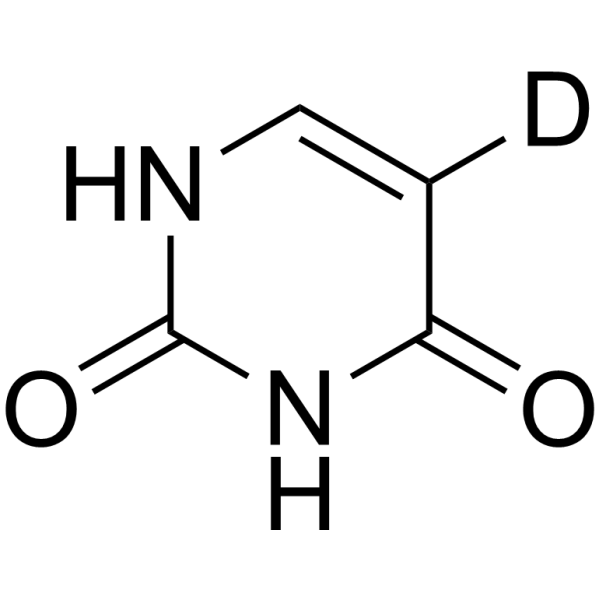
Uracil-d1 is the deuterium labeled Uracil. Uracil is a common and naturally occurring pyrimidine derivative and one of the four nucleobases in the nucleic acid of RNA.
Nur für Forschungszwecke. Wir verkaufen nicht an Patienten.
- Reinheit : 99.96%
- CAS. Nr.: 24897-50-5
- Formel: C4H3DN2O2
- Molecular Weight:113.09
-
Speicherung:Powder -20°C, 3 years , 4°C, 2 years ; In solvent -80°C, 6 months , -20°C, 1 month

To place orders, for customer services and technical support, please contact: MedChemExpress USA
Tel: 609-228-6898 E-mail: [email protected] [email protected]


-
 Biologische Aktivität
-
Chemical Information
-
Lösungsmittel & Löslichkeit
- Reinheit & Dokumentation
- Verweise
-
 Help & FAQs


Alle Endogenous Metabolite Isoform-spezifische Produkte anzeigen
More

Biologische Aktivität
Beschreibung
In Vitro
Stable heavy isotopes of hydrogen, carbon, and other elements have been incorporated into drug molecules, largely as tracers for quantitation during the drug development process. Deuteration has gained attention because of its potential to affect the pharmacokinetic and metabolic profiles of drugs[1].
MedChemExpress (MCE) has not independently confirmed the accuracy of these methods. They are for reference only.
Anwendung
1. This compound can be used as a tracer
2. This compound can be used as an internal standard for quantitative analysis by NMR, GC-MS, or LC-MS.


Chemical Information
-
CAS. Nr. 24897-50-5
-
Unlabeled CAS 66-22-8
-
Appearance Solid
-
Molecular Weight 113.09
-
Formel C4H3DN2O2
-
SMILES
O=C1NC(NC=C1[2H])=O
-
Versand
Room temperature in continental US; may vary elsewhere.
-
Speicherung
Powder -20°C 3 years 4°C 2 years In solvent -80°C 6 months -20°C 1 month


Lösungsmittel & Löslichkeit
In Vitro:
DMSO : 100 mg/mL (884.25 mM; Need ultrasonic; Hygroscopic DMSO has a significant impact on the solubility of product, please use newly opened DMSO)
Please refer to the solubility information to select the appropriate solvent. Once prepared, please aliquot and store the solution to prevent product inactivation from repeated freeze-thaw cycles.
Storage method and period of stock solution: -80°C, 6 months; -20°C, 1 month. When stored at -80°C, please use it within 6 months. When stored at -20°C, please use it within 1 month.
Please refer to the solubility information to select the appropriate solvent. Once prepared, please aliquot and store the solution to prevent product inactivation from repeated freeze-thaw cycles.
Storage method and period of stock solution: -80°C, 6 months; -20°C, 1 month. When stored at -80°C, please use it within 6 months. When stored at -20°C, please use it within 1 month.
Konzentration (Stammlösung) × Volumen (Stammlösung) = Konzentration (Ziellösung) × Volumen (Ziellösung)


Reinheit & Dokumentation
-
Data Sheet (275 KB)
-
SDS (252 KB)
- English - EN (252 KB)
- Français - FR (252 KB)
- Deutsch - DE (252 KB)
- Norwegian - NO (252 KB)
- Español - ES (252 KB)
- Swedish - SV (252 KB)
- Italian - IT (252 KB)
- Korean - KR (252 KB)
- Portuguese - PT (252 KB)
-
Handling Instructions (2659 KB)
Verweise
[1]. Russak EM, et al. Impact of Deuterium Substitution on the Pharmacokinetics of Pharmaceuticals. Ann Pharmacother. 2019 Feb;53(2):211-216. [Content Brief]
[2]. Pałasz A, et al. In search of uracil derivatives as bioactive agents. Uracils and fused uracils: Synthesis, biological activity and applications. Eur J Med Chem. 2015 Jun 5;97:582-611. [Content Brief]


Complete Stock Solution Preparation Table
Please refer to the solubility information to select the appropriate solvent. Once prepared, please aliquot and store the solution to prevent product inactivation from repeated freeze-thaw cycles.
Storage method and period of stock solution: -80°C, 6 months; -20°C, 1 month. When stored at -80°C, please use it within 6 months. When stored at -20°C, please use it within 1 month.
| Optional Solvent | Concentration Solvent Mass | 1 mg | 5 mg | 10 mg | 25 mg |
|---|---|---|---|---|---|
| DMSO | 1 mM | 8.8425 mL | 44.2126 mL | 88.4252 mL | 221.0629 mL |
| 5 mM | 1.7685 mL | 8.8425 mL | 17.6850 mL | 44.2126 mL | |
| 10 mM | 0.8843 mL | 4.4213 mL | 8.8425 mL | 22.1063 mL | |
| 15 mM | 0.5895 mL | 2.9475 mL | 5.8950 mL | 14.7375 mL | |
| 20 mM | 0.4421 mL | 2.2106 mL | 4.4213 mL | 11.0531 mL | |
| 25 mM | 0.3537 mL | 1.7685 mL | 3.5370 mL | 8.8425 mL | |
| 30 mM | 0.2948 mL | 1.4738 mL | 2.9475 mL | 7.3688 mL | |
| 40 mM | 0.2211 mL | 1.1053 mL | 2.2106 mL | 5.5266 mL | |
| 50 mM | 0.1769 mL | 0.8843 mL | 1.7685 mL | 4.4213 mL | |
| 60 mM | 0.1474 mL | 0.7369 mL | 1.4738 mL | 3.6844 mL | |
| 80 mM | 0.1105 mL | 0.5527 mL | 1.1053 mL | 2.7633 mL | |
| 100 mM | 0.0884 mL | 0.4421 mL | 0.8843 mL | 2.2106 mL |


Uracil-d1 Related Classifications
HY-I0960S7 Related Classifications
 Powered by Bioz