



Neryl acetate

Based on 1 Customer Validation
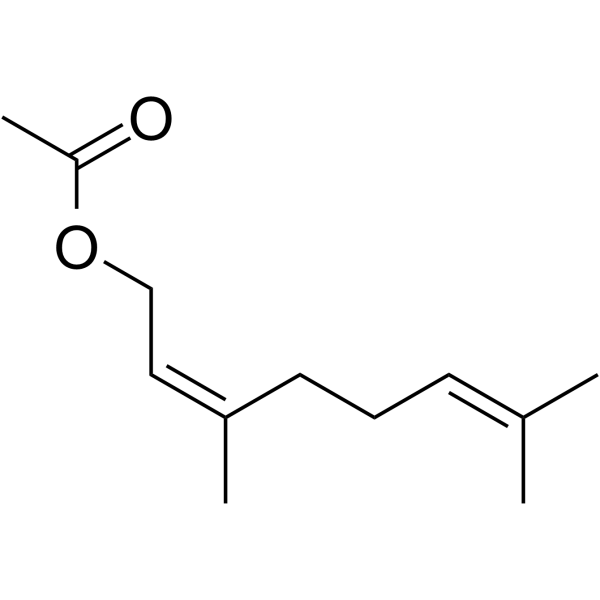
Neryl acetate is an essential oil component. Neryl acetate upregulates genes associated with epidermal differentiation, skin barrier formation and ceramide synthesis; it also increases filaggrin expression, total lipid and ceramide contents. Neryl acetate acts as the core driver mediating the skin barrier-forming and antibacterial effects of Helichrysum italicum essential oil.
For research use only. We do not sell to patients.
- Purity : 98.99%
- CAS No.: 141-12-8
- Formula: C12H20O2
- Molecular Weight:196.29
-
Storage:Pure form -20°C, 3 years , 4°C, 2 years ; In solvent -80°C, 6 months , -20°C, 1 month

To place orders, for customer services and technical support, please contact: MedChemExpress USA
Tel: 609-228-6898 E-mail: [email protected] [email protected]


-
 Biological Activity
-
Chemical Information
-
Solvent & Solubility
- Protocols
- Purity & Documentation
- References
-
 Help & FAQs


-

HY-W014983R
Neryl acetate (Standard)Standard of Neryl acetate -
HY-N6952
GeraniolAntibacterial Agent -

HY-W115529
Geranic acidTyrosinase Inhibitor -
HY-W013507
(rac)-Methyl jasmonatePhytohormone -

HY-W013507R
(rac)-Methyl jasmonate (Standard)Phytohormone -
HY-117215
β-OcimeneBiochemical Assay Reagent -
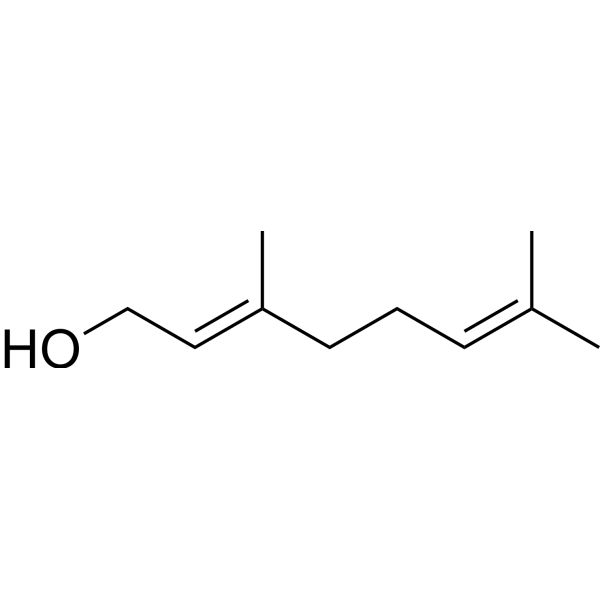
HY-N6952R
Geraniol (Standard) -
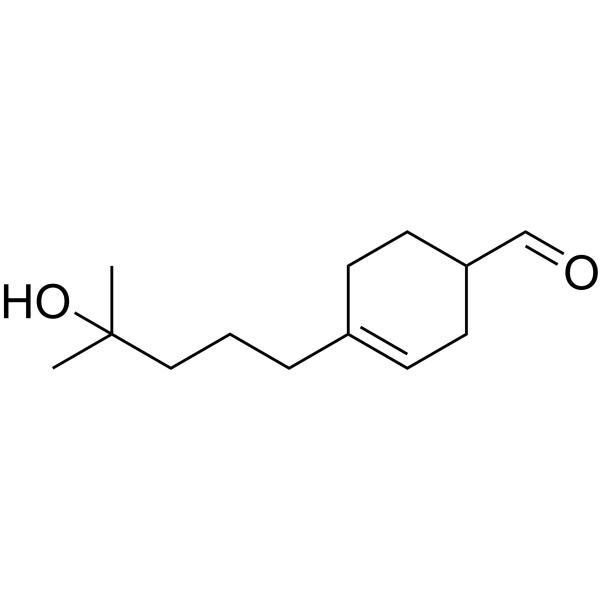
HY-W035214
Hydroxyisohexyl 3-cyclohexene carboxaldehydeHapten -

HY-W107616
3,7,11,15-Tetramethyl-2-hexadecen-1-olEndogenous Metabolite -

HY-W107616R
3,7,11,15-Tetramethyl-2-hexadecen-1-ol (Standard)Endogenous Metabolite


Biological Activity
Description
Cellular Effect
|
Cell Line

|
Type | Value | Description | References |
|---|---|---|---|---|
| HEK293 | EC50 |
13.3 μM
Compound: 2a
|
Agonist activity at rat TRPA1 expressed in HEK293 cells assessed as increase in intracellular Ca2+ concentration by Fluo-4-AM dye based spectrofluorimetry
Agonist activity at rat TRPA1 expressed in HEK293 cells assessed as increase in intracellular Ca2+ concentration by Fluo-4-AM dye based spectrofluorimetry
|
[PMID: 25455494] |
| HEK293 | IC50 |
>100 μM
Compound: 2a
|
Antagonist activity against human TRPV1 expressed in HEK293 cells assessed as inhibition of capsaicin-induced increase in intracellular Ca2+ concentration by Fluo-4-AM dye based spectrofluorimetry
Antagonist activity against human TRPV1 expressed in HEK293 cells assessed as inhibition of capsaicin-induced increase in intracellular Ca2+ concentration by Fluo-4-AM dye based spectrofluorimetry
|
[PMID: 25455494] |
| HEK293 | IC50 |
>100 μM
Compound: 2a
|
Antagonist activity against rat TRPM8 expressed in HEK293 cells assessed as inhibition of icilin-induced increase in intracellular Ca2+ concentration by Fluo-4-AM dye based spectrofluorimetry
Antagonist activity against rat TRPM8 expressed in HEK293 cells assessed as inhibition of icilin-induced increase in intracellular Ca2+ concentration by Fluo-4-AM dye based spectrofluorimetry
|
[PMID: 25455494] |
| HEK293 | IC50 |
20.7 μM
Compound: 2a
|
Antagonist activity against rat TRPA1 expressed in HEK293 cells assessed as inhibition of AITC-induced increase in intracellular Ca2+ concentration by Fluo-4-AM dye based spectrofluorimetry
Antagonist activity against rat TRPA1 expressed in HEK293 cells assessed as inhibition of AITC-induced increase in intracellular Ca2+ concentration by Fluo-4-AM dye based spectrofluorimetry
|
[PMID: 25455494] |
In Vitro
Neryl acetate (0.03%; 5 days) significantly increases the protein level of filaggrin by 51% in full-thickness human abdominal skin explants treated for 5 days, thereby promoting the formation of the cornified envelope[1].
Neryl acetate (0.03%; 5 days) increases the production of neutral lipids in the intercellular spaces of epidermal cells in full-thickness human abdominal skin explants after 5 days of treatment[1].
Neryl acetate (0.03%; 5 days) significantly increases the total epidermal ceramide level by 64.2% in 5-day treated human full-thickness abdominal skin explants, and specifically elevates the levels of multiple ceramide subclasses[1].
H. italicum essential oil with high neryl acetate content exhibits significant bacteriostatic/bactericidal activity against Gram-positive bacteria and Candida albicans (with an MIC as low as < 1.4 μg/mL against S. aureus), and inhibits S. aureus biofilm formation. Its antimicrobial efficacy results from the synergistic effect of neryl acetate with components such as α-pinene (HY-N1367) and γ-curcumene. It shows weak activity against Gram-negative bacteria, and its overall antimicrobial spectrum is closely related to the chemotype of the essential oil[2].
MedChemExpress (MCE) has not independently confirmed the accuracy of these methods. They are for reference only.


Chemical Information
-
CAS No. 141-12-8
-
Appearance Liquid (Density: 0.91 g/cm3)
-
Molecular Weight 196.29
-
Formula C12H20O2
-
Color Colorless to light yellow
-
SMILES
C/C(C)=C\CC/C(C)=C\COC(C)=O
-
Structure Classification
-
Initial Source
-
Shipping
Room temperature in continental US; may vary elsewhere.
-
Storage
Pure form -20°C 3 years 4°C 2 years In solvent -80°C 6 months -20°C 1 month


Solvent & Solubility
In Vitro:
DMSO : 100 mg/mL (509.45 mM; Need ultrasonic; Hygroscopic DMSO has a significant impact on the solubility of product, please use newly opened DMSO)
Please refer to the solubility information to select the appropriate solvent. Once prepared, please aliquot and store the solution to prevent product inactivation from repeated freeze-thaw cycles.
Storage method and period of stock solution: -80°C, 6 months; -20°C, 1 month. When stored at -80°C, please use it within 6 months. When stored at -20°C, please use it within 1 month.
Please refer to the solubility information to select the appropriate solvent. Once prepared, please aliquot and store the solution to prevent product inactivation from repeated freeze-thaw cycles.
Storage method and period of stock solution: -80°C, 6 months; -20°C, 1 month. When stored at -80°C, please use it within 6 months. When stored at -20°C, please use it within 1 month.
Concentration (start) × Volume (start) = Concentration (final) × Volume (final)
In Vivo:
Select the appropriate dissolution method based on your experimental animal and administration route.
- For the following dissolution methods, please ensure to first prepare a clear stock solution using an In Vitro approach and then sequentially add co-solvents:
- To ensure reliable experimental results, the clarified stock solution can be appropriately stored based on storage conditions. As for the working solution for In Vivo experiments, it is recommended to prepare freshly and use it on the same day.
- The percentages shown for the solvents indicate their volumetric ratio in the final prepared solution. If precipitation or phase separation occurs during preparation, heat and/or sonication can be used to aid dissolution.
Add each solvent one by one: 10% DMSO 40% PEG300 5% Tween-80 45% Saline
Solubility: ≥ 2.5 mg/mL (12.74 mM); Clear solution
This protocol yields a clear solution of ≥ 2.5 mg/mL (saturation unknown).
Taking 1 mL working solution as an example, add 100 μL DMSO stock solution (25.0 mg/mL) to 400 μL PEG300, and mix evenly; then add 50 μL Tween-80 and mix evenly; then add 450 μL Saline to adjust the volume to 1 mL.
Preparation of Saline: Dissolve 0.9 g sodium chloride in ddH₂O and dilute to 100 mL to obtain a clear Saline solution.
Add each solvent one by one: 10% DMSO 90% (20% SBE-β-CD in Saline)
Solubility: ≥ 2.5 mg/mL (12.74 mM); Clear solution
This protocol yields a clear solution of ≥ 2.5 mg/mL (saturation unknown).
Taking 1 mL working solution as an example, add 100 μL DMSO stock solution (25.0 mg/mL) to 900 μL 20% SBE-β-CD in Saline, and mix evenly.
Preparation of 20% SBE-β-CD in Saline (4°C, storage for one week): 2 g SBE-β-CD powder is dissolved in 10 mL Saline, completely dissolve until clear.
In Vivo Dissolution Calculator
Please enter the basic information of animal experiments:
-
-
-
-
Recommended: Prepare an additional quantity of animals to account for potential losses during experiments.
Please enter your animal formula composition:
-
%DMSO +
Recommended: Keep the proportion of DMSO in working solution below 2% if your animal is weak.
-
%+
-
+%Tween-80 + +
-
%Saline +
The co-solvents required include: DMSO, . All of co-solvents are available by MedChemExpress (MCE). , Tween 80. All of co-solvents are available by MedChemExpress (MCE).
Working solution concentration: 0.22 mg/mL
Method for preparing stock solution: mg drug dissolved in μL DMSO. Stock solution concentration: mg/mL.
1. Take μL DMSO stock solution;
2. Add μL .
μL , mix evenly;
3. Then add μL Tween 80, mix evenly;
4. Then add μL
Please ensure that the stock solution in the first step is dissolved to a clear state, and add co-solvents in sequence. You can use ultrasonic heating (ultrasonic cleaner, recommended frequency 20-40 kHz), vortexing, etc. to assist dissolution.


Purity & Documentation
-
Data Sheet (278 KB)
-
SDS (536 KB)
- English - EN (536 KB)
- Français - FR (536 KB)
- Deutsch - DE (536 KB)
- Norwegian - NO (536 KB)
- Español - ES (536 KB)
- Swedish - SV (536 KB)
- Italian - IT (536 KB)
- Korean - KR (536 KB)
- Portuguese - PT (536 KB)
-
Handling Instructions (2659 KB)
References
[1].
Lemaire G, et al. Neryl acetate, the major component of Corsican Helichrysum italicum essential oil, mediates its biological activities on skin barrier. PLoS One. 2023 Mar 3;18(3):e0268384.
[Content Brief]
[2].
Šovljanski O, et al. Antibacterial and Antifungal Potential of Helichrysum italicum (Roth) G. Don Essential Oil. Antibiotics (Basel). 2024 Aug 1;13(8):722.
[Content Brief]


Complete Stock Solution Preparation Table
Please refer to the solubility information to select the appropriate solvent. Once prepared, please aliquot and store the solution to prevent product inactivation from repeated freeze-thaw cycles.
Storage method and period of stock solution: -80°C, 6 months; -20°C, 1 month. When stored at -80°C, please use it within 6 months. When stored at -20°C, please use it within 1 month.
| Optional Solvent | Concentration Solvent Mass | 1 mg | 5 mg | 10 mg | 25 mg |
|---|---|---|---|---|---|
| DMSO | 1 mM | 5.0945 mL | 25.4725 mL | 50.9450 mL | 127.3626 mL |
| 5 mM | 1.0189 mL | 5.0945 mL | 10.1890 mL | 25.4725 mL | |
| 10 mM | 0.5095 mL | 2.5473 mL | 5.0945 mL | 12.7363 mL | |
| 15 mM | 0.3396 mL | 1.6982 mL | 3.3963 mL | 8.4908 mL | |
| 20 mM | 0.2547 mL | 1.2736 mL | 2.5473 mL | 6.3681 mL | |
| 25 mM | 0.2038 mL | 1.0189 mL | 2.0378 mL | 5.0945 mL | |
| 30 mM | 0.1698 mL | 0.8491 mL | 1.6982 mL | 4.2454 mL | |
| 40 mM | 0.1274 mL | 0.6368 mL | 1.2736 mL | 3.1841 mL | |
| 50 mM | 0.1019 mL | 0.5095 mL | 1.0189 mL | 2.5473 mL | |
| 60 mM | 0.0849 mL | 0.4245 mL | 0.8491 mL | 2.1227 mL | |
| 80 mM | 0.0637 mL | 0.3184 mL | 0.6368 mL | 1.5920 mL | |
| 100 mM | 0.0509 mL | 0.2547 mL | 0.5095 mL | 1.2736 mL |


Neryl acetate Related Classifications
HY-W014983 Related Classifications
 Powered by Bioz
Keywords